By Cat Woods -
In late 2025, Sydney Peace Laureate Navanethem (“Navi”) Pillay received the Sydney Peace Prize from the Sydney Peace Foundation. Soon after, she gave a National Press Club address. Pillay’s career has been one of outspoken courage and establishing firsts. She was the first non-white woman to serve in the High Court of her birthland, South Africa, and the first woman to start a law practice in Natal Province (1967).
She experienced apartheid first-hand, defending many of its opponents in both civil and criminal cases, and was elected by the UN General Assembly to serve on the International Criminal Tribunal for Rwanda as a judge for four years, and president for four. She has written and spoken extensively on international humanitarian and criminal law, and particularly the crime of sexual violence in conflicts.
‘Our common humanity’
The Sydney Peace Prize has a long tradition of highlighting issues, and triggering reflection and conversation, as was evident in the address by 2003 recipient, Dr Hanan Ashrawi.
“It is important that we recognise each other and our humanity, our common humanity, as we are forging together a common language. And it is during times of adversity and pain, of violence and victimisation, of unilateralism and militarism, of ideological fundamentalism and absolutist exclusivity, that the world is most in need of voices and forces of sanity, reason and moral responsibility – the genuine building blocks of peace.”
Ashrawi is the Founder and Secretary General of the Palestinian Initiative for the Promotion of Global Dialogue and Democracy (MIFTAH). The lectures of previous winners are available in transcript, video and audio on the Sydney Peace Prize website, and to revisit them in 2026 reveals that while some things change, structural discrimination and division remain obstinate barriers to peace.
As the Foundation nears its 28th anniversary, it remains a leading voice for justice, inclusivity, and amplifying advocates of human rights. In 1998, Emeritus Professor Stuart Rees AM established the Sydney Peace Foundation (SPF) to bring together a council and jury which represent the spectrum of business, media, community and public services, and academia. To this day, the recipients of the annual prize showcase the best of human values, and the courage of Australian and international actors for peace in opposing violence and division.

LSJ Online spoke with the Sydney Peace Foundation’s Executive Director, Melanie Morrison, about what this prize requires of recipients, and what the foundation is focused on for 2026.
“It was set up as Australia’s only International Prize for Peace,” she explains. “It was set up as part of the Centre for Peace and Conflict Studies [at the University of Sydney], which looked at issues of peace and conflict across the globe, whether it be in West Papua or with the Uyghurs in western China, or Indigenous people throughout the world.”
There have been a number of prominent Australian winners alongside international laureates, but all have a global impact, Morrison says.
Being independent
Last year, the Foundation officially became an independent, not-for-profit Foundation after being based at the University of Sydney for 27 years. It remains supported by the University of Sydney, along with the City of Sydney, a major partner. The Sydney Peace Prize gala dinner is not the only feather in the organisation’s bow. Recipients of the Prize attend Cabramatta High School on Peace Day to discuss the vital role of justice in maintaining peace with thousands of Sydney school students. The annual lecture given by the winner attracts media far and wide, and the transcripts and video are available on the Foundation’s website.
In 2025, former UN High Commissioner for Human Rights and international jurist, Navanethem “Navi” Pillay, was recognised for “her unwavering commitment to defending fundamental human rights, promoting peace with justice, and championing the rights of women and marginalised communities”.
Pillay is the most recent winner in an impressive history of human rights leaders and peace advocates to be given the Sydney Peace Prize platform to voice their achievements and present concerns.
“The 2025 Sydney Peace Prize Laureate, Navi Pillay, was incredible in terms of our impact,” says Morrison. “We had huge impact. We had a number of meetings in Canberra, parliamentary briefings, the press club briefing, meetings with ministers and senators, and then back in Sydney at quite a few partner events, as well as our two core events, which are the lecture and the gala dinner.”
Forging a path
Pillay’s personal courage, intricately woven with her professional determination and achievements, stemmed from birth. She was born into a Tamil family under apartheid in Durban, South Africa, at a time when discrimination stacked the odds against her career progression. She was the first non-white woman to open a law practice in Natal Province in 1967, and the first non-white woman judge of the High Court of South Africa. Despite the risks to her life, Pillay represented political prisoners and anti-apartheid activists, and has played a central role in holding war criminals to justice. She was a Judge at the International Criminal Tribunal for Rwanda, where she presided over the first international ruling that rape can constitute an act of genocide. She was also Judge at the International Criminal Court (ICC) and continues to serve as Judge Ad Hoc of the International Court of Justice in the Application of the Convention on the Prevention and Punishment of the Crime of Genocide (The Gambia v Myanmar).
As a lifelong advocate for women’s rights, she co-founded international women’s rights group Equality Now, and between 2008 and 2014, Pillay was the UN High Commissioner for Human Rights. Just over a decade later, she is presently the President of the International Commission Against the Death Penalty based in Madrid, the President of the Advisory Council of the International Nuremberg Principles Academy and the Chair of the Quasi-Judicial Inquiry into Detention in the Democratic People’s Republic of Korea and heads the Commission of Inquiry on Israel and the Occupied Palestinian Territory.
Though the 28th Peace Prize recipient remains undetermined for now, the past laureates are an eminent roll call of names. Amongst them are the International Red Cross and Red Crescent Movement, Iranian activist and actress Nazanin Boniadi, the Uluru Statement from the Heart, Senator Patrick Dodson, the Me Too movement, Professor Joseph Stiglitz, Julian Burnside AO QC, scientist, environmentalist and feminist Dr Vandana Shiva, and Dr Hanan Ashrawi, founder and Secretary General of the Palestinian Initiative for the Promotion of Global Dialogue and Democracy (MIFTAH).
Selecting a winner
The process of selecting the annual laureate is “a quite a robust process”, according to Morrison.
“There’s an open call for nominations from about July, and last year they closed on the 30th of November. So, anyone can nominate. We do have some selection criteria in terms of aligning with the Peace Foundation: core principles of peace with justice. We look at diversity as a big issue in terms of the criteria.”
She adds, “We have an independent jury, where we bring together people from civil society, our partners, experts in the field, and there’s either seven or nine on that jury. I was involved in last year’s as one of nine, and it was a really good, robust process. Basically, [we decide on a recipient] just through a discussion and looking at the strengths, the challenges, the suitability and also the availability.”
“[T]hat’s the way that we are able to promote principles and values, through their visit here.”
That availability is key.
“One of the things that we need is for someone to come to Australia to accept the prize, because that’s the way that we are able to promote principles and values, through their visit here.”
Since becoming independent at the end of 2025, Morrison says the Foundation plans to intensify its year-round impact.
“There’s a lot of partner events, we run student programs and educational programs. As a newly independent entity, which happened very recently, there were certain things we couldn’t do at the university – largely government grants that we are not eligible for, and now we are. The University of Sydney is now a sponsor.”
The work of academia
Beyond the prize-related events, there is also a longtime commitment to working within academia.
“In universities, we have an internship program that is part of a student’s coursework, which has been strengthened in the past few years. The students come out with a specific product that they develop – which might be a podcast, report, or social media strategy depending on their area of study. We’ve been approached by other universities to roll this out, but we are limited by our resources on how we can monitor and manage the program at present.”
Last year was the 20th anniversary of Cabramatta High Peace Day.
“The laureate goes to the school and students can ask questions,” explains Morrison. “There are 55 different nationalities and cultural groups at Cabramatta High … it’s just a beautiful day of solidarity and celebration of diversity. I think it’s the best part of Peace Week.”
Morrison is also enthusiastic about the role of the legal profession and academics in promoting peace and justice, especially in a bleak media landscape where chaos seemingly reigns. Asked to name some of the individuals she most admires, she doesn’t resitate.
“There’s a number of law academics, a lot at Sydney University. Professor Ben Saul is incredible. Professor Emily Crawford, an expert in international humanitarian law, and there’s Western Sydney University’s Catherine Renshaw.”
Morrison also lauds Larissa Behrendt at the University of Technology Sydney, Justice Michael Kirby, Elizabeth Evatt (“a long time retired, but still very active, very sharp in her 90s”), international human rights lawyer Chris Sidoti, Jennifer Robinson, and Professor Teela Reid at the University of Sydney.
Inspiration amid obstacles
The present landscape offers any number of obstacles to peace. Morrison says, “I don’t think you can go past the undermining of international law and international legal standards, and the impunity that has allowed this to happen. Everyone should be very concerned about that. Palestine is where we see it in its lowest, most devastating form, but also in in Sudan. The impunity regarding Ukraine, Yemen, Afghanistan … these are the epicentres of where the international community, and specifically people like Donald Trump, are allowing the grossest violations of human rights abuses to occur.”
Morrison is deeply concerned by the US government withdrawal from UN participation.
“America has just withdrawn from 66 UN agencies. This is a real concern for us because international law and the work of the UN is the last line of defence before the world falls apart, where impunity reigns and where human rights abuses run rampant. We need to all work towards upholding those international laws and the work of international lawyers.”
Morrison returns to the work of Pillay as a beacon of hope.
“When we’re talking about international lawyers, obviously, Navi Pillay has worked over many decades, and another UN Rapporteur, Francesca Albanese, have both faced huge personal risk for speaking out about the need to uphold international law. The whole world really needs to be on alert, and quite terrified by developments over the past couple of years.”
Morrison adds that we should never underestimate lawyers as the voice of reason and revolution in the face of injustice.
“[Pillay] is 84, and she persists, she’s incredible. Last year, she launched a book called Feminist Judgments: Reimagining the International Criminal Court, co-edited by Kcasey McLoughlin, Rosemary Grey, Louise Chappell and Suzanne Varrall. It focuses on gender, nationality, ethnicity, and how the court can apply its mandate to properly achieve justice for all.”
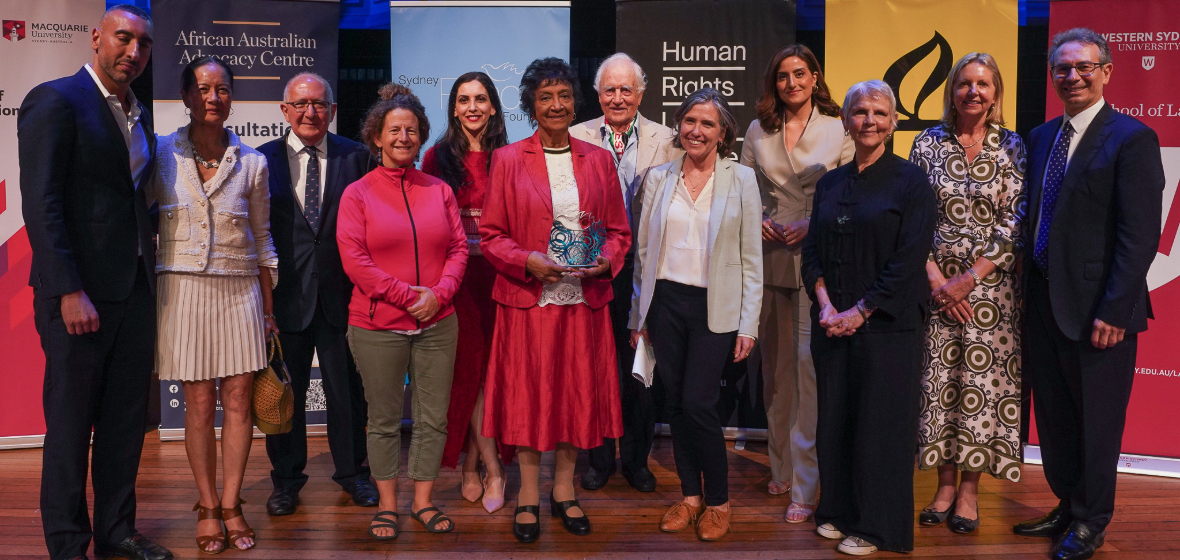
Main image, 2025 Sydney Peace Prize winner Navanethem (“Navi”) Pillay (centre) with Sydney Peace Foundation Executive Director Melanie Morrison. (Photo, Michelle Haywood)