
By Francisco Silva -
Danielle Captain-Webb has used the opportunities presented to her to inspire and help her First Nations community. As the Law Society of New South Wales launches its Indigenous Solicitor Foundation, she reflects on her career and how the profession is better with a fairer representation.
Growing up, Danielle Captain-Webb didn’t consider becoming a lawyer. The proud Wiradjuri and Gomeroi woman grew up on Darkinjung Country (on the Central Coast of New South Wales) and a legal career was never on the cards. “The only lawyers I ever knew were the ones that my family was interacting with,” she tells LSJ Online. “The legal profession, being a lawyer, a barrister, going to the bench, was never an option – because you can’t aspire to be what you cannot see.”
What changed this was exposure. The day a young Captain-Webb was presented with alternative career paths. She had always been driven by an acute sense of justice, was especially interested in criminal justice, and looked at NSW Police as a career path where she could build on those interests and change the system from within. When she was exposed to an alternative path, one in the legal system, her parents convinced her to apply. “I realised that the legal profession and being a lawyer would better position me to try and create system change,” she says. “[T]he over incarceration of First Nations peoples, the high statistics of child removal, the high number of deaths in custody, the access to justice issues that my First Nations community was facing, inspired me to then pursue a career in law.”
Today, Captain-Webb is an accomplished solicitor whose work as an advocate resonates with the philosophy of “changing from within”. She’s the first First Nations solicitor to be elected to the Law Society of NSW Council, co-chair of the Law Society’s Indigenous Issues Committee, and Solicitor Advocate of Legal Aid NSW’s Coronial Inquest Unit. She’s also a board member for the Darkinjung Aboriginal Land Council and a member of the First Nations Advisory Group in the Office of the Director of Public Prosecutions. It looks like every role she takes is focused on advocacy, and that’s no accident. Captain-Webb started her career after her studies in criminology and law, but would quickly pivot to advocacy.
“Pursuing a career in law was never about status,” she explains. “It was always about impact, systemic change and creating a better society for everyone.”
“But I also felt a deep sense of obligation and responsibility to my community.” She addresses the privilege she had, to be given the tools that allowed her to, in her words, “to move through barriers that had existed for people in my position”. Overcoming these social and historical obstacles, and seeing others from her community who weren’t given the same opportunities, galvanised Captain-Webb to follow a path where she could give back.
“[W]e need more First Nations lawyers, policy writers, barristers, First Nations people on the bench to be working within the system, people with lived experience.”
This focus on her community is evident from the beginning of our chat. She takes every chance she can to pivot the conversation to the wider picture, the part she’s more interested in. But the wider picture is also the crux of her own story.
When she finished her law degree at the University of New South Wales, Captain-Webb was set to begin a career in criminal law. She joined the Public Defenders Office as a paralegal, under the guidance of now Judge Sophia Beckett, before taking a graduate role as a solicitor with the Public Interest Advocacy Centre (now known as the Justice and Equity Centre), working on civil claims concerning law enforcement, including wrongful imprisonment, intentional tort and discrimination. She then moved into a graduate position at Legal Aid NSW as a criminal lawyer in the community where she was born and raised. It was there that Captain-Webb experienced a decisive moment that made her realise the limitations of her practice as a criminal lawyer.
“I felt like I had become a cog in the wheel,” she explains. If she managed to steer a client away from custody, she would feel like she had just done a great service to her community. But on the other hand, if things didn’t go as planned, she experienced a sense of having let her community down, and contributing to a system that reinforces the over-representation of First Nations People within the justice system. “In those times I felt like it didn’t matter that I was there as their advocate,” she explains. “Nothing I would have said or done would have changed the outcome.
“And for me, that was the biggest barrier, where I felt like I couldn’t create systemic change or lasting improvements in the system,”
And then there was the one case that changed everything. A client had their bail refused, and his family told Captain-Webb that if he died in custody, she had his blood on her hands. “That was heartbreaking,” she quietly confesses. “Because I went to war to stop that from happening, and the fact that they had seen me as part of that system rather than a person trying to stop it, was career-defining for me. This impacted me not only as a lawyer, but as an Aboriginal person. The limited Aboriginal lawyers available for guidance at this time made navigating these complexities especially difficult. In hindsight, this is the colonial load that Aboriginal lawyers have to carry every day.
“I always look back to that moment as the one that made me really rethink what I wanted my career to look like, what I wanted to change, what I wanted to do, and whether or not my practice at that point in time was the best use of my skills, ability and knowledge.”
Captain-Webb left the role and set her sights on bigger things within Legal Aid. She worked in the Strategic Law Reform Unit and was the inaugural solicitor in the State Wide Advice Unit, before joining the Coronial Inquest Unit as Solicitor Advocate, where she remains today.
There is no fast way to fix the ongoing and systemic problems that affect First Nations peoples in New South Wales. But Captain-Webb addresses each issue that needs to be addressed. She points out the responsibility of the legal profession to expand its knowledge of First Nations experiences. “Whatever way you want to look at it, we are dealing with a justice system that is always going to intersect with First Nations Peoples and experiences, she says. It can be a contentious political issue for many people, but Captain-Webb sees that not addressing the problems perpetuates the status quo. “As a society, every person has an obligation to understand and collectively try to make things better for our state,” she says.
“[W]e need more First Nations lawyers, policy writers, barristers, First Nations people on the bench to be working within the system, people with lived experience.”
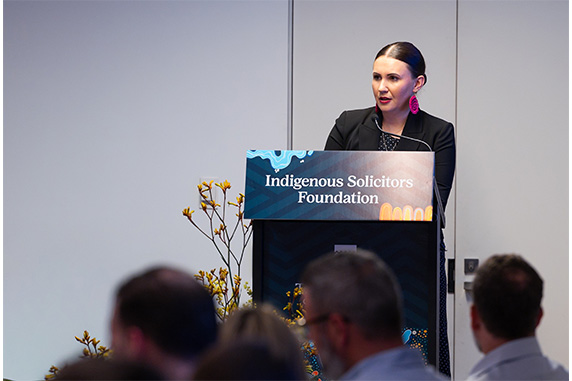
For this reason, Captain-Webb welcomed the Law Society’s new Indigenous Solicitors Foundation (ISF). An idea first raised in the Law Society’s Indigenous Reconciliation Strategic Plan, the ISF is a registered charity set up to support and empower Aboriginal and Torres Strait Islander peoples interested in pursuing a career in law.


“If you can create change and better systems for First Nations people, that is change you’re creating for the broader community.”
The last Profile of Solicitors in NSW revealed that only 350 solicitors identified as Aboriginal or Torres Strait Islander, making up only 0.8 per cent of the entire solicitor profession. Perhaps even more concerning is that trend of Indigenous representation is going down. “It’s important that we support First Nations law students and lawyers to progress through the profession, so that we don’t lose them,” Captain-Webb says. “First Nations people will be coming to the profession with a range of lived experiences and knowledge that other solicitors may not have, and that doesn’t just benefit the clients that we’re working with. It benefits the court system. It benefits the judiciary to understand things differently.”
The ISF directly addresses the barriers that Captain-Webb experienced as a law student. She benefited from a scholarship and was able to live on campus. But when her first son was born, she had to move back home and commute every day from the Central Coast. After she finished her degree, Captain-Webb couldn’t afford to pay for her practising certificate until she received assistance from the NSW Bar Association, Indigenous Barristers Trust – The Mum Shirl Fund. She acknowledges the work of Tony McAvoy SC and Chris Ronalds AO SC with the Trust. “I am incredibly indebted and fortunate for their support during that time,” she says. “So really what the ISF tries to do is fill a gap that exists (…) [to] ensure that First Nations solicitors are provided with support to navigate barriers and systems that are closing doors on them.”
Captain-Webb says that firms know that employing First Nations solicitors adds a cultural richness that is valuable to the profession. Even if these are small steps, they might eventually lead to an ideal level of representation. Breaking glass ceilings isn’t new to her. In meetings of the Law Society Council, she looks at the wall of past Law Society presidents, and the lack of diversity reminds her of the importance of bringing new voices to the profession. “I now feel like I’m able to continue to [achieve] systemic change within the legal profession,” she concludes. “If you can create change and better systems for First Nations people, that is change you’re creating for the broader community.
“I hope that First Nations people, particularly young people, can see and hear my journey to the law, as a First Nations woman, mother of five children, from a regional community, that coming to the law is really [an] option for them, [where] they can create change, their views and their knowledge is respected and that the profession is only more fruitful from having them within it.
“What I want from this story is for First Nations people considering a career in the law to know that we see you, we want you, and we support you.”
Click here to learn more about the ISF and how your firm can give its support.