
By Karl Hoerr -
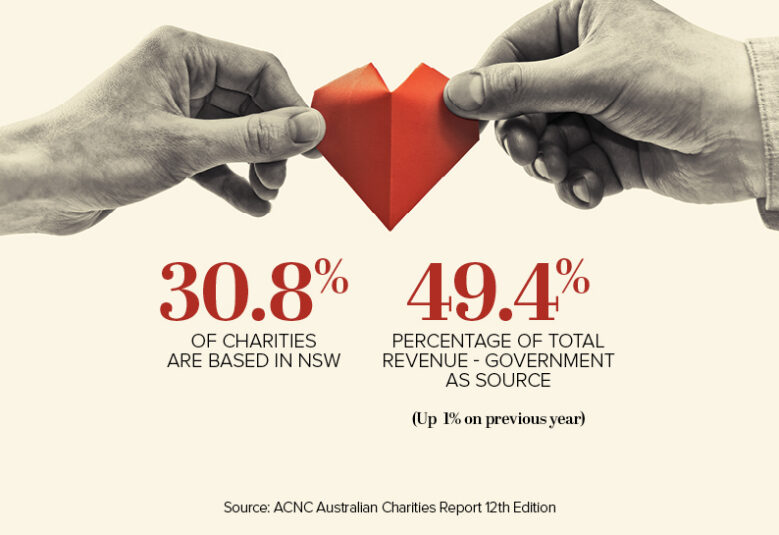
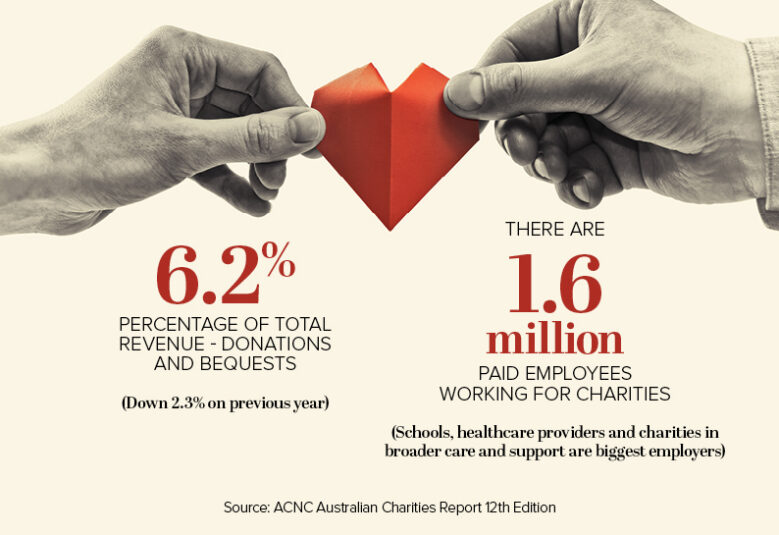
Generating $239 billion in revenue and employing 1.6 million people, the nation’s charity sector is a key economic driver, according to its regulator, the Australian Charities and Not-for-profits Commission. Charities depend on legal advice, but many solicitors working in this space believe the sector is long overdue for reform, especially when it comes to the process for determining tax deductible status.
Mergers and acquisitions might not be the first thing that springs to mind when thinking about charities, but it can be a key aspect of the work that solicitors do in this field. Claire Jones is a Special Counsel at Prolegis, a firm set up in 2001 to provide specialist legal services in relation to charities, not-for-profits and philanthropy.
“The whole thing was about to fall over,” she recalls about the planned merger of two state-based organisations. It was a matter Jones worked on previously and as she explains to the Journal from the firm’s offices in North Sydney, it had started with an especially difficult relationship between the different arms of this group.
“[A]s we know, sometimes the states don’t particularly see eye to eye, and this was a classic New South Wales v Victoria [situation] … neither wanting to cede to the other.” As charities have had to become more sophisticated and business-like over the past couple of decades, in the face of changing regulation and governance standards, mergers such as this have not been uncommon.
What at first seemed like insurmountable hurdles, were passed in the end. “We were able to come in and guide them through the process in such a way that we could achieve meeting of minds between the parties and get the merger to happen,” says Jones.
To some of those involved, getting the deal done had seemed an unlikely prospect. “By the end of the process, the Victorian Director flew up and took me out to dinner because he was just so thrilled that it all came together,” recalls Jones.
Her colleague at Prolegis, partner Tina Lee, explains that such mergers involve a range of factors, requiring a different approach. “Legally, on one level, it’s much easier than merging publicly listed companies, but what’s difficult in the charities and not-for-profit space is sometimes the hearts and minds, getting those on board, because usually with a merger, it involves board members losing their position as board members or one CEO losing their position as CEO.”
In 2022, Labor promised to double philanthropic giving by 2030, a pledge it has maintained in government. The Productivity Commission was asked to report on ways to help achieve this goal, but a number of its key 2024 recommendations have not been acted upon.
Chief among these, to many in the charity sector, is reform to the Deductible Gift Recipient (DGR) system, which the report found was “not fit for purpose”.
If Australia’s support for charities is to be seen as a question of ethics, the same can probably be said of the legal profession. It often goes to the heart of what motivates practitioners in the field. The Journal has discovered this extends beyond an alignment of values, to the diverse nature of the work, often traversing different areas of law.
But as the nation increasingly depends on the work of charities, what are the key legal barriers standing in their way? What role do lawyers play in smoothing that path? And what changes could be made to ensure charities are focused on what they were set up to do?
Recent reform
Among the many ways charities are supported in Australia is a mechanism known as ‘giving funds’, which until recently were known as ‘ancillary funds’. There are public and private versions of these funds, which can receive tax-deductible contributions. Grants are then issued to deductible gift recipients.
Public giving funds, which have existed in tax law since 1963, must seek donations from the public. Private giving funds are often set up by businesses or families. As outlined in a consultation paper on giving fund reforms published by Treasury last year, private giving funds “are restricted in their ability to receive donations from people other than their founders or relatives, associates and employees of the founders”.
At the time of the report, there were almost 2,300 private giving funds and just over 1,400 public giving funds in existence. Both funds are regulated by the Australian Charities and Not-for-profits Commission (ACNC) and the Australian Taxation Office (ATO).
According to Philanthropy Australia, in 2022-23, private giving funds distributed almost $800 million, and the figure for public giving funds was nearly $480 million. Private giving funds have been required to distribute at least five per cent of net assets as grants per year, and four per cent for public giving funds.
In February, the federal government announced it would set the minimum annual distribution rate for both private and public giving funds at six per cent of net assets. Funds will also be allowed to smooth distributions over a three-year period, allowing them to support large initiatives, without prohibitive drawdowns.
The announcement was framed by the Assistant Minister for Productivity, Competition, Charities and Treasury Andrew Leigh as a response to the Productivity Commission’s report and the Not-for-profit Sector Development Blueprint, as part of the 2030 goal to double philanthropic giving.
But some of the reaction has been far less favourable. In a statement at the time, peak body Philanthropy Australia expressed concern that critical, broader reforms, have been sidelined. This was a reference to the DGR system, which determines which charities can receive tax-deductible donations and grants from giving funds.
“The system is complex, confusing and hard to navigate for donors and charities,” said Philanthropy Australia CEO Maree Sidey. The statement expressed strong support for Justice Connect’s ‘Unlock DGR’ campaign, which points to the more than 50 DGR categories as being outdated and overcomplicated.

Geraldine Menere is the Head of Not-for-profit Law at Justice Connect. “[M]ore than half of Australia’s charities won’t see the benefit of this increase without that broader DGR system reform,” she says.
Justice Connect Chair Brooke Massender says the current system can be baffling to people unfamiliar with its intricacies. “Many normal people would assume that charitable status and DGR status are synonymous and the reality is that they’re not.”
Massender describes the DGR categories as archaic and an accident of history, something that has a significant impact on charities. “[I]f you are just that small organisation that is just battling to keep the lights on, it’s a real, real-life challenge, not just for the staff and volunteers in that organisation, but for the board as well.”
Menere explains that the way charities support people has evolved, but the system doesn’t reflect this change. “One of the key issues that we see is that it’s too rigid for modern charities that do many good things,” she says. “The system is essentially asking them to do just one good thing.”
She cites the example of ‘neighbourhood houses’. There are about 1,000 of them across the country, providing support for anything from social cohesion to loneliness, food relief to emergency and disaster relief. Menere says around 400,000 people use one of these houses every week, but this kind of support isn’t reflected in the DGR system. “It doesn’t let communities drive how they want to support themselves and their needs and it just doesn’t make sense.”
Claire Jones agrees with the need for change. “You can sometimes wonder why certain causes get DGR endorsement and others don’t. And it’s simply because the right lobby at the time managed to make their voice heard and achieve a new category, and that doesn’t seem like an equitable reason for applying tax deductibility, which is a significant concessional advantage.”
Menere acknowledges there would be a cost to such reform, estimated to be $120 million per year in forgone revenue, about 12 years ago. “Because we see the benefit that DGR status provides organisations on a daily basis when they’re able to secure it, and that flowing of funding, not just from philanthropy, but government as well, to organsations and the communities they support, we think that the benefit far outweighs the cost,” she says. “There’s a real return on investment for the sector.”

In a written response to questions from the Journal, Andrew Leigh says the government tasked the Productivity Commission with an inquiry to better understand giving by Australians and how to encourage them to give more. He says the final report resulted in a series of recommendations.
“We are working through these reforms with careful consideration, and we will continue to be guided by the recommendations of the Productivity Commission’s Future Foundations for Giving as well as the sector-led Not for Profit Sector Development Blueprint as we work to double giving in Australia.”
On the issue of how much is distributed from giving funds, Jones explains that this is frequently influenced by people taking a longer-term view of what can be achieved. “Often, that’s why there’s quite large amounts of money in giving funds. It’s not because people are trying to delay giving it to charity, it’s because they’re trying to grow the fund so that they can better partner with charity now and into the future.”
Treasury’s 2025 consultation paper acknowledged the risk of reduced giving. “In setting the minimum annual distribution rate, the government seeks to strike a balance between maximising benefits to DGRs and encouraging new giving funds.”
But in his statement announcing the higher minimum rate, Andrew Leigh said Treasury analysis found that funds could last for decades while distributing six per cent, even without further contributions. He also pointed out that around two-thirds of public giving funds and around half of private giving funds already distribute more than six per cent of net assets.
However, Claire Jones says it could act as a disincentive. “Short and even medium term, it looks like you’re getting more out to charity, but when you start looking intergenerationally, you’re ultimately reducing the money in the philanthropic space over the long term, simply by changing that percentage. And that’s even without the potential these changes have to discourage people setting up new giving funds.”
Tina Lee says there have already been signs of cooling. “[W]e need encouragement for people to give more and this might discourage people to set up new private and public ancillary funds, and according to a recent report published by the Minderoo Foundation, over the past two years, there’s only been growth of about four per cent, on average, in the number of private ancillary funds, down from about seven per cent a year over the previous decade,” she says.
For Jones, the nature of those who are giving in large sums, can lead to misconceptions about their motivation, when it comes to issues such as tax. “Policies that only tend to apply to the wealthiest end of town look like they’re a perk that’s unfair or unreasonable but it’s more the nature of how much money needs to be going into these funds in order for them to … be self-sustaining.”
“[I]f you are just that small organisation that is just battling to keep the lights on, it’s a real, real-life challenge, not just for the staff and volunteers in that organisation, but for the board as well.”
Who do charity lawyers deal with?
Luke Hall is Head of Pro Bono and a special counsel at Baker McKenzie, with more than 20 years’ experience in the for-purpose sector. Speaking to the Journal from the firm’s Barangaroo offices high in the precinct’s International Towers, he explains that aside from the pro bono practice, his personal specialty is charities and non-for-profits. “The clients of my legal practice are either charitable and not-for-profit organisations or philanthropists who want to get to that particular stage and status,” says Hall.
Certain areas tend to dominate this kind of work. “In Australia, the charity and NFP legal regime includes corporate and taxation law, property and employment, and you do need that kind of specialist knowledge to be able to deal with the specialist sector in Australia, just like you would for the telecommunications or healthcare sectors,” Hall says.
“Regulators that I deal with would be the Australian Taxation Office and the Australian Charities and Not-for-profits Commission, as well as other regulators, from a structural point of view, so that could be ASIC or New South Wales Fair Trading, Consumer Affairs Victoria and the equivalents.”
Like others who work in the field, Hall has observed the debate surrounding the minimum annual distribution rate for giving funds but is less concerned about the impact of the increase. “I don’t think it would reduce giving,” he says.
“I think there are some in the sector who … have argued against any increase of going from four or five up to six [per cent] in that it is reducing the ability to increase a capital base to then be able to fund philanthropy through operating revenue. I think that’s probably a bit of a small section of the sector. I think that most of the sector are welcoming of the change.”
He’s also regularly having to deal with DGR categories which he says don’t allow for much crossover at all. “It’s definitely complex,” explains Hall. “We get many clients who come to us that want tax deductibility and to be a deductible gift recipient (DGR), but with no real knowledge as to how to actually get there, and no real understanding about how we as lawyers need to navigate the client’s circumstances, their vision, their purpose … You’re either in that particular DGR category or you’re not, and that doesn’t then allow you, or might preclude you from being in another DGR category, because you’ve got these mixed purposes. Sometimes, it’s really … a square peg in a round hole.”
Case study: HabilisSupported, long-term housing for people with chronic mental illness “Embarrassing” is how Professor Olav Nielssen describes the neglect of people with schizophrenia, in an otherwise successful society. The psychiatrist and founder of registered charity Habilis has seen a lot since starting out as a psychiatric nurse in 1977, including working in prisons, looking after a boarding house and 20 years of doing a clinic at the Matthew Talbot Hostel. “There’s a lot of blame of the mentally ill for not looking after themselves and taking substances and all this sort of thing, but it’s really beyond them because of this illness. Schizophrenia is a terrible illness,” he says. At the heart of this issue is the need for stable housing. Decades of experience dealing with this highly disadvantaged group convinced Nielssen that the best approach is individual housing, in small scale communities, rather than group homes. He founded Habilis to provide just that, and in May 2024, its first centre opened at Summer Hill in Sydney’s inner west, providing 20 units, designed to balance privacy and the chance for residents to interact. “The way our model is different perhaps from what’s been done before is it includes medical care,” Nielssen tells the Journal. “People have complained it’s hard to see a psychiatrist, but in fact, if you’ve got a psychiatrist doing a clinic onsite, it’s actually quite easy.” Nielssen says there about 3,000 rough sleepers in New South Wales. “And my estimate is between a third and a half have severe and disabling mental illness,” he says. Nielssen explains that the costs of accommodating these people in other settings, such as prisons, psychiatric hospitals or general hospitals, are vastly higher. “The costs are enormous,” he says. “If you put aside the moral argument … the economic costs are absurdly in favour of doing it. It costs far more … to neglect the homeless mentally ill than it does to house and treat them.” Institutional care for the centre’s first 20 residents, totalled $4.4 million in the year before they moved in, according to Nielssen. “And since then, we’ve only had a couple of brief hospital admissions for people who’ve had little relapses.” Habilis would welcome support from donors, as it seeks to advance plans for its second centre. “If we got some legacy payments from people leaving money to us … or some generous endowments, we’d use that towards building the next one,” says Nielssen. |
What’s it like overseas?
So how charitable are Australians? In its 2025 World Giving Report, Charities Aid Foundation (CAF) ranked Australia 44th out of 107 countries or territories. It found 56 per cent of the population donated to charity and 24 per cent directly to people in need. 20 per cent volunteered.
Earlier this year, a report commissioned by the Minderoo Foundation and the Edward Alexander Foundation, Unlocking Generosity, argued that a range of barriers were standing in the way of greater support for charities. These include people “feeling that they cannot afford to give, not knowing how to structure their giving, or simply not having thought about it”.
The report suggested that donations could increase by up to $12 billion, if financial advisors, accountants, lawyers and fundraisers offered more support on charitable giving. Among the suggestions was for lawyers to ask more people about charitable giving when making their will, as a measure to increase the amount of money going to bequests. This step alone could lift bequests by at least $229 million, according to the report.
International comparisons have ranked Australia behind the United Kingdom, Canada, New Zealand and the United States, in terms of total giving as a share of GDP. According to Tina Lee, our laws are a big part of the picture.
“In England and Wales, the tax regime is much more straight forward. If you’re a registered charity [in Australia] that … doesn’t give you immediate access for being a deductible gift recipient, whereas in England and Wales it does,” she says.
“In the US, also, they have what they call section 501(c)(3) organisations, and they are like a UK charity, and if you’re one of those, you’re automatically able to get a tax deduction if you give to them. So you can see that here in Australia, the regime we have is really not very fit for purpose or easy and also, it’s very expensive for our clients.”

Geraldine Menere says in Australia, some confusion persists for charities on whether their DGR issue is a matter for the ACNC or the ATO. “Most overseas jurisdictions, I think, have ironed out those wrinkles a bit more than we have,” she says. “We’ve got some work to do.”
Brooke Massender agrees. “I was speaking to one of my colleagues in London last night … and I was even just trying to describe the premise of this conversation that we were having today and he sort of looked at me really confused and he said, ‘What, you mean, it’s not just enough to be a charity?’ I was like, ‘well, no, because then you’ve got your tax as a separate regulator’. He said, ‘Well it’s separate here as well’, as in your tax concessions in England would come from the equivalent of the tax office, but it’s fairly straight forward to navigate once you are designated a charity by their Charity Commission.”
Some additional reforms to DGR have been implemented since the Productivity Commission report. Responsibility for assessing eligibility for cultural and environmental organisations, along with harm prevention charities and developing country relief funds and organisations, was assumed by the ATO. They were previously administered by a number of government departments. The government also created a new category for community charities.
Legal needs of a typical charity
Among the charities to have engaged legal services is Families Australia. Established in 2001, it offers policy advice to the federal government and Parliament, on lifting the wellbeing of families, particularly those with the highest levels of vulnerability and marginalisation.
Families Australia CEO Jamie Crosby says the charity has had a range of legal needs. “We have sought specialist advice in relation to human resource and employment matters from time to time,” he says.
“Most recently, we undertook a review and a restructure of our constitution as a national peak body, and specifically engaged a law firm to assist us through that process. We’re also currently going through the process of applying for public benevolent institution status and relevant classification through the ACNC to further our purpose and objectives and again, we’ve engaged legal services advice to support us through that process.”
Case study:
|
Crosby says legal advice has been fundamental to the organisation achieving its goals. “Knowing what it is we want to achieve and being able to have a discussion with knowledgeable, informed and expert people, they can map out some of the processes, opportunities, but also challenges that we’ve had to deal with along the way in progressing that work.”
He explains that legislative requirements, taxation laws and regulations are cases in point. “And it’s just the detail involved in some of the spaces and environments that we work in that we need to be able to access current knowledge and expertise but also an understanding of how a variety of factors interrelate to each other in that environment and what that actually means practically on the ground for organisations such as ourselves.”
Another issue for Families Australia is the safeguarding of children, which Crosby says is at the forefront of everyone’s mind. “We work in a fairly fluid environment, so changes to regulations and legislation in different areas, particularly acknowledging the diversity of the types of organisations that are operating in the sector, it’s important to again have access to that advice to ensure that you’re complying and your status, whichever type of entity you are, that you’re meeting all of your obligations and requirements.”
Insurance is also an area where assistance can be required, Crosby points out. “Some fun and enjoyable activities might be seen by an insurer as a very high-risk activity. So, do you have the appropriate coverage, do you have the appropriate processes in place to ensure that you’ve covered off all of your obligations?”
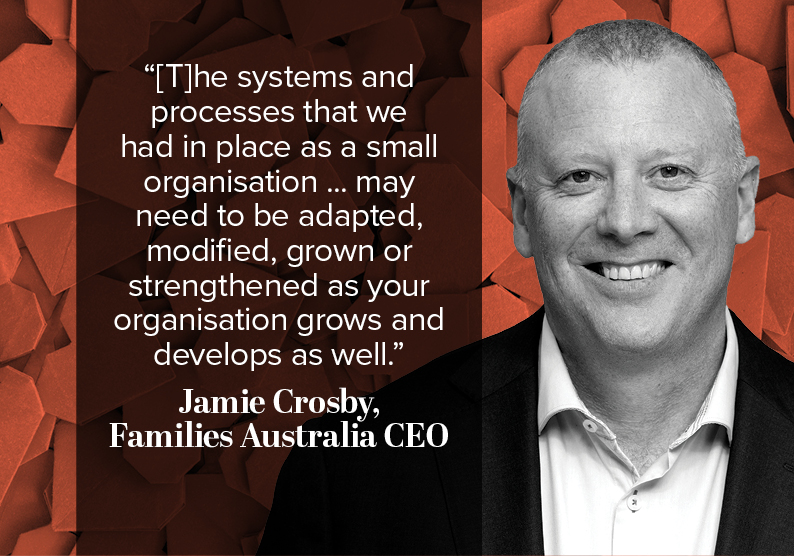
And charities can also encounter issues as they grow. Crosby explains this requires a reassessment of what’s underpinning the operations of the organisation. “[T]he systems and processes that we had in place as a small organisation … may need to be adapted, modified, grown or strengthened as your organisation grows and develops as well,” he says.
Legal work in this sector can sometimes be very different to regular corporate or commercial work. “We’ve got some antiquated structures, like entities established by letters patent in Queensland,” says Claire Jones. “[A] lot of the big church bodies have their own incorporations regimes that sit completely outside the Corporations Act.”
Tina Lee says the infrequency of litigation has its own impact. “A lot of charities don’t have the necessary means to take various points of law to court and so we have to deal with some very obscure case law,” she says.
Big compliance, little resources
Justice Connect sees the legal needs of the charity sector close-up and those needs only seem to be growing. It’s part of the reason the service produces a suite of self-help resources, including more than 300 legal information guides and fact sheets. “What we know is lots of lawyers use those resources as well, and recommend them to their clients, because it’s impossible to keep across everything that’s going on,” says the group’s Head of Not-for-profit Law, Geraldine Menere.
Justice Connect Chair Brooke Massender says a recent survey of pro bono clients at her firm Herbert Smith Freehills Kramer, was revealing. She says there’s a “burden of compliance and regulation that is coming at organisations from all different directions”. Massender acknowledges this is happening for “very sensible reasons”.
“But if you think about big changes around privacy, data management, cyber, the whole psychosocial risk, it’s kind of one thing after another,” says Massender.
“And if you’re on the board of a not-for-profit, the reality is you’ve got the same sort of regulatory compliance burden to manage and the same risk profile as any other corporate entity in Australia, but a tiny, tiny fraction of the resources to respond to it with.”

The challenges and rewards
What drives a solicitor to practice in this area of law? Luke Hall says it depends on the individual. “[D]ifferent people, have their own motivations as to why they want to do charitable work, but the charitable work that is done is good for all society. And being able to play a part in all of that as a corporate lawyer, it’s great.”
For Hall, there was a particular satisfaction in seeing a not-for-profit he helped to establish, later partner with his law firm, Baker McKenzie. Hotel Etico is a hotel group staffed by people with disability, the first such social enterprise in the country.
Hotel Etico began in Italy in 2015, based on the dream of a young man with Down Syndrome called Niccolò Vallese. Hotel Etico’s vision is to enable those with a disability to live in dignity and independence through work, to empower employers to create diverse and inclusive workplaces and to break down prejudices about the talents of people with a disability. The group has hotels in the Blue Mountains and Canberra, and overseas in Italy, Argentina and Albania.
Hall explains how Hotel Etico works. “So they take in students and interns, train them for a year, provide them with a [certificate] three or [certificate] four in hospitality, most of their beneficiaries and students have an intellectual disability, and we here at Bakers have a charity partnership with them, and we’ve been able to actually employ one of their graduates, and Aaron is going great,” says Hall.
“He’s just like anyone, any other employee and I think that that’s a real life example of the good feeling that you get in being able to be a part of the charity NFP sector, even though you yourself are just a lawyer and you’re doing corporate taxation type things, but being able to make a real impact in the world out there.”
For Geraldine Menere it’s about the purposeful mission of the work, the people she meets, the creative solutions she sees, and the impact of it all. One of the things Justice Connect is working on at the moment is helping to update the constitution of the Men’s Shed. “Those things might seem mundane, but the gratitude that you get from those organisations and those people, because they just wouldn’t have had access to that type of support. I really enjoy that aspect of it,” she says.
Massender explains the impact of helping to connect people. “[I]t all comes back to the magic of being that matchmaker, often between a person or people in an organisation who are really struggling and grappling and are finding something really out of their reach to comprehend and action, and you’re connecting them with the person that actually … knows how to do it, and the relief, the relief that you see when you make that connection and they go, ‘Oh, actually, we can do this, this is going to happen’, that never gets old for me.”
For Claire Jones, it can even be assisting a charity that does work she has little familiarity with. “They’re trying to do their bit to help other people and to make the world a better place and I think that makes the work such a joy … We see our role as helping organise the legal side so that they can get on with doing what they’re passionate about.”
Her colleague Tina Lee agrees. “I jump out of bed every morning and am delighted to be here doing the work that we do to help our clients to be able to do their work better.”
Asked about the future of the charities and not-for-profit sector, Luke Hall says there will always be a need. “[T]here are such a diverse range of passions but also needs that the government can’t support or the private sector won’t support,” he says. “[T]he more dedicated resources it has, and specialised knowledge from professional services like lawyers, the more experience [lawyers] have in that particular sector, I think will lead to a better charity NFP sector, and better social outcomes for everybody.”
President’s Charity The Justice and Equity Centre’s Homeless Persons’ Legal Service“At the heart of the Justice and Equity Centre’s work with people facing homelessness is a simple but powerful belief: everyone in our community should have a safe and secure home. One of my vivid memories growing up in the west of Ireland, was my mother’s compassion for those homeless people who came to our door seeking help. Inspired by that example and my own recent professional experience in working for a major provider of services to vulnerable Australians, I’ve chosen the Justice and Equity Centre’s Homeless Persons’ Legal Service as my President’s Charity for 2026. Your support will assist the Justice and Equity Centre to continue its vital work.” Ronan MacSweeney President, Law Society of NSW |