By Francisco Silva -
Director: Olivier Assayas
Writers: Olivier Assayas and Emmanuel Carrère, based on the novel by Giuliano Da Empoli
Cast: Paul Dano, Jude Law, Alicia Vikander, Tom Sturridge, Jeffrey Wright
Winston Churchill, calling Russia “a riddle wrapped in a mystery inside of an enigma”, always felt to me like an unfair cop-out from a leader who makes no effort to understand a superpower. What Churchill really wanted to say, I reckon, is how can a superpower not have the same will for colonial hegemony as the other European countries do? Don’t go after me, this is how I chose to analyse one of the most important political figures of the twentieth century. And if I can take the liberty of unpacking Churchill at my own leisure, so is Oliver Assayas allowed to try to analyse Vladimir Putin.
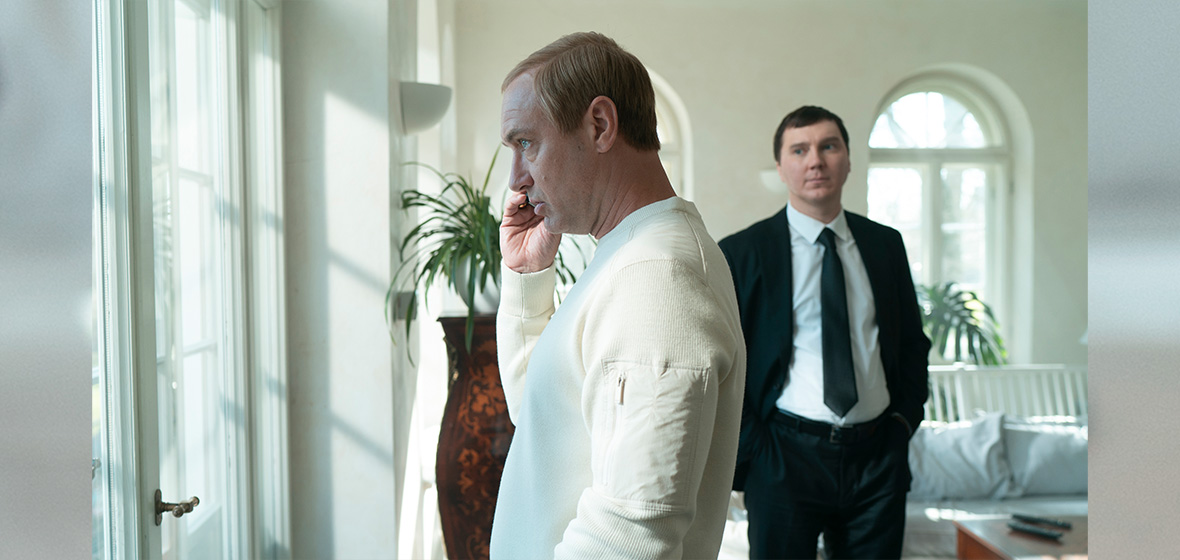
Based on the novel by Giuliano da Empoli, The Wizard of Kremlini is a film of two halves, framed around a conversation that Vladimir Baranov (Paul Dano) has with an American researcher visiting Moscow, Rowland (Jeffrey Wright). Both are fictional, but while Rowland only exists as a framing device to drive the story for the audience, Baranov is heavily based on Vladislav Surkov, the mastermind behind the rise of Putin in Russian Politic. Putin’s Roy Cohn, if you will.
In the first half, we see Russia mutating after the fall of the Soviet Union. Baranov, the son of a dedicated civil servant, enjoyed a happy childhood, which he almost resents. With the fall of the Union, young Baranov rebels through art, like any young adult in the West does. What a time to be in Russia. Rock music everywhere. Art was confronting and exciting. Baranov directs a play, and he meets and falls in love with Ksenia (Alicia Vikander) as she performs a punk-dominatrix gig inside a derelict building. Capitalism was, in fact, fuelling creativity.
But as expected, that excitement quickly morphed into mindless exploitation. The cool punk concerts in unique venues turn into dance clubs where vodka and champagne energise the excess. And Baranov transforms from an artist into a private TV network producer with a fondness for manipulative reality shows. Suddenly, Baranov is meeting oligarchs in private parties, like Dmitri Sidorov (Tom Sturridge), rubbing shoulders with media moguls lobbying for political power. Using Boris Yeltsin (George Sogis), here portrayed as a barely functioning puppet, to further their economic interests. In one of the film’s most entertaining scenes, Boris Berezovsky (Will Keen), another powerful media man, engineers Yeltsin’s re-election, even if he has to tie him to the chair for an address and dub his voice to make him at least intelligible.
It’s Berezovsky who recruits Baranov to shape the reluctant director of the Intelligence Services as the next leader of the country. A certain chap called Vladimir Vladimirovich Putin (Jude Law), who sees the potential of Baranov to help him cling to power, against the interests of Berezovsky. The transformation of Russia into a proto-fascist oligarchy is completed only when the rebel artists, sons of the soviets, learn the machinations of power and corruption of society. And Putin, the one man who saw the opportunity for absolute power that corrupts absolutely. Not exactly subtle, but neither is Russia, which, like a character astutely says, is shaped by the axe.
And this is where filmmaker Olivier Assayas loses steam. The second half, when Putin and Baranov start building the foundations of the current government, all the way to Putin’s triumphant Sochi Olympics ceremony, his Triumph of the Will, is an hour-long montage that lacks the urgency and political wisdom of the first part, growing increasingly depressing as we power through an inevitability we all know so well.
Putin also disappears during most of that sequence, which is fitting as he turns more into an isolated spectre that haunts anyone who tries to contradict him. Makes sense, but it’s undeniable how his presence held a lot of gravity when it was on the screen.
Law also brings a performance of two halves. The looks and mannerisms are uncannily similar, and he knows how to arrest the screen with just a look. Law’s star quality has always been very natural and pragmatic. He is charming, and Putin would have to be as well, even if said charm comes from fear and severe media training. And then he talks, and just sounds like Jude Law with his posh RADA accent in Putin’s face. Like an AI video with someone else’s voice imposed on it. It’s not bad, but it lingers somewhere in the uncanny valley.
Dano does well with the little that he’s given. He gets the calm and defeated personality of a man who was burned by the ethos of his own ideologies.
Assayas is a great director, but his political thriller here lacks the satirical bite of the original novel. You can see the moment when he knew his thesis was completed. It’s when the film needs to drive the point home and indulge in a more commercial approach that Assayas resists. Ironically, the part that an American production would’ve nailed. Like Robert McKee said, always wow them at the end. Assayas accepts that Putin is a mystery, a riddle and an enigma all in the same package. His heart is on exploring a post-communist society devouring itself in the throes of capitalism.
Verdict: 3 out of 5
For anyone with an obsession with modern Russian geopolitics. Even if it’s all fictional, it’s grounded enough to feel believably real.