

By Francisco Silva -
The Blue Trail
Director: Gabriel Mascaro
Writer: Gabriel Mascaro and Tibério Azul
Cast: Denise Weinberg, Rodrigo Santoro, Miriam Soncarras
The Birthday Trip
Director: James Robert Woods
Writer: James Robert Woods
Cast: Luke Jacobz, Annelise Hall, Nicola Frew, Josephine Starte, David Quirk
The Blue Trail
The world barely changed in Gabriel Mascaro’s The Blue Trail. It’s the very recent future, and the Brazilian government has a program of relocating every person who turns 80 to an island where they can live their twilight years in peace without putting a strain on the rest of the society, and freeing time and space for the younger generation. Forced retirement, for people who cannot afford to retire and mitigating unemployment rates. Teresa (Denise Weinberg) is 77 and lives alone on the outskirts of the jungle where the Amazon River serpents through. She works in a local slaughterhouse for the processing of crocodile meat, a safe, uneventful routine organises her day.
But Denise is told the threshold to go to the old people’s island has moved to 75, and now two years overdue, she’s ordered to present herself for relocation. She’s not ready. She may be old, but there’s a lot left for her to do before she bows out, and she decides on one innocuous thing: to fly on an aeroplane. But what for her is just a recreational trip, the rest of society sees as an attempt to flee, and, as, at that age, she’s given to the care of her daughter, she’s refused a ticket from a local travel agency for a same-day return flight.
So starts the odyssey of Teresa along the Amazon, trying to reach another river town where someone has a plane she can hopefully rent for her joyride before she’s finally caught by the government, shipped to an island to die. For Teresa, it’s not just a trip for a taste of freedom; it’s a way of making a stand for her human dignity. Old people caught by the government are transported in these small, rickety caged vans, said to be for their protection. A benevolent oppression is still oppression, and Mascaro recognises that when fascism comes again, it’ll come in the guise of the greater good, like altruism of centrism. “There’s no more wanting, these days”, says someone to Teresa at some point, resigning themselves to a reality they deem necessary.
But not for Teresa. She catches a ride with a lonely, forlorn ferryman (Rodrigo Santoro), who teaches her the wonders of a mysterious Amazonian snail that secretes a psychotropic blue goo that people use to see an inner truth. Later in her trip, she accepts a lift with Roberta (Miriam Soncarras), a Cuban octogenarian who sells modern digital Bibles from her boat. She avoided the island by paying the government for a certificate that exempts her from forced retirement, and recruits Teresa to help her on her journey. Unsurprisingly, the rules are not for those who can afford it.
Mascaro films the Amazon like it’s home for Teresa. Where others saw an unforgiving nature that tolerates some humans, Mascaro wants us to understand that in that place, where nature wins the fight against civilisation, Teresa can find her satisfying sense of freedom. The raindrops are heavy and loud, the sun scorching and sweaty. Humans live in a state of almost constant alertness against a system that can take them away from their place. No one is to be trusted, even if Teresa pays them for help. It feels like a society broken apart, where the things that make us human are lost or left out to rust like the cabins near the river.
But it’s in this place that Mascaro gives Teresa her deserved happiness. Naked and ecstatic, gambling under the influence of hallucinogenic. It’s like the world envisioned by a William S. Burroughs finding himself, but here unconstrained by the point of view of a white American fetishising the jungle. It’s genuine and human.
Complementing Mascaro is Weinberg’s perfect performance. Her resilience against a law she feels is unfair is the type of stand that could start revolutions. There’s a scene where she eventually finds herself in one of those “wrinkle-wagons”, and her slouched, angry expression says more than what a monologue could. It’s fitting she finds Soncarras to fill in her gap. The two exude so much joi de vivre in a chemical reaction that settles the film through its last third.
The Blue Trail is a very Brazilian film. In this, I mean it’s moved by a narrative idea that is unique to South America. It’s closer to the films of Glauber Rocha than some of the modern filmmakers out there. It would pair well with this year’s Australian film Wolfram, as both offer a new post-colonial perspective surrounded by nature. The outback in Warwick Thornton’s film, and the jungle in Mascaro’s. And both wish for their people to find peace in their environment.
Verdict: 4 out of 5
For anyone who once found an urge to break the rules.
The Birthday Trip
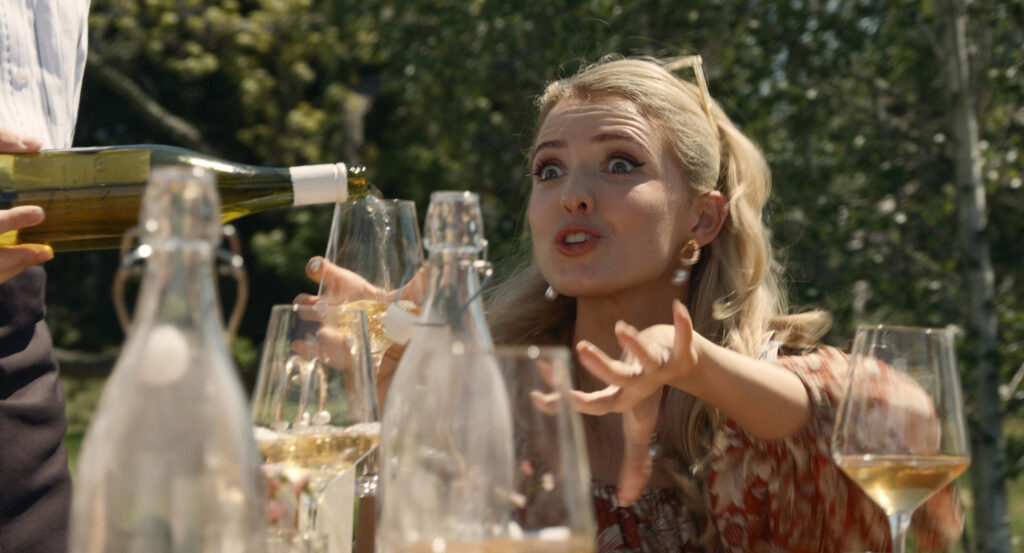
Advertised as an Australian White Lotus, The Birthday Trip is a satirical comedy about rich people on holiday in the Southern Highlands of New South Wales. Celebrating the joint 30th birthday of three high-school friends, three couples rent a cottage in the countryside for a long weekend. So it’s White Lotus because it’s a reflection of the upper class, but there’s a little bit of The Big Chill creeping into a story of six 30-something friends pouring their relationship chagrins onto each other.
The three friends are Clare (Nicola Frew), Angie (Josephine Starte) and Isabel (Annelisa Hall). Clare, a frustrated artist is married to Jim (David Quirk), himself a frustrated hipster who makes his life writing soulless advertising jingles instead of focusing his talent on real art. Angie is in a long engagement with Lars (Luke Jacobz), a loud and bragadocios finance bro who is completely emotionally detached from the damage his work does. And Isabel, starting her career as a TV producer, is married to Mark (Ben Gerrard), the manager at a weapons manufacturer who definitely knows the damage his job does, but “someone has to do it, right?” And then there’s the “others”, which here is just the caretake Felix (Robert Preston), and his wife Sapphire (Sapphire Blossom), who live in the premises in poorly conditions, contrasting with the lavish luxury of the house where the couples are staying.
James Robert Woods, who both writes and directs the picture, isn’t one to be subtle about it. Right in the first scene, Mark talks on the phone with his assistant about a media statement over a year in the Middle East, while his partner on the side makes posts on a social media reel. It’s a strong start to enhance the dissonance of realities, but it’s one that the rest of the film doesn’t follow through on. The satire is blatant; no one can deny that, but most of the jokes fall flat for having neither the depth nor the vision of a good caricature. Woods’ writing comes across like a first draft of a script, rough around the edges and not scrutinised by a good script editor that could have helped focus and shape the elements of his message together. His directing also fails to hold interest. An overused handheld that sits somewhere between The Office and Celebration, but isn’t as funny as the TV show or as gritty and dark as Thomas Vinterberg’s film.
The result is a film that tries to explore an important message of class divide in Australia – something that Australian art could definitely do with – but doesn’t really understand what part of the theme it wants to explore. Bafflingly is the portrayal of the “poor people”, simply a working-class couple constantly arguing and shouting at each other with no discernment, making me wonder if Woods has ever talked to a working-class person in the first place.
The Birthday Trip is a good idea that should’ve stayed in the oven for a little bit longer. It reveals a problem I see in Australian filmmaking, where the fact that a project is produced should be enough to be lauded. Filmmakers are surrounded by yes people who do nothing to advance an industry torn between making elevated art and entertaining products to sell to Americans. If there’s a lesson here it is the plea to filmmakers to question everything. Question their scripts. Question their decisions. And above all, question themselves.
Verdict: 2 out of 5
For millennial self-aware upper-class Australians from the Eastern Suburbs of Sydney, whose favourite film is The Big Chill.
Ticket giveaway – Holy Days
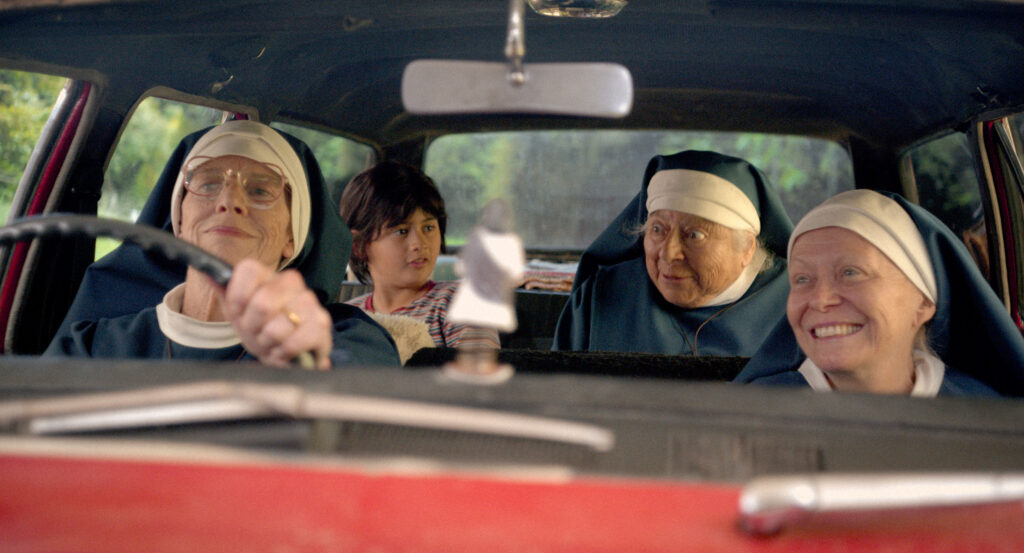
LSJ and Kismet film have five double passes for the upcoming Kiwi comedy HOLY DAYS.
Miriam Margolyes, Judy Davis and Jacki Weaver lead the heartfelt new comedy Holy Days, a joyful and uplifting story about faith, family and unexpected friendship. Set in 1970s New Zealand, the film follows a grieving young boy and three eccentric nuns who embark on a chaotic road trip to save their beloved convent before it’s too late. Filled with warmth, humour and plenty of heart, Holy Days is a moving celebration of community, resilience and hope. A feel-good community experience, made for the big screen! In cinemas August 6. Watch the trailer here.
For a chance to win one of the digital tickets, email your LawID to journal@lawsociety.com.au with the subject line HOLY DAYS by Tuesday 4 August.