By Francisco Silva -
Director: Olivia Wilde
Writers: Will McCormack and Rashida Jones based on the film by Cesc Gay
Cast: Seth Rogen, Olivia Wilde, Penélope Cruz, Edward Norton
You can almost hear the pleas of discourse when The Invite starts with an Oscar Wilde axiom. “One should always be in love. That is the reason one should never marry,” it reads across the screen, the silent whisper of a million internet sleuths trying to connect this film with the private life of its director. Wilde, who signed here her third picture, famously had her marital issues blown up and scrutinised in the public square during the press tour of her second picture, Don’t Worry Darling. The whole shebang was only made worse by the fact that the film, a metaphorical science-fiction examination of a marriage breaking apart in front of its community, failed to be the critical and audience success Wilde hoped it to be.
So for her to come back, Wilde returns to the subject she failed in Darling, but through a different perspective. A married couple is realising their union is falling apart, but this time it’s a private and introspective affair.
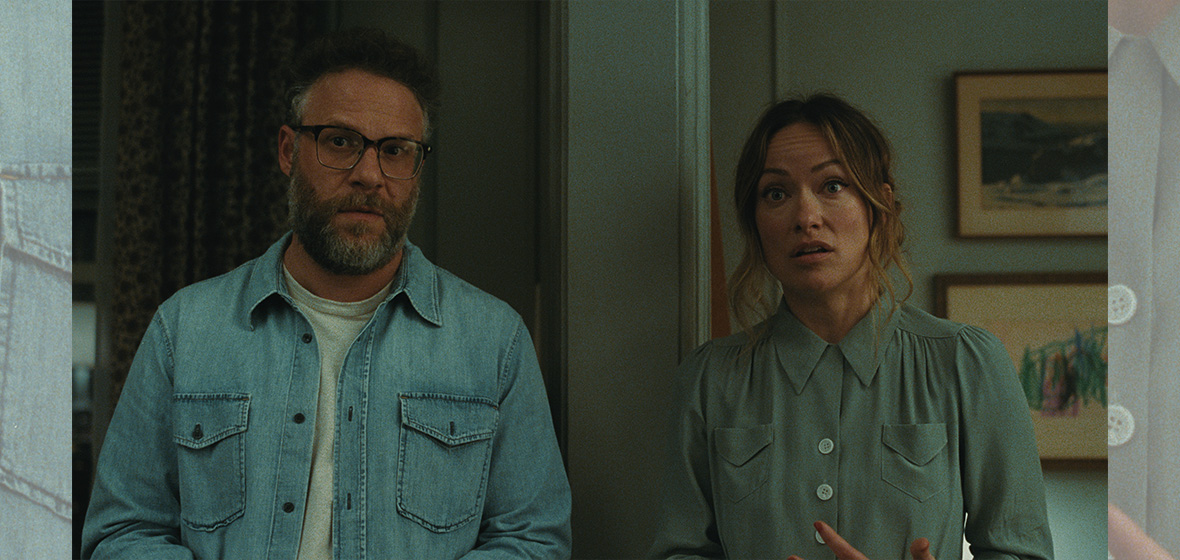
The difference starts already with the setting—a nice apartment in San Francisco. Joe (Seth Rogen) and Angela (Wilde) can afford to live there because it belonged to his parents. So it’s not status that got them here. Angela doesn’t work, and Joe is a music teacher. Both are unhappy about their circumstances, but also reached that level of denial that married couples eventually get to, where no one wants to admit there is nowhere left to go. When the film starts, Joe arrives home to the unwanted surprise that they’re about to have visits – the upstairs neighbours Hawk (Edward Norton) and Piña (Penélope Cruz). He’s tired from a job that doesn’t satisfy him, his back hurts, and he holds a very poor opinion of Hawk in particular and of the couple’s preference for disturbingly loud sex. Angela, on the other hand, is excited. She wants to take the opportunity to thank the neighbours for their patience while their home was being renovated. She bought a new rug for the living room, and she’s making soufflé. They have no wine left, and started arguing again. And then the bell rings.
Written by Will McCormack and Rashida Jones, based on a Spanish film by Cesc Gay, the film has the mechanics of a theatre play. It reminds me sometimes of the work of French-Persian playwright Yasmina Reza, but without the satire (because, let’s be honest, Americans can’t do satire). Instead, Wilde and her writers have the pleasant structure of an American sitcom. The result is palatable and frankly quite funny. The elements are well laid out at the start, without feeling contrived. Joe agrees to go ahead with the dinner if he can call out the other two for their disturbances. Angela evidently has a secret reason for why she wants this soirée to go ahead so badly, and Hawk and Piña arrive with an agenda – first to apologise to themselves as they are aware their noise bothered Joe, but also to make them an unexpected offer.
Though there is no interest from McCormack and Jones to include a humorous sociological study, they do include a little intergenerational observation. Rogen and Wilde are dejected millennials whose comfortable financial circumstances don’t hide their ennui, while Norton and Cruz play optimistic Gen Xers whose economic woes are overshadowed by their acceptance of circumstances. Where the film achieves anything close to a good analyse, is in the understand of how each character expresses sexually. Joe’s relationship with sex has to be a taboo, while Angela feels repressed. Hawk uses it to address trauma, but also as a performative space. And Piña, as the only non-American, is the only one honest enough to include it so openly in her personality.
This character study, which is revealed at the halfway twist, pairs well with Wilde’s style. No scene is shot the same, even if the whole plot happens in one location, but understanding how the dynamic between the characters functions, Wilde blocks each scene as a reflection of their concerns and our perception. In one scene, she moves the point of view far away, even through a window, reminding us we are only observing from afar and any judgment is flawed by the lack of context and the fact that it’s none of our business (if the internet voices need to take a hint).
Wilde comes out as the winner here. Not only is her artistry perfect for this genre, reminding us she really shouldn’t waste time with high-concept sci-fi when her will is so grounded in dramatic character studies. But her performance as Angela doesn’t miss a beat. Her movement, dropping the soufflé in the bin while trying to appease her guests, is as sad as great comedy needs to be. She doesn’t let herself be outshined by Cruz, who, expectedly, is as brilliant as a Sofia Loren teaching Americans the wonders of physical attraction.
The Invite stops close to being a masterpiece, but it’s a respectable statement by Wilde after her talent was questioned. It was never a doubt in my eyes, but here she shows precisely why Booksmart is such a success.
Verdict: 4 out of 5
For couples in need of a serious conversation.