By Francisco Silva -
Director: François Ozon
Writer: François Ozon and Philippe Piazzo, based on the novel by Albert Camus
Cast: Benjamin Voisin, Rebecca Marder, Pierre Lottin, Denis Lavant
In the review of Luchino Visconti’s The Stranger (1967), Roger Ebert says that Visconti’s only fault is that he followed Camus’ novel too closely, and that “halfway through we realize the film will have no surprises”. Ebert still gave the film a stellar review, and it is a forgotten Visconti film that probably fails by casting a 40-year-old Marcello Mastroianni as the 20-year-old Meursault, but Ebert is right, Visconti adds nothing new to the novel and struggles to justify the film he’s making.
Maybe that’s the reason it took so long for another filmmaker to adapt this. Maybe it’s why no other French auteur wanted to touch it. Camus is like Sartre, an untouchable whose work can only be approached through insubordination. And The Stranger? The epitome of Camus’ existentialism via his absurdism, told from a matter-of-fact narration with little to no judgement, until the final monologue when Camus acknowledges, addresses and shakes the status quo. The “delirious day life” at full blast from a man sentenced to death not because he killed another man, but because he didn’t cry at his mother’s funeral.
I love this book. Maybe it’s a cliché but it’s part of my formative experience like Infinite Jest is to other men. I’m not ashamed of how much Camus’ work means to me because it’s personal. I avoided dissertations and deep analysis of it, because they would add nothing to what I understand about the story. In other words, I do not care about what anyone says, I know what the book says to me. As far as I’m concerned, the only piece of art that managed to recreate the depth of the novel was The Cure’s 1980 song “Killing of an Arab”. I can turn and walk away, or I can fire the gun // Staring at the sky, staring at the sun // Whichever I choose, it amounts to the same // Absolutely nothing.
A new take is always welcomed. It’s like observing the mind of another person, like reading a dissertation they were brave enough to share with the world. Go to bold and you risk diluting the point of the source material, get too close and it’s boring, like someone trying and failing to please everyone. What François Ozon did with The Stranger was right in the middle, a personal interpretation of a famous story that captures the spirit of the book to a T and adds an important element Camus missed.
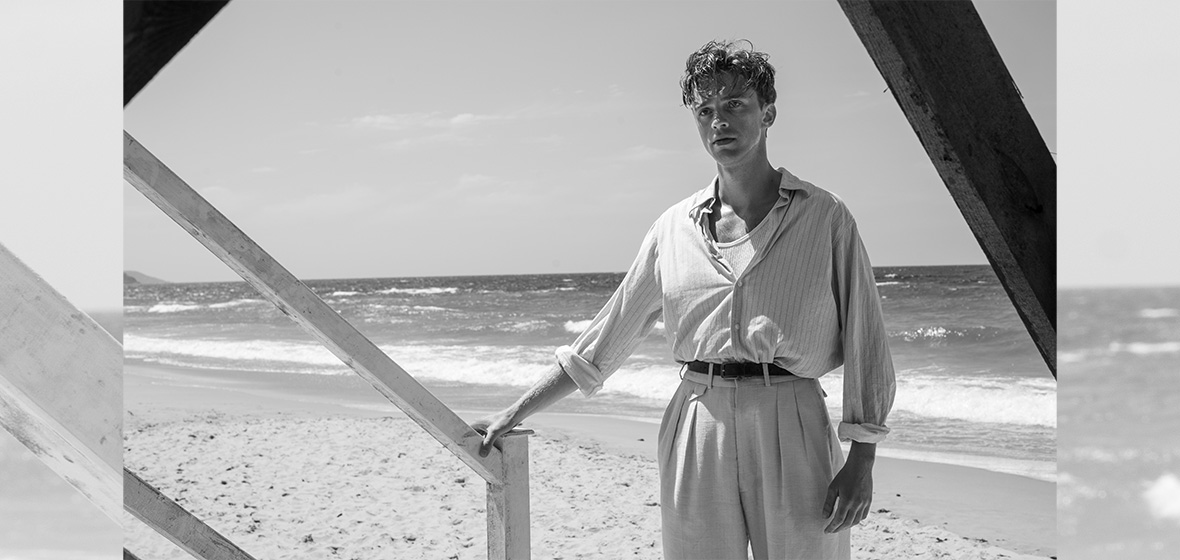
Shot in a grungy black and white, taking us back to classic French cinema from Robert Bresson to Marcel Carné, the story starts with an advertisement for Algiers as a holiday paradise for the French in 1940s, disturbed by a graffiti calling for an Arab revolution. From here we meet our protagonist, because it’s too much to call him a hero, Meursault (Benjamin Voisin) is a quiet stoic man whose mother just died. He attends the funeral, barely talks to anyone, and returns to his office job. He spends time with Marie (Rebecca Marder), who wants to marry him, and tolerates his obnoxious neighbour Raymond (Pierre Lottin) who got into a bit of a mess with a group of Arabs. It’s because of this that Meursault ends up killing one and is later arrested.
Ozon’s trick is to accept Camus’ matter-of-fact narrative and maintain the same pacing. He pits Meursault’s stoicism against different emotional states, like his mother’s dear friends crying at her funeral, Marie’s romantic approaches, or an endearing moment when his neighbour Salamano (a tremendous Denis Lavant) loses his dog. Ozon understands there needs to be balance where Meursault is a passive observer surrounded by people who rely on him, and he finds it by filming Voisin like the most beautiful man to ever walk the Earth. No wonder Marie wants to marry him even when he shrugs his shoulders. I would as well.
But the twist is how Ozon, very overtly, puts the anti-colonial message front and centre. An element from the novel becomes the raison d’être for the film. The title is written in Arabic, almost defiantly. Every opportunity he can to show the oppression, he does, like when he frames a shot in the cinema to include a sign in the background that says, “No natives allowed”. And then there are the new scenes, mostly centred on the Arab’s sister who finds that the demise of her family came from getting too close to Raymond. In a moment without Meursault, she talks to a sympathetic Marie in the courtroom voicing the protest of her people. But in an ultimate act of defiance, after Meursault mumbles the novel’s famous final words, Ozon takes the bravest swing and gives the Arab a name.
All is accompanied by an ethereal soundtrack from West African Arab composer Fatima Al-Qadiri that reflects the film’s observant tone while hinting something larger and more dangerous bubbling under his surface. During the credits, Ozon, feeling like he’s on a roll, plays the song by The Cure, because, why not? Ozon strides with so much confidence he can throw a bone to his most obvious instinct. The Stranger is a treat for fans of the book. It doesn’t undermine anyone’s own personal views on the subject and adds a layer we weren’t expecting. And that addition fits perfectly with the modern reading of a classic, providing another reason to perpetuate Camus’ work into the future.
Verdict: 5 out of 5
For fans of the book. Not sure about everyone else, but if you read and enjoyed the novel, then you owe it to yourself to see this on the big screen.