
By Francisco Silva -
Michael
Director: Antoine Fuqua
Writer: John Logan
Cast: Jaafar Jackson, Nia Long, Colman Domingo, Miles Teller, Mike Myers
Alphabet Lane
Director: James Litchfield
Writer: James Litchfield
Cast: Tilda Cobham-Hervey, Nicholas Denton, Henry Nixon
Michael
Regardless of its subject, the point of a film, like all art, is to challenge as much as it engages with its audience. Throw away any selfish idea that you, yes, you, deserve anything from the filmmakers. Not entertainment, nor validation. No one, no artist in this world, owes any audience anything but the respect you give to any intelligent person who is willing to read and engage with nuance. Keep that in mind as you rave through Antoine Fuqua’s sycophantic Michael, which manages not to address the big elephant in the room but, more egregiously, portrays the King of Pop as a dull, Christ-like figure. Even Jesus had to test his will. This Michael Jackson is not only a paragon of talent and goodness in the world, but also a glitzy cardboard cutout.
Set from the time Jackson and his brothers blew up as the Jackson 5, and ending right after the release of his 1987 album Bad, Michael is framed strictly around his rise as the world’s biggest pop star and his tempestuous relationship with his father, Joseph Jackson (Colman Domingo). But in between these scenes that apply to those two very tenuous storylines, there is a chronological sequence of events, situations, anecdotes and trivia moments made so your friend who is strangely obsessed with Michael Jackson can lean over to you and whisper “so this is the day he gets his monkey bubbles which he absolutely loved”. So, if this review serves anything, it is to not go and see this film with that friend.
The point is a life, this is not. I concede that the scenes with his father are at least interesting, but maybe only because drama is so sparse in this film, we cling to any bit we can get. But even those moments do not lend the film any gravitas. It becomes clear quite early that Fuqua and writer John Logan have no interest in analysing or understanding who Jackson was, when they can simply recreate paragraphs from his Wikipedia page and call it a day. None of the sequences connect, beyond reinforcing the same set of ideas over and over again – that Michael Jackson was incredibly talented, that he loved animals/his mother/his siblings/his fans, that he disliked his father. We don’t see him struggle with himself or understand what it meant to become a symbol of American pop culture. We don’t notice the house of cards falling because in iFuqua’s’s version, there is no house of cards. Jackson was a perfect human being betrayed by the hubris of others, since, I guess, he has none.
Why is something like this so egregious? It isn’t because Fuqua, whom I only partially blame for this boring mess, has no curiosity. Fuqua is an interesting filmmaker; it’s worth understanding how he got to where he is. Because the man who blew into the scene with the exciting and gritty Training Day became one of the most reliable mercenaries in Hollywood. The go-to guy when a big studio had a star action vehicle and wanted someone who could deliver a success that also followed the studio notes and the test audience feedback. Michael is partially produced by his siblings, save for Janet who refused to be included in the film which raises question about this version but also gives us one of the funniest details I found that whenever a Jackson sister is on screen someone has to s “y “La T “ya” to make sure we know who this isn’t. But this means it’s the sanitised, fan-serviced version of the story. Not one that tries to uncover the many layers of Michael. Because, yes, there are no layers here.
So, the music has to work, and of course it works because it’s Michael Jackson. The only inspired idea Fuqua has is to use instrumental versions of Michael’s songs in the score, which nods again to the audience at how important this is.
But the rest is so trifling. In one scene, he accidentally watches a news broadcast about gang violence in Los Angeles, and in the next, he’s inviting both gangs to a rehearsal of “the “Beat It” dance routine so he can say “music can bring us together”. This leads nowhere. In another, he convinces the director of CBS (played by Michael Myers) to play his songs on the very white MTV. Then Michael stands on top of a cab in New York surrounded by his fans while Myers proudly looks at him from his office. Is this important? Does it affect Michael psychologically? Does anything? He meets some burn victims in the hospital and feels so bad that he drops a line that he wants his share of his next concert to go entirely to that hospital.
I feel for Jaafar Jackson, who plays Michael in a reverent pantomime, doesn’t get to show depth and emotion because the film doesn’t give him anything. All that’s left is a cracking impression. Domingo will probably be criticised, but honestly, he seems to be the one to at least get something out of it. He chews the scenery with heft, which in context is at least something the audience can feel.
What is the point of Michael? True, don’ts don’t need this. You want to celebrate Michael Jackson? Watch his 1988 performance at Wembley Stadium. It’s 10 minutes longer than this film but feels one hour shorter. The failure of Michael made me think of the film Good Vibrations, a little British indie about the life of Northern Irish businessman Terri Hooley. The central point of the film is a beautiful scene about the day John Peel playing Teenage Kicks on the radio for the first time and the effect it had on people listening to that song for the first time. I thought Michael would do something similar for the release of the Thriller music video. Kids rushing home from school to tune in to MTV and feel like they were part of something. But no, nothing. No heart, no emotion. Nothing but the hollow thud of artistic integrity disappearing in the middle of a billion dollars.
Verdict: 1.5 out of 5
For the obsessive Michael Jackson with low standards.

Alphabet Lane
As far as elevator pitches go, James Litchfield’s first feature, Alphabet Lane, is a compelling one. A couple recently moved to rural New South Wales and started joking among themselves about having imaginary friends, but slowly lost control. I spent a couple of months if rural New South Wales and I get it. Coming from a big city, the sprawling countryside can feel daunting and oppressive. Mind you, it’s all in our fragile urban-rotted brain, but the concern exists. So, I felt this film, even though I hoped that Litchfield had the courage to take the concept to even more complex planes.
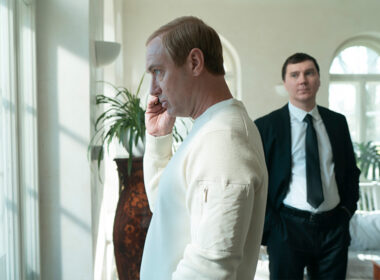
Anna (Tilda Cobham-Hervey) and Jack (Nicholas Denton) live in an isolated house surrounded by farmland and pastures. Jack is an engineer, and Anna is a doctor assigned to the night shift at the local hospital. The two mostly meet every morning or every night in the middle of the road leading to their property, as one returns home and the other leaves. The isolation and difficulty in making new acquaintances is harder than expected. It took me a while to find someone I wanted to waste my time on in Sydney, I can imagine how hard it would be when there is no soul in a 5km radius.
As a joke, Jack pretends to have met a neighbour called Joe and his wife, Michelle, and tells the story to Anna as if it’s an amusing fantasy. Like Nicole Kidman telling Tom Cruise about her affair in Eyes Wide Shut, but only here it’s made to keep the flame of their relationship burning. For a moment, Anna appreciates the attention, but the joke becomes a way for them to express their own grievances to each other. Anna tells Jack about a conversation she had with Joe, and Jack creates a whole backstory for their characters, including a son who had fallen into hardships.
But as the story progresses, Michelle grows increasingly dependent on the lie and refuses to give in when confronted by others. The fantasy is starting to feel real in Anna’s head as a way to cope with the growing isolation in their lives. In a stroke of inspiration, Litchfield flips the plot to its natural progression while pretending to be Michelle sharing correspondence with Jack that becomes dangerously flirtatious.
For such a simple premise and a tight 80 minutes, Alphabet Lane is a solid, entertaining drama that I’d classify as a psychological romance. Litchfield, who also wrote the script, understands that pacing is key for this crazy concept to work, so he doesn’t get distracted by side stories or irrelevant details. Even better, he doesn’t want us to think that Anna is losing grasp of reality. It’s very clear that she knows what’s real or not, but she just chooses to accept that this story, which she and Jack created in her mind, is more interesting and appealing than whatever the real world has to offer. And can we blame her? Aren’t we eager to let ourselves go into the world of a film, or a book, without questioning? Down in Woop Woop, they make their own stories.
If anything, I’d say that Litchfield’s inexperience is the film’s only downside. Sometimes it feels like he tries to hold on to his instincts to really push the boundaries, lest he scare the audience away. A glimpse of this freakiness is visible in the fantastic ending. It’s beautiful and romantic, but in this gloriously deviant way. It’s a good sign that he was on the right path, which made me wish there was just a little bit more of that.
Verdict: 3.5 out of 5
For the unassuming romantic willing to go the long way for a very good joke.