By Francisco Silva -
Blue Moon
Director: Richard Linklater
Writer: Robert Kaplow, based on the letters between Lorenz Hart and Elizabeth Weiland
Cast: Ethan Hawke, Bobby Cannavale, Andrew Scott, Margaret Qualley
It Was Just an Accident
Director: Jafar Panahi
Writer: Jafar Panahi, Nader Saïvar, Shadmehr Rastin and Mehdi Mahmoudian
Cast: Vahid Mobasseri, Mariam Afshari, Ebrahim Azizi, Hadis Pakbaten
Blue Moon
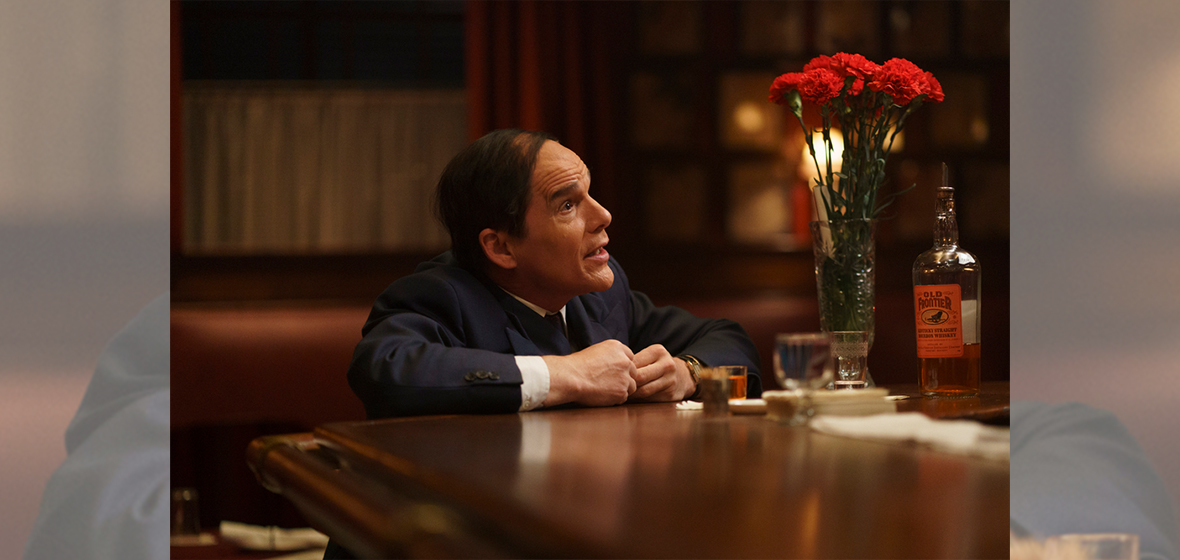
Very few things are as sad as they are romantic, as a lonely man at the bar with a glass of whisky. Sad because we learn, from this picture, that the man is there of his own-accord and because of his own failures. And romantic because every other male filmmaker, given the chance, would rather idealise the poor figure as a victim of circumstances.
The man in Richard Linklater’s Blue Moon is Broadway’s lyricist Lorenz Hart (Ethan Hawke). In the beginning we learn three things about him, that he was both a genius admired by his peers, a charming but miserable person, and that he will eventually die alone in a dark alley of New York. But we start seven years before, Hart begrudgingly leaves the premiere of “Oklahoma!” and heads to the bar where the after party is held. While he waits, he airs his grievances to the bartender (Bobby Cannavale), a young soldier on leave playing the piano (Jonah Lees) and the writer E.B. White (Patrick Kennedy). Lorenz spews his thoughts with the intensity of someone who has everything to say, constantly dragging people to the conversation as quickly as he lets them go. His issues are many. This is the first time his working partner Richard Rodgers (Andrew Scott) is working without him, and he may get his first box-office success. He doesn’t find the new lyricist, Oscar Hammerstein II (Simon Delaney) but that matters little because Lorenz believes tonight’s the night he’ll sleep with Elizabeth (Margaret Qualley), the 20-year-old student he’s been courting for the past couple of months.
The undoing of Lorenz’s character is gradual. In the first scene he fires at all cylinders with gusto and entertainment. A monologue about incorrect use of a famous Casablanca line (“A precedent is being broken? How can you break a goddamn precedent?”), a film he admires, is quickly followed by a romantic tribute to Elizabeth (“she’s completely undeserving, but isn’t that the way it always is?”, and ending with the details that Lorenz, trying to stay off the booze, orders liquor to admire while he sips club soda.
As people arrive, the mysticism broken. His relationship with Rodgers deteriorated because of his unpredictability and alcoholism. And the read he has on Elizabeth is off by a mile. She sees him as a confidant who can help her career in the industry. And yet Lorenz soldiers on, making at least for him that night about himself, something that no one else, save for the bartender, seems to share.
It’s interesting this month was bookended by two Linklater releases that have a thematic connection. Nouvelle Vague was a stylistic account of a charming French man whose idiosyncratic ways paved the road for a cultural revolution, while Blue Moon is a simpler analysis of an American who failed to live up to his talent’s expectations because of his own egotistical destructiveness. Lorenz is now known for writing the lyrics of Blue Moon, which has been covered by everyone from Sinatra, The Beatles, Bob Dylan and Ella Fitzgerald. And yet Lorenz shudders when someone references the song, as if that was not the footprint he wanted to leave.
Linklater’s decision to set the film in one location, could’ve been the start of a play, but as a savvy director he understands the medium offers him a chance to get close to his characters in a way that the play couldn’t. It’s very New York, with touches of old Woody Allen, some Louis Malle and maybe even a little bit of the energy of John Cassavetes. But it remains very Linklater, whose vision is also secured in his dedication to keep a film pragmatic and effective.
Little of this would work if Hawke wasn’t so good in it. And by good I do mean this is a performance that could make other actors feel impotent. A mystery of this award season is how Hawke, who was nominated for an Academy Award, isn’t in a serious conversation to take the prize. No one else on that list reaches his level of pathos and drollness. A performance so gentle and tragic, it alone is worth the price of admission. The kind of decision that in years from now we’ll look back with embarrassment for ignoring.
Blue Moon is the kind of film that’s easy to recommend. The script by Robert Kaplow, inspired by the letters between Lorenz and Elizabeth, has that beat of classic American films. If the character wasn’t so tragic, it could’ve been there next to the work of Billy Wilder and George Cukor. And while the subject is more Wallace Shawn than, say, Cary Grant, it paints a real picture of how the art can forever be separate from the artist, but the artist will never separate himself from the art.
Verdict: 4.5 out of 5
For anyone who connects with the charm and class of classic American storytelling. Fun, sad and elevated by a generation-defining performance.
It Was Just an Accident
It’s a regretful situation that Jafar Panahi’s award-winning It Was Just an Accident finally arrives in Australia as citizens of his home country of Iran are subjected to weeks of violence from an authoritarian government targeting protestors. According to senior government officials, at the time of writing, up to 30,000 people have been killed. The internet is still cut in the country, and it’s hard for the diaspora to contact their loved ones.
Jafar Panahi has been here before. His career is notorious for rebellion, from his 2006 film Offside, about a group of women trying to sneak into an Iran soccer match dressed as men, to the films he made while in house-arrest, to his defiance of the government banning him from making films for 20 years which led to some of his most interesting and original recent works of revolutionary filmmaking like This Is Not A Film, Close Curtain and the brilliant No Bears.
Eventually the filmmaking and travel ban was lifted, but Panahi still had to keep his projects a secret from the government. The one throughline between all his projects is how they deal with small acts of defiance he finds are important seeds for a necessary change. Even No Bears, which follows Panahi in a small border village remotely directing a film, who ends up witnessing a forbidden romantic exchange between two people that can cause a rift in that small community, is grounded in a deep moral and ethical sense of art as a conduit for freedom.
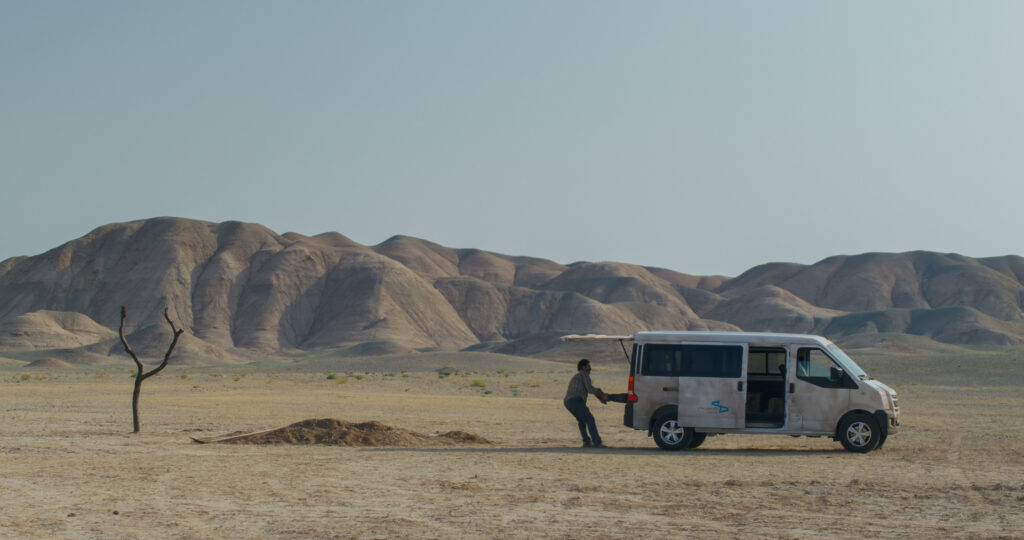
It Was Just an Accident is probably his most direct and angry film so far. The story follows Vahid (Vahid Mobasseri), a mechanic, recognises a man with a prosthetic leg as potentially, Eghbal (Ebrahim Azizi), the man who tortured him in the past. Vahid kidnaps him and gathers a group of people who were affected by Eghbal’s violence and are still dealing with the traumatic effects of it. As the group drives around with an unconscious man in the trunk, they must decide if this is the right person, and if it is, what is the right course of action for a satisfying revenge, if there is one?
Panahi’s style has always been joyful in the face of oppression. Even when he was under intense pressure from the government, he found a way to channel comedy to the quotidian he is filming. But in It Was Just an Accident there is anger and desperation brewing, like a young idealist bursting to address the bigger questions in his mind. When it all settles and Iran is free, what is going to happen to the ones who suffered and the ones who acted on behalf of the government to enact that suffering? Can the country ever be healed?
And yet he doesn’t give in completely to these brooding thoughts. In one of the best sequences, the group finds out that ‘maybe not Eghbal’s wife’ is in labour and go out of their way to transport her to the hospital, look after her, and arrange for gifts to be sent. In the middle of the mess Panahi’s mischievousness shines through, allowing him to remember that in spite of the deep trauma oppression causes, the values of the Iranian people remain unfazed.
It Was Just an Accident is a film that tries to represent a lot about modern Iran, but aware that this is just the tip of the iceberg. The ending is one of for the ages, a showstopper of a final shot that represents a complicated future for the filmmaker’s home country. The pain and the trauma will never go away, and it’ll take a whole generation until people can stop fearing who’s behind them.
Verdict: 4.5 out of 5
For anyone aware of what’s happening in Iran and understands the urgency of such a film in the global discourse. But beyond its revolutionary position, it holds its ground as piece of art.
Ticket giveaway – Crime 101

LSJ and Sony Pictures have 10 double passes for the upcoming thriller Crime 101.
Set against the sun-bleached grit of Los Angeles, Crime 101 weaves the tale of an elusive jewel thief (Chris Hemsworth) whose string of heists have mystified police. When he eyes the score of a lifetime, his path crosses that of a disillusioned insurance broker (Halle Berry) who is facing her own crossroads. Convinced he has found a pattern, a relentless detective (Mark Ruffalo) is closing in, raising the stakes even higher. As the heist approaches, the line between hunter and hunted begins to blur, and all three are faced with life-defining choices–and the realisation that there can be no turning back. In cinemas February 12. Watch the trailer here.
For a chance to win one of the passes, email your LawID number and postal address (the passes are physical and will have to be posted) to journal@lawsociety.com.au with the subject line CRIME 101 by Tuesday February 7.