By Wendy Yang -
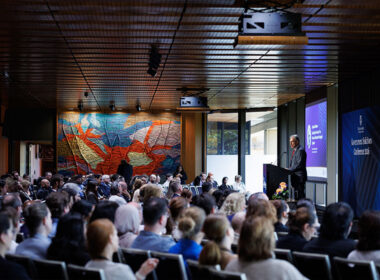
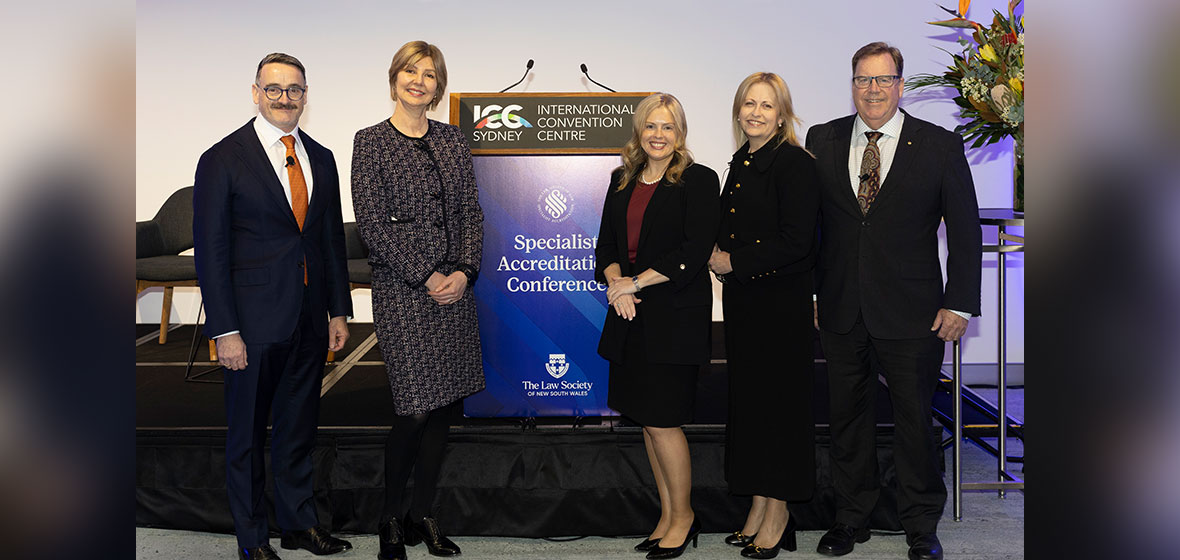
Close to 500 attendees were present on day one of the sold-out Specialist Accreditation Conference 2026 at the International Convention Centre Sydney yesterday.
Jacqui Dawson, Senior Vice President of the Law Society of NSW and Chair of the Specialist Accreditation Board celebrated her fifth Specialist Accreditation Conference as Chair. Reflecting on her history with the conference, she recalled the first time she stood on the stage at the event in 2022 in the wake of the pandemic.
Dawson recalled how exciting and valuable it was to come together to learn alongside and connect with like-minded peers and colleagues, noting that the experience is as valuable today as it was back then.
For Dawson, the Conference is one of the key events on the Law Society’s calendar. She acknowledged that attaining Specialist Accreditation is an important recognition of the skill and expertise of solicitors who have devoted themselves to a specific area of law.
Ronan MacSweeney, President of the Law Society of NSW, said New South Wales is home to the largest number of solicitors in Australia. “[I]t is fair to say that the work we do here profoundly affects not just the legal, but also the political, social, and of course economic life of our country,” he said.
MacSweeney emphasised the importance of Specialist Accreditation, noting that it enables solicitors to demonstrate their extensive knowledge of their chosen practice areas in NSW. He said it conveys a strong message to the community that these solicitors are not only highly experienced in their areas of practice but are also trustworthy professionals. By establishing a “higher standard to strive for,” it elevates the entire profession, he added.
The Honourable Deputy Chief Justice Robert McClelland AO of the Federal Circuit and Family Court of Australia gave his keynote address on “The ongoing importance of legal expertise and specialisation, in the face of AI, and a changing legal landscape”.
The Deputy Chief Justice acknowledged that generative artificial intelligence (AI) is a “practical reality in legal work” and the various tasks AI can do to strengthen productivity, lower costs and facilitate greater access to justice. The Deputy Chief Justice reminded the audience that although AI can be a beneficial tool in legal practice, the legal practitioner’s experience or expertise, their professional judgment and professional obligations remain crucial.
The 2026 Conference featured a diverse range of panel discussions and presentations across five streams: Business law, Elder Law, Wills & Estates, Family Law, Personal Injury, and Property Law.
Elder Law, Wills & Estates
The Elder Law, Wills & Estates stream explored dispute resolution in the elder law context, complex estate planning, will construction and rectification and an engaging panel discussion on elder abuse featuring panellists from Legal Aid NSW, NSW Ageing and Disability Commission and NSW Trustee and Guardian.
The panellists discussed capacity, which they described as a topical issue, the demographics of perpetrators of elder abuse, coercive control in the elder abuse context and how solicitors can work with other stakeholders such as financial institutions and police to identify elder abuse.
Family Law
The Family Law stream explored a range of issues in the family law space from the latest developments in the Family Law Act and its impact on spousal and child maintenance, to updates in coercive control, the latest developments impacting property settlements in family law matters, and acting in matters involving self-represented litigants.
The morning session involved a thought-provoking and valuable panel discussion on ‘Family law matters involving allegations of family violence’ with Dr Martha Barnett SC, barrister at Culwulla Chambers and the Honourable Justice Juliet Behrens, Federal Circuit and Family Court of Australia. The panel, which was moderated by Alicia Elliott, Practice Director at Broun Abrahams Burreket Lawyers, discussed a range of issues including when a court “should” or “must” make a decision about family violence and a range of practical considerations for solicitors.
Business Law
In an interesting line up of topics from recent complex contract law decisions, family business disputes, merger control reforms, to insolvency, and risk management for business lawyers, the presenters on day one of the business law stream covered relevant topics for practitioners in this space.
Andrew Rider, barrister at Level 22 Chambers, presented a useful session on relevant tax issues for small business lawyers. He reiterated the importance of due diligence and considered tax and duty in family farm transfers.
Personal Injury
With recent legislative amendments to the Workers Compensation Act in force from 1 July 2026, the personal injury stream contained a practical session on ‘Reform in action: A new era for workers compensation in NSW.’ Presented by Jennifer Gair, Managing Partner and CEO of Gair Legal, the session provided a helpful overview of the key workers compensation reforms.
Other sessions in the stream included an examination of the evolving legal landscape governing historic child abuse claims, expert evidence in personal injury claims, assessment of damages for catastrophic injury and an insightful panel discussion on the use of AI in CTP claims.
The session titled ‘AI in CTP claims – Better claims or bigger industry problems?’ featured an expert panel that included Judge Gerard Phillips, President of the Personal Injury Commission, Karen Bulluss, Principal at McInnes Wilson Lawyers, and Christopher Rymer, Head of CTP Claims at QBE Insurance.
The panel, moderated by Leigh Davidson, Principal Solicitor of Advantage Legal and Deputy Chair of the Law Society of NSW’s Injury Compensation Committee, engaged in a stimulating discussion about use of AI, the need for oversight by a human, the benefits and limitation of AI use in legal proceedings and the importance of retaining key legal skills and passing on the knowledge or skill of how to prepare legal documents to the next generation of legal practitioners.
Judge Phillips emphasised that AI cannot be used in decision making. However, he acknowledged that he would be interested to see how AI will work for practice management.
Property Law
This year’s program kicked off with an examination of the latest cases and trends in the property law space. The program also covered other hot topics impacting property lawyers in 2026 from planning and housing law reforms to risk management and risk reduction under the new anti-money laundering regime.
The 2027 Specialist Accreditation Conference will be held on 12 and 13 August 2027 at the International Convention Centre.