By Wendy Yang -
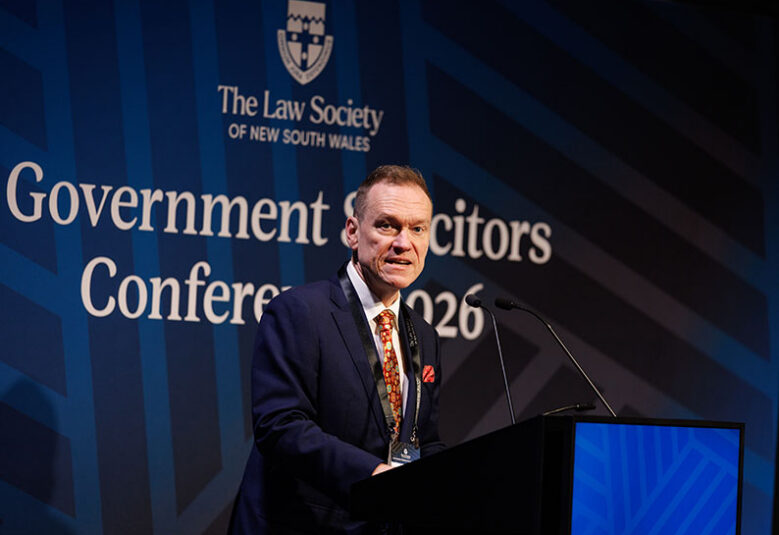
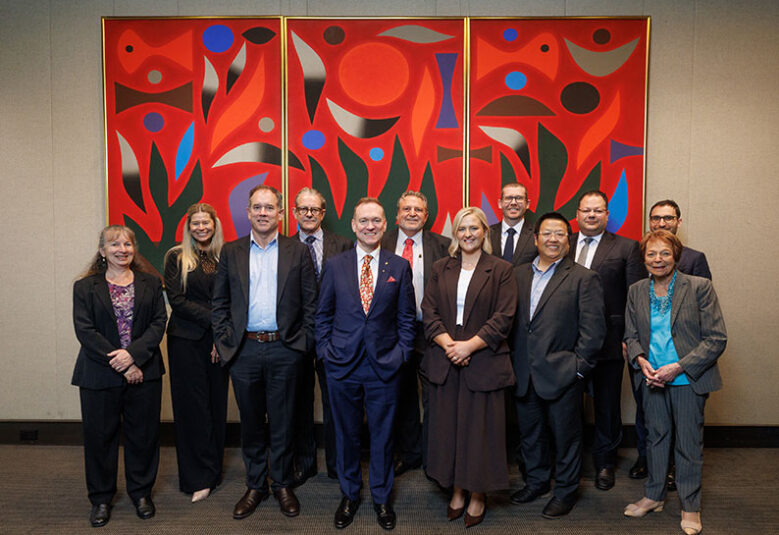
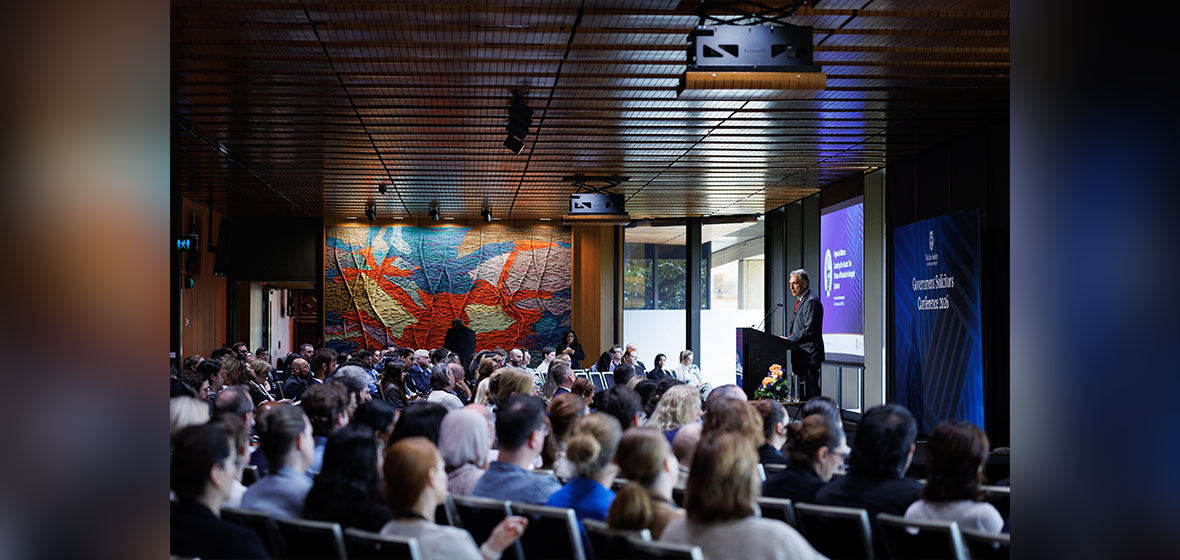
From automated decision making to sovereign citizens, the sold out 2026 Government Solicitors Conference held on 2 September at NSW Parliament House delivered a day of insightful and engaging discussions on the complex legal issues shaping government practice today.
The conference brought together government lawyers from across NSW to examine some of the most pressing legal issues facing the public sector.
Dr Mel Keenan, principal legal officer, policy & legislation at the NSW Electoral Commission and Chair of the Government Solicitors Committee acted as Master of Ceremonies.
The conference drew special guest speakers including the Hon. Michael Daley MP NSW Attorney General and the Hon. John Hatzistergos AM, Chief Commissioner of the NSW Independent Commission Against Corruption. The packed room of delegates hung on every word of the Chief Commissioner’s keynote address titled “Guarding the guards: the virtue of restraint in integrity systems”.
In his address, the Attorney General acknowledged the Indigenous Solicitors Foundation initiative. He said one of the privileges of his office is that he is able to appoint members of the judiciary, emphasising that the judiciary should “reflect the society that it presides over”.
Referring to the Legal Practitioners Admission Board, Daley pointed out that although the Higher School Certificate is important, people’s lives should not be set in stone at 18. Reflecting on his own career trajectory, the Attorney General admitted that he has benefitted from opportunities later in life. “Doors should always remain open. Power of a second chance, the power of an opportunity cannot be understated,” he said.
The Attorney General acknowledged the important role of government solicitors, remarking on the fact that much of their work is done behind the scenes. “Governments come and go, ministers come and go, policies change, but the institutions remain. Public service remains,” he said.
Addressing those who have just started out in their careers, Daley encouraged them to persist. He said, “don’t underestimate what you’ve chosen to do. It’s not an easy profession but it’s an integral one, because democracy is preserved not only by the great speeches, the great judges or the great political moments, it’s preserved every day by people quietly doing their jobs properly.”
In his keynote speech, Hatzistergos spoke to restraint as a “virtue that is shared by every institution in our system of accountability”, however it has a different meaning for each. “For courts, it is doctrinal: the disciplined observance of the boundary between legality and merits.
“For Parliament, it is structural: the responsibility to design institutions with care, and then to refine them on principle rather than reaction.”
Hatzistergos emphasised that the Commission is not, and does not aspire to be, a fourth branch of government.
Addressing the legal profession, and the role of legal practitioners, the Chief Commissioner emphasised the legal profession’s role in appearing before the Commission, their role to advise, whether it’s witnesses, public officials or agencies, their role in drafting legislation and so forth. “The integrity system of this State is not the Commission alone; it is the whole reciprocal structure … and the legal profession is a load-bearing part of it.
“My invitation to you is not to trust the Commission more or less but to play your role in that structure: to hold us, as we hold others, to the terms of the powers we have been given,” he said.
[D]on’t underestimate what you’ve chosen to do. It’s not an easy profession but it’s an integral one, because democracy is preserved not only by the great speeches, the great judges or the great political moments, it’s preserved every day by people quietly doing their jobs properly.
The Hon. Michael Daley MP NSW Attorney General
Following the Chief Commissioner’s address, the NSW Anti-slavery Commissioner Dr James Cockayne joined a panel discussion with Giles Fryer, solicitor and the John Hennessy Scholarship Holder, on important issues in anti-slavery in NSW. The panel was moderated by Geri Ettinger, mediator and member of the Government Solicitors Committee at the Law Society of NSW.
Cockayne discussed the current framework in NSW and his role as commissioner in supporting agencies and to build capabilities to detect and deal with modern slavery risks in their supply chains. “My role, I often like to say, the role of the anti-slavery commissioner under the legislation is a little bit like that of a teacher.
“So, I look at the reporting each year from agencies, and we mark, in a sense, that homework. But it’s with a view to helping the agencies develop their capabilities,” he said.
Fryer discussed his research into the exploitation of temporary migrant workers. He explained that many of the workers are indebted to their employers and are often required to work their way out of substantial debts through physical labour.
This was followed by a presentation by David Hume SC, Sixth Floor Selborne Wentworth Chambers on ‘Failure to enquire’ and a presentation by Scott Alden, Partner at Mills Oakley and member of the Government Solicitors Committee at the Law Society of NSW on ‘Risk assessment and drafting key documentation during procurement’.
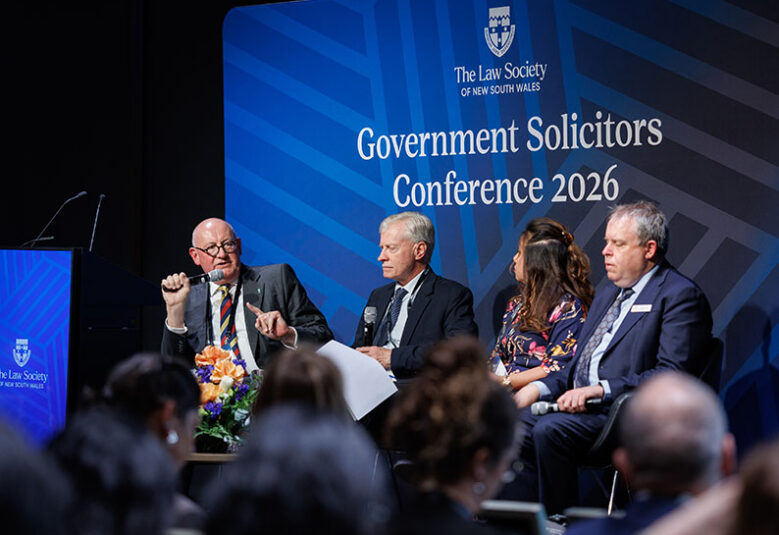
Judge Rami Attia, Local Court of NSW, Ram Pandey, Acting Assistant Commissioner, Litigation and Legal Services at the Australian Taxation Office, Taylor Murray, Associate Legal Counsel at Lake Macquarie City Council and member of the Government Solicitors Committee at the Law Society, and Jason Tozer, Senior Prosecutor with the NSW Police Force and Accredited Specialist in Criminal Law joined moderator Ronan MacSweeney, President of the Law Society of NSW, in an engaging discussion about the increasing number of sovereign citizens engaging with the legal system and their impact on the rule of law.
Wrapping up the conference, was a fascinating panel discussion between Paul Monaghan, senior ethics solicitor, Professional Support Unit, The Law Society of NSW, Vaughan Roles, solicitor at Legal Aid NSW and Councillor of the Law Society of NSW, and Tiffany Tran, principal lawyer, Governance Risk & Compliance, iCare and member of the Government Solicitors Committee, and moderator, David Miller, Partner at Colin Biggers Paisley and Chair of the Ethics Committee at the Law Society, on automated decision- making.
On the impact of artificial intelligence (AI) on legal practitioners, particularly those in government, Miller emphasised that “when you translate law into an algorithm or a code, the legal risk doesn’t disappear; it migrates and that’s where your role as lawyers comes to the fore.”
He pointed out that in the private sector, legal practitioners are concerned with privacy, confidentiality of client information and professional negligence claims. But for government solicitors, they have an additional public law element as well.
Monaghan explained the important role performed by government solicitors, as independent advisers and legal service providers within government. He emphasised that technology, including automated systems, will not displace a solicitors’ obligations or duties under the conduct rules or their duty to provide “independent and objective legal advice.”