
By Francisco Silva -
Director: Craig Gillespie
Writer: Ana Noguira, based on the characters created by Jerry Siegel and Joe Shuster
Cast: Milly Alcock, Jason Momoa, David Corenswet, Eve Ridley, Matthias Schoenaerts, David Krumholtz
Craig Gillespie’s Supergirl is a frustrating feature. Its importance goes beyond its quality as a film. It represents a business strategy, a cog in a larger plan of corporate scheming that spans as many years as the business plan presented to their stakeholders. In the upcoming promised merger of Paramount with Warner Brothers, there is probably an entire chapter dedicated to the Intellectual Property of the characters, the actors playing them, and the expected revenue investors can expect over that timeframe. Before being a film, Supergirl is content. Used to continue the monetary exploration of its capital. According to Deadline, the film almost recouped its production investment with the commercial partnerships. Its box-office performance is irrelevant. Its value remains on streaming platforms, setting up sequels and upcoming films in the same universe. And the frustrating part is that it’s trying to be really cool about it.
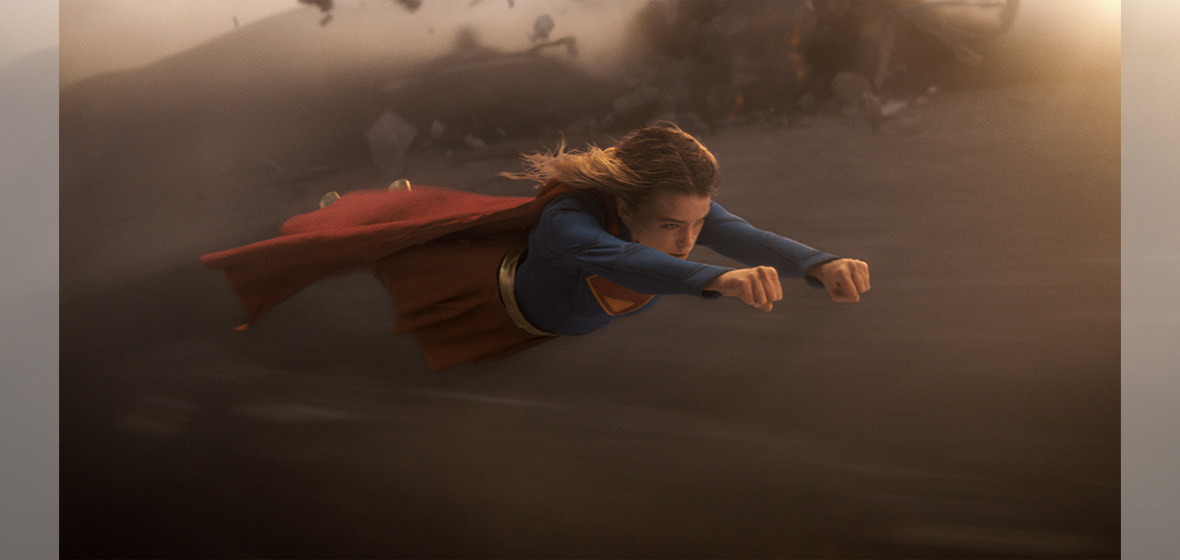
If you were there last year with James Gunn’s Superman, which we very much enjoyed here at the LSJ, you met Kara Zor-El (Milly Alcock), the Supergirl of the title. She appears right at the end of the film, dealing with a hangover and sporting a pair of 90s-era earphones. The cheap ones with the orange foam. She had the air of millennial rebellion that’s out of date in 2026, but is still undeniably cool for millennials. And I get it. If I think of non-conformity, I think of denim jackets, girls blasting Hole or Bikini Kill through their wired headphones. Have you listened to Sleigh Bells and Wet Leg? Riot Grrrl is back, baby. And this time, it was endorsed by a multi-billion-dollar corporation.
What’s also frustrating is how much Gillespie tries to stand out from the avalanche of superhero slop that’s been blamed for audience fatigue over the past five years. Gunn’s Superman was a breath of fresh air, with tight, effective storytelling, and Gillespie wanted his Supergirl to mirror the character’s defiance of authority. What he decided was a loose adaptation of Supergirl’s famous series “The Woman of Tomorrow.”
Zor-El is on an intergalactic pub crawl to celebrate her birthday. Just her and her dog Krypto. From the outside, it looks like a young girl exploring her freedom in dive bars across the universe, but there’s a sadness in this. She doesn’t have any friends, doesn’t really connect with anyone, and seems to be in a constant state of inebriation. It’s in one of these bars that she meets Ruthye (Eve Ridley), a young girl looking for the group of ruffians that killed her entire family, particularly their sadistic leader Krem (Matthias Schoenaerts). Zor-El doesn’t want to get involved, after all, she still has some drinking to do, but by the grace of the plot Gods, Krem himself appears and poisons Krypto with a conveniently macguffin-friendly formula that gives Supergirl three days to get the antidote from Krem and save her pup.
To add some weight to the cardboard plot, writer Ana Nogueira (in her first feature) sprinkles a series of flashbacks that create more context for Supergirl’s woe, how she escaped Krypton, sent by her father (David Krumholtz) to be with her cousin Kal-El/Superman (David Corenswet) on Earth. How the trauma of seeing her planet and family die led her to a stunted emotional state that she could only treat with alcohol.
And then there’s Lobo (Jason Momoa), a mysterious, powerful, bike-riding, cigar-smoking bounty hunter demon God who is searching for one of Krem’s henchmen, therefore crosses paths with the girls once in a while until he has the chance to give Zor-El a moral point of view she most needs.
A lot of the decisions in Supergirl sound like the creative team didn’t have the time to hone the right product. The film is particularly ugly, suffering not only from underdone visual effects but also from a cinematography that masks its shortcomings with some horrendous contrasts and colour palettes. Nogueira’s script scratches the surface of a lot of ideas but doesn’t satisfyingly connect them. There’s a moment when Ruthye lashes out at Zor-El about her drinking and lack of empathy, which shows the lack of attention to detail, for by then Ruthye hadn’t witnessed Zor-El’s lifestyle to reach that conclusion. So much here is half-baked; we have to assume they didn’t have time to perfect what they had in mind.
Most is held together by Allcock’s personality and, later, Momoa. Schoenaerts has the ingratitude of playing a lacklustre villain who will be forgotten in a couple of weeks. Alcock and Momoa, though, work so well that I would gladly catch up with them in other, better films.
But it can’t just be that that works in this place. Because I admit I wasn’t bored. I questioned every decision, but behind the veneer of ugly pictures and shallow plot, you could see what Gillespie and Nogueira were trying to do. It was during the final climax that it all clicked. They weren’t only trying to capture 90s counterculture, they were being inspired by it. A lot of film has the spirit of Rachel Talalay’s deranged Tank Girl, and the final act reminded me less of George Miller’s Mad Max (like many are comparing this to), but to another piece of 90s post-apocalyptic dystopia – Kevin Reynolds’ Waterworld. And the connection between those two films is that they are all box-office flops that found their place in a niche group of pop-culture dissidents.
This is where the frustration lies. In their effort to stick it to the man, Gillespie and Nogueira (and Gunn) forgot they still have overlords to answer to. Supergirl hovers between trying to be defiantly its own thing and complying with a set of demands from a board of directors. They are trying something new, it just so happens that the new thing isn’t that great. But the effort is visible, and it’s its saving grace. Supergirl is inspired by its own shortcomings. Focused on some ideas it never gets to explore, and stylistic decisions it never gets to perfect.
More than flawed, Supergirl is a mess. But it’s also not soulless. And that alone earns it one extra star.
Verdict: 3 out of 5
For old millennials who miss messy, undercooked blockbusters so much that they haven’t been able to enjoy the polished sheen of modern films.