By Francisco Silva -
Nuremberg
Director: James Vanderbilt
Writer: James Vanderbilt based on the book by Jack El-Hai
Cast: Michael Shannon, Rami Malek, Russell Crowe, Colin Hanks, Richard E. Grant
Eternity
Director: David Freyne
Writers: Patrick Cunnane, David Freyne
Cast: Miles Teller, Elizabeth Olsen, Callum Turner, Da'Vine Joy Randolph, John Early
Nuremberg
It’s surprising how there aren’t many courtroom dramas based on historic trials, even though the genre has one of the earliest classic masterpieces with Carl Theodor Dreyer’s The Passion of Joan of Arc that managed to dramatise a trial with tremendous visual bravado for a silent film. It’s a tremendous film, one of those classics every film historian studies and every film student needs to cover in their first year. But since then, not much. Where’s the film on the Burr Conspiracy? David Niven played Aaron Burr in The Magnificent Doll in 1946 but that was more about a fictional romantic triangle and less about the trial. De Palma’s The Untouchables is more about the agents that investigated Capone and ends right when the juicy law stuff is about to kick in. And for that matter, how come it took Hollywood so long to dramatise the arguably most famous trial of recent history?
That last one is a question that I think filmmaker James Vanderbilt was asking himself while making Nuremberg, because his film is built like a classic 90s award-season bait of the prestige Hollywood era, coming in strong with a strong cast, a classic and dramatic score and the emotional sledgehammer of an idea that is not interested in the subtlety of its subject matter.
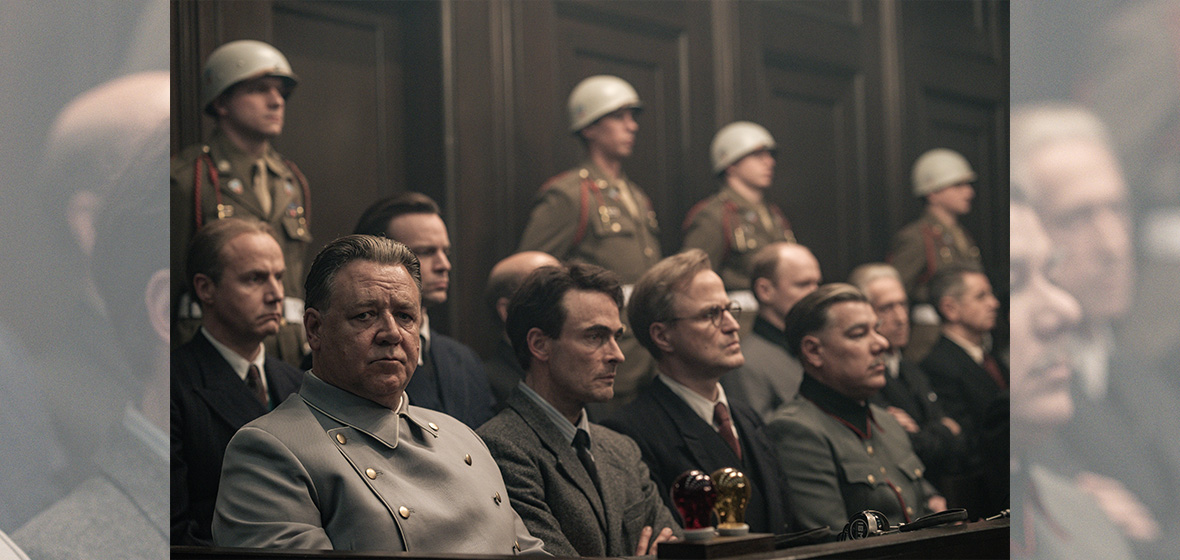
The story is framed around psychiatrist Douglas Kelly (Rami Malek), assigned by U.S. Supreme Court Justice Robert Jackson to oversee the incarceration of a series of high-ranking Nazi officers before their trial in Nuremberg. The official case is to ensure the prisoners do not take their own life before they must answer for their crimes, but Kelly takes this as an opportunity to analyse the men responsible for one of the biggest atrocities committed by humans. A perfect subject for a book and to understand if this was a case of collective madness, or something more complex. Central to his study is the big fish of the prisoners, Hermann Göring (Russel Crowe), who we first see being captured in a car with his family driving and willingly handing himself in to the authorities.
So, let’s be honest, the trial here is background noise. It encompasses the second half of the second act, and mostly to heighten some dramatic flair to Göring’s personality and the complications of Kelly’s research. The juice of the film is relegated to Kelly’s interactions with Göring and his fascination of how can a man, seemingly so normal and humanised, be involved in genocide? The film makes a good case for this approach and goes with Justice Jackson’s reasoning of why the men should face trial and not instantly be sentenced to death. The through line from Hannah Arendt’s “banality of evil” is puzzling to us even today, but while something like Jonathan Glazer’s Zone of Interest explored this idea with a minutia of an almost scientific lens, Nuremberg approaches only at surface-level. It’s all very cleaned and built on the shoulders of these fine actors, giving their best “prestige” performance. And what a cast it is. Crowe almost stands out by chewing the scenery with such determination he almost misses the point of Göring (which should be to be perceived as weak, charming and larger than life), Shannon should get more roles like this, he’s grounded like that, and a collection of critically-acclaimed actors stop by in small scenes in automatic, but effective mode, including Colin Hanks as a rival psychiatrist, Richard E. Grant as the British deputy chief prosecutor Sir David Maxwell-Fyfe, and John Slattery playing a no-fuss U.S. General, the most John Slattery role.
Nuremberg would’ve been the biggest film of the year in 1995, but even then, it wouldn’t have broken any boundaries. There’s something so old school about how it looks and plays, like this was an idea a studio had three decades ago, to be directed by a Ron Howard on top of his career or a Lasse Hallström campaigning for an Academy Award. But nowadays audiences have different appetites, especially in the award season, more focused on complex emotional variations and nuanced ideas.
So, Nuremberg is not a bad film, but it’s little above a historical editorialised account of one of the most important trials in human history. There are big ideas that resonate, but the film doesn’t explore them to the best of its capacity. In an important moment, the camera notes how the German Nazis react to the harrowing footage from the concentration camps. Watching that in 2025, it’s hard not to correlate to today, when war atrocities are spread on social media as they happen, and the people from the countries perpetrating them remain unfazed by the images, actively rationalising the events as if anything justifies the death of innocent lives. Kelly’s book blamed these men’s drive on ambition and nationalism. Nothing more banal than that.
Verdict: 3 out of 5
For dedicated fans of World War II historic accounts, especially the ones to do with the politics and not with combat. There’s a better film in this story to be made, but as far as re-enactments go, it’s not without its value.
Eternity
Artists obsessed with the afterlife are not a new thing. I have a theory about that. The process of artistic creation is inherently egocentric, and so is the concern that our existence is pointless and frivolous, and when it’s done, it’s done. What do you mean I experience something after life? Maybe I’m being unfair, but I think there’s something selfish about that thought of not accepting the never-ending void. As if the universe owed us something.
What’s even more interesting is how Hollywood likes to imagine the afterlife as a corporate nightmare of never-ending bureaucratic loopholes and, in Eternity’s case, a hotel with a fair where people try to sell you your own bespoke version of paradise. An eternity in a neo-liberal market on a capitalist corporate landscape? Just yeet me all the way to hell and be done with it.
Eternity starts with a lovely elderly couple, Joan (Betty Buckley) and Larry (Barry Primus) driving to their daughter’s place for the gender reveal party of their grandchild. With them they keep the secret that Joan is dying of cancer. During the party, it is Larry who dies, choking on a piece of pretzel.
He wakes up in the afterlife where we all look how we were when we were most happy, which in Larry’s case means he now looks like Miles Teller from when he first married Joan. Anna (Da’Vine Joy Randolph) is assigned to help Larry in this first step to the rest of his existence. He can stay in the hotel for one week, after which he’ll need to decide which eternity he wants to spend in, and there are many: one for smokers where cigarettes don’t harm you, an eternal cruise, beach world, one where no men are allowed (currently full as they are building a new one), one for Marxists, etc. The caveat is that when you choose one, you’ll stay there forever, and if you try to escape, you’ll be sent to the void and sentenced to an eternity of floating in the nothing.
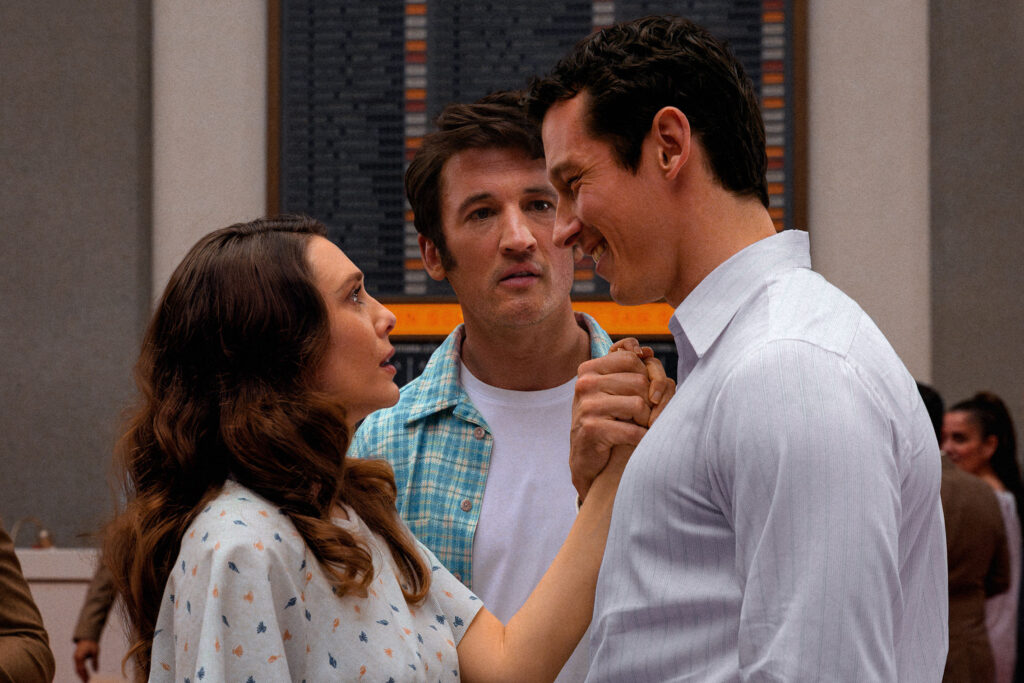
Larry doesn’t know what to pick because he, of course, wants to be with his wife, but eventually decides on one. On his way out he bumps into Joan arriving, now looking like Elizabeth Olsen. It seems like a perfect situation and the two can decide together where to go, until Joan’s assistant Ryan (John Early) makes a revelation, that Joan’s first husband who died in the war in Korea, Luke (Callum Turner) has never chosen a place and has been working in the hotel as a bartender waiting for Joan to arrive. It’s a simple dramatic problem, should Joan be with her first love, taken away from her too soon, who loved her so much he was happy to wait over six decades? Or the man who she formed a family with for better or worse?
As far as concepts go, this one is a simple and effective one. The moral issue behind Eternity is evident and the film takes some good turns to explore it. One of the solutions passes by Joan spending a day with each of the men on an eternity they chose, which of course leads to Joan spending a romantic time with the man she hasn’t seen for a long time, and cranky old couple time with the other one. But is love that elation of happiness, or the certainty to be with someone who understands you well enough to argue as much as listen?
Those are some simple ideas, but they are treated with care. Director David Freyne idealises the world of that hotel like a 1970s department store, which fits the strange uncanniness of the situation, but it’s complemented by a cinematography that mixes the grainy-ness of old 70s comedies, with the set-up of new high-end TV shows. Olsen, Teller and Callum take on their roles like they’re in a sitcom and in fact the whole film as the mood of light tv-episodic entertainment, and if we can appreciate a couple of episodes of a sitcom, nothing stops us from appreciating a film version of that.
Verdict: 3.5 out of 5
For anyone looking for effective light entertainment, this is a winner. No moral issues to be addressed, no big philosophical ideas, just a central romantic idea that frankly is more interesting than any of the stories in Love, actually.