
By Francisco Silva -
Sandy Mak came to Australia to study law and worked her way up to become one of the country’s leading mergers and acquisitions lawyers. From her offices overlooking Sydney Harbour, she tells the Journal how she accidentally found her calling, the importance of mentors, and how different the day of an M&A lawyer is.
The deal that convinced Sandy Mak she was on the right career path was a small transaction that most people came to forget. Today, Mak is one of Australia’s most accomplished mergers and acquisitions lawyers, the head of corporate at Corrs Chambers Westgarth, who oversees some of the highest-profile and large-scale deals in the country. Billions of dollars move across countries, continents and hemispheres. But it is this small transaction that Mak still vividly recalls. After a nasty interaction with the opposite firm, ASIC ruled in her team’s favour. “I remember when the mail came in, the collective screaming from everybody”, she says. “That’s when I remember thinking I really like the idea of doing this in a team. I like sharing. This is the closest thing to team sports I will ever have in my life.”
Much has flowed since then. Multi-billion dollar transactions, international mergers and high-profile acquisitions. She was part of CoStar’s lightning acquisition of Domain for $1.7 billion. She advised Coca-Cola European Partners PLC in its $11.1 billion acquisition of Coca-Cola Amatil Limited. She was instrumental in deals involving American, British, European and Asian companies. And yet, she returns to the memory of this earlier deal. “That initial one, that little tiny one that no one will ever have ever heard of or remember, was the one that made me think ‘I can see myself doing this’.”
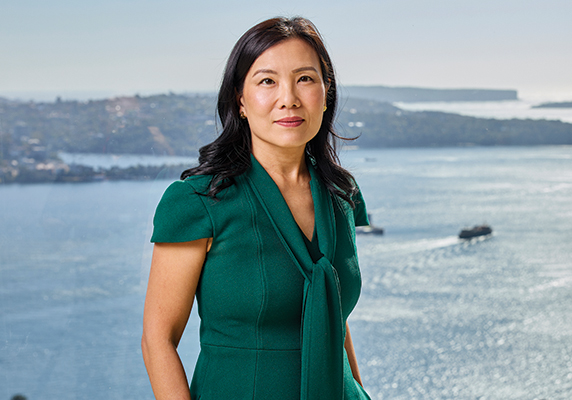
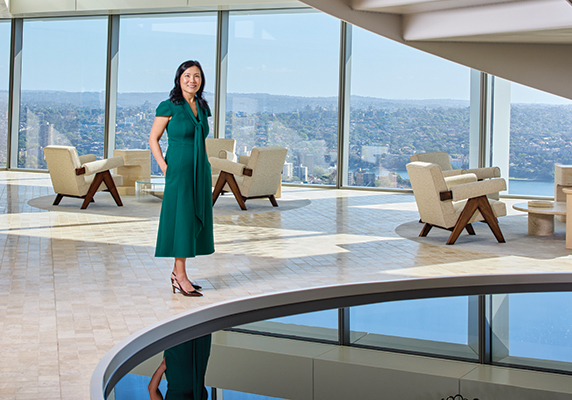
The offices of Corrs Chambers Westgarth are on the upper floors of the Quay Quarter Tower, the renovated AMP Centre building in Bridge Street, which was once Sydney’s tallest building. Their offices lean out towards the waterfront, and a stunning backdrop beckons. I was asked to sit in the foyer while we waited for Mak, but who could sit in front of this view? From up here, you can see the line of the horizon and a whole world beyond it. An apt metaphor for the work that happens here.
A happy accident
By her own admission, Mak’s story to get here was “a complete accident”. “I wanted to be a doctor,” she confesses. “[I]n high school I did physics, chemistry, biology, advanced mathematics, all the science subjects”. Mak grew up in Malaysia with her twin sister and younger sister. All three ended up moving to Sydney to study. First was Mak’s twin, who came for medical school and is now one of the country’s leading breast cancer surgeons (“the successful one,” jokes Mak). They travelled together their entire lives, always doing the same thing, but when Mak arrived in Sydney, she decided to take a different path. “I realised I liked the study of medicine, but I wasn’t so sure whether I wanted to practice medicine, and in my panic, I looked down at the next hardest thing to get into, and it was a combined law degree.” In the spur of the moment, she signed up for accounting and law at the University of New South Wales.
On the first day, Mak sat down for a microeconomics class and felt out of her depth. She didn’t know what a demand and supply curve was, yet people were talking about Keynes and monetary and fiscal policy. That night, she called her mother in Malaysia from a public telephone booth in tears, fearing she may have made the biggest mistake of her life.

It was a new world for Mak. Their youngest sister joined them in Australia to study in high school. At 19, the twins were not only university students in a foreign country, but guardians to their younger sister, attending lectures and parent-teacher conferences. Looking back, Mak confesses it forced them to grow up so quickly, but she didn’t feel that pressure at the time. The sisters have always been very close, and the experience of living alone at such a young age tightened the bond further.
Resilience spoke louder. Mak made friends with the student who sat next to her, who happened to have topped the state in the HSC. “I thought, you know what? I can do this. I can do whatever I set my mind to if I just try.” By the end of the course, she was top of the class in economics. Mak notices how, regardless of it all, she never really felt like she was struggling. She worked different jobs through university, lived a frugal life and benefited from essential government support, which she points out doesn’t exist anymore. “I really do feel for younger kids from less advantaged backgrounds trying to get through uni,” she says.
It was the law part of her degree that made a mark. Her world was science, and she found that law is word mathematics. Law concepts like social justice and the rule of law were foreign to her, so she had to rewire her brain to tune it to more philosophical notions. “But fundamentally,” she says, “law is analytical, and I am analytical, so there were bits of learning new things, and then bits of using skills [I had].”
She got a summer clerkship at a law firm where her talent caught the eye of Braddon Jolley, one of Australia’s best mergers and acquisitions (M&A) lawyers, who became a mentor to Mak and instilled in her a passion for this field of law. “I happened to be good at it. I happened to like it, so it was just luck to be honest. It wasn’t by intention or design, it just happened.”
“I honestly believe that if you find the right people to inspire you, and you are in an area that constantly pushes you and keeps you intellectually interested, you can be good at whatever, as long as you have effort and application and intellectual curiosity.”
Mak points out that the three sisters have very driven personalities, the kind that you either have or you don’t. “[I] never, in my wildest dreams, would have imagined that I would be where I am today, with this view, in this practice, with the leadership position that I have.” She never had a specific way of measuring success, neither financially nor a set career goal. Her approach has always been to look at the short term and how she can excel. “It’s just making sure that whatever I’m doing in the moment, I’m doing the best I can,” she says. “That gives me personal satisfaction”.
That is ultimately how Sandy Mak measures success, asking herself if she’s doing the best job she can. Recognition from her peers, new deal opportunities, and awards ultimately and naturally come with leadership. “I sit here today, and I look back at it. I’m just as surprised as the next person.”
Mak took the opportunity to expand her horizons by moving overseas for six years: four years in the Freshfields London office and two more in their Hong Kong office. The experience of working in one of the largest firms in the world, showed her the value of Australian talent. The deals here may be smaller, “but our investment banking community and our legal community are intellectually, creatively and work-ethically as driven as anyone in another jurisdiction that I’ve worked in.” Australian lawyers often leave for a period to find experience elsewhere in the world, and most of them return, while other countries may lose important talent to markets abroad.
On LinkedIn, Mak describes herself as “a lawyer with few borders”. There aren’t many East Asian women in M&A. Not growing up in Australia meant she had to forge her path without the opportunity offered by private school, private equity and investment banking connections. “I was just from [the] wrong background, wrong race, wrong gender.” Although she didn’t see herself as disadvantaged, it forced Mak to explore areas where traditional connections counted for less. That’s how she ended up in the international cross-border sphere. In those six years overseas, she established connections she could tap into and expand on her return. Today, she has a growing list of clients from the US, Europe, Singapore, and Hong Kong. The lack of connections in her upbringing was not a problem here; everyone fighting and pitching for work was on the same level playing field.

Mak was never concerned that she would be pigeonholed into specific work because of her race and gender. She credits her mentor for exposing her to a diverse portfolio of transactions. “Pigeonholing is a risk regardless of gender or race,” she says. Lawyers can end up in a particular area they struggle to get out of. “Now, if you love it, great. There’s nothing wrong with having a niche,” says Mak. “But if you’re not loving it … you need to back out of it relatively quickly before it gets too late.”
The student becomes the teacher
The relationship with Jolley was vital in Mak’s formative years as an M&A lawyer. The two even appeared together in an LSJ article about their mentor/mentee relationship (LSJ June 2014).
When Mak was abroad, Jolley called her every year to ask when was she thinking of returning. When she finally did, she joined his team at Herbert Smith Freehills, and two years later, when he moved to Corrs Chambers Westgarth, Mak followed him. “Our relationship is more than a mentor/mentee relationship,” she said in 2014. “It’s a sponsor relationship as well … If you look at Braddon and me, you couldn’t find two more different people. But we’re complementary and that’s what makes it so successful.”
One of those points of difference came right at the start of Mak’s career. She admits she was, at the time, a terrible team player. Jolley told her she was intellectually the most brilliant lawyer he’d ever come across, but the worst team player. It came down to the fact that Mak wouldn’t check in on him to see if he needed help. She replied this was a cultural difference, that it wasn’t normal for her to talk to the boss, and if he wanted something, he should ask her.
It was the nudge Mak needed to steer in the right direction. “I think a lot of partners have a role to play in setting expectations that they want from people and not making assumptions about people’s initiatives or motivations,” she continues. Mak believes transparency and dialogue are paramount in motivating new lawyers; if an issue arises, it can only be resolved with openness instead of passive-aggressive actions. “And look, sometimes genuinely there’s a mismatch of behaviours,” Mak concedes. “Maybe you’re not right for this platform or job, but sometimes it’s just a difference in expectation of behaviour.” With Jolley and Mak, it came down to just that one conversation, and after that, it was good again.
The move back to Australia was her sliding doors moment. Mak confesses she wouldn’t be here today if Jolley hadn’t insisted she return. “I don’t pretend that my entire career has been due to my intellectual ability, work ethic, or great legal prowess,” she says. “You have to have effort, application, and the technical ability to do this job, but where you go in life is also a function of the people you meet along the way, whether they take you under their wing or send you off in a certain direction.”
That said, Mak struggles to explain exactly what she looks for in an M&A lawyer. There’s a level of common sense specific to the person, an ability to mingle between the commercial and legal sides. Because at the core of it is supporting businesses and companies to achieve their goals, but it also requires a thorough knowledge of legal matters. Mak explains, “There’s a commercial overlay to how you weigh the risks against the commercial appetite to do the transaction. So, it is about a risk appetite, and lawyers that can stand back and understand that commercial overlay, tend to do really well in M&A.”
Dealing with takeovers requires a strong application of the law, panel rulings, ASIC regulatory guides, and strong project management skills. A lawyer must coordinate with multiple specialty groups from different practice areas and constantly interface with the client. And finally, there’s attitude, which Mak says is the first thing she looks for. “Just a real willingness to throw yourself into this and to be excited by it and have a passion for it. If you’ve got that, I think you’re already 50 per cent of the way there”.
The responsibility of leadership
Mak’s career is a remarkable collection of Australia’s highest-profile mergers and takeovers in the past decade. Her clients traverse energy, retail, multimedia, finance institutions and new technologies. But is there a difference in dealing with Coca-Cola in Europe, DAZN in London/Saudi Arabia or the ESR Group in Singapore? It’s about adjusting your style to better communicate with the different stakeholders. “The one commonality with this job, though, is that the cross-border nature means really unsociable hours”, Mak says. “My inbox starts in New Zealand and finishes on the West Coast of the US”.
Mak’s quietest day tends to be Mondays, because it’s still Sunday in most of the world. However, her Friday evenings and Saturdays are dedicated to synchronising with Europe and America. “That’s the price you pay for doing interesting, large cross-border transactions.”
The work is often unpredictable. Everything can change from the moment you receive an email. Hours can be unforgiving, and one simple phone call can occupy your entire month. The pressure is not only based on the timing and volume of work, but also the capacity to multitask and support clients. “You have to adjust priorities,” explains Mak. “And the art is saying to every client that [their] deal is the most important, because [for them] it is. If they’re doing a company-defining M&A transaction, that is the most important thing on their agenda. And even though you’ve got five or six of them going on at the same time, at no stage can they ever feel like they’re not your priority. That is a real skill set.”
This is where building a good team is essential. “You might be the figurehead of the team, but we all know that it is all of the other people in that team that are really driving this transaction,” Mak explains. “And that allows me to jump from deal to deal and really contribute at a strategic level.”
Mak sees recruiting as a priority of her leadership, not just to find the people with the right skill set but who will also complement the rest of the team.
M&A requires a level of dedication and sacrifice not everyone is willing to make.
While it’s important to keep spirits running high in the team, it’s impossible to please everyone. Mak’s philosophy is to lead by example. She built a coaching environment with more experienced lawyers to support others. If new hires struggle, they will receive guidance and support to upskill. “I always tell the young lawyers,” she explains, “remember this when you become more senior. It’s your turn to pay it back”.
Commitment trickles down. It’s fundamental that senior staff adopt attitudes that benefit those under their guidance. This includes understanding how much people’s circumstances and priorities change, how small issues can affect a colleague’s performance, and what that means to the rest of the team. There needs to be an open and transparent dialogue so they can better adapt to new situations and contexts. If the relationship isn’t working, then as a leader, Mak needs to have a transparent conversation about whether or not this is the right role for that person.
Mak believes that confrontation is where many partners fall short. “I have, over the years, come to this place where I’ve realised that anything done with kindness can be done. If this is not the right place for you to thrive as a professional, then that conversation can take place with kindness.”
This direct and candid approach is not threatening but rather empathetic. As a leader, Mak thinks not only about her team and the projects they are working on but also about the other person and whether their skills are best used. However, hand in hand with the pressure of the work comes the concern that it can lead to burnout and exhaustion. At Corrs, Mak says they allocate work and support each other. The firm has offices in Sydney, Melbourne, Perth, Brisbane, and Port Moresby and look internally for support whenever necessary.
They can spread the work between different offices to even out the workflow as much as possible. “The worst thing is a feeling of isolation, when you’re doing it by yourself,” she says. The team spirit is there to rally everyone and offer support. It gets them through those long nights working at three in the morning. Mak explains that if you feel supported, the harder aspects of the job are more palatable.
When you feel the weight of isolation, it all becomes demoralising. “It can be really overwhelming, terrifying and exhausting [but] as a partner, the buck stops with you,” she says. “If there are mistakes made, they’re your mistakes to own; you never throw the team under the bus. That’s one of the worst things you can possibly do to destroy morale within the team: not to stand up for your team members when things go badly.”
Mak confesses that others may look at her work-life balance with trepidation. “They’ll say I’m mad, but everyone thrives in their own form of madness,” she says. Her relationship with her children is wonderful, if different from other families, because she has less time to offer them than she would like. She talks about her children with beaming pride. Her career has made her miss out on important milestones, but she says that hasn’t affected her relationship with them. It comes down to what a parent must do to provide for a happy family. She admits she wouldn’t be a great stay-at-home parent. “I know myself, I would drive my children crazy. Sometimes they go, ’Mum’s got a lot of leave coming up … oh no, she’s going to want to do stuff every day now.’”
“The dynamic I have works for me and my family. It doesn’t work for everybody, but everyone has to find the thing that works for them internally with their own value set.”
Project management is people management
Dealing with takeovers and mergers involving large amounts of money can be daunting. But Mak admits that more money doesn’t generally mean more complex transactions. She points out that clients are usually more careful about their use when the amounts are smaller, and involve personal funds instead of corporate money.
The intricacies come when dealing with clients from other jurisdictions. Mak has perfected the art of giving the 101 to new clients. She has clean sheets that go out to all parties with all the information and the dos and don’ts when starting a public M&A transaction in Australia. “Because our rules are different to your rules,” she says. “You might accidentally trip up an association prohibition, you might trip up a disclosure on a substantial holder notice, and you’re not ready to disclose the deal to the market. The stuff you do inadvertently now can cause problems down the line.”

One of the biggest differences is Australia’s association rules, where two shareholders getting together and talking about a transaction can accidentally crystallise an association, which puts them in breach of Australia’s takeover rules and requires them to disclose to the market all their discussions. The US instead has disclosure letters, formal documents from the seller to the buyer disclosing important information about the business being sold. “In Australia, you disclose the whole data room against the representations and warranties,” Mak explains. “So, every document in this virtual data room is treated as being disclosed.”
This is where the project management skillset is extremely important. To maintain the pace of all the cogs functioning, from being on top of market intricacies and nuances about disclosures, to looking at exchange rates and hedging foreign currencies against the Australian Dollar, Mak’s team creates large and colour-coded checklists for the start and end of each day. This is essential when when contact with clients is restricted by different time zones. It leaves everything clear in writing, what needs to be done, what instructions are passed to the client, and where in the process they are currently. “[This] project management piece cannot be underestimated, and if you do it well, you get 24 hours around the clock done, rather than 12. If you do it badly, you lose days.” Not only does this help streamline the process, but it also reassures the client, who has been unavailable for the past 10 hours, that everything is in motion.
Instructions to the client vary in nature. They can be to read contracts or offer instructions about contracts, how they want to proceed on structuring issues, or what to do when there’s an uncooperative shareholder. There is a myriad of commercial and legal tasks that constantly need addressing. They have to ensure clients have what they need to make an informed decision.
Things can get particularly difficult at the tail-end of a merger when deals are close to being signed. Mak recalls Compagnie de Saint-Gobain’s $4.3 billion acquisition of CSR Limited, and the Coca-Cola European Partners PLC $11.1 billion acquisition of Coca-Cola Amatil Limited, when she was up all night, going through every outstanding item and getting instructions about the last details. “And then they go to sleep, and you have to carry on negotiating with the Australian firm on the other side during the day,” she explains. “It’s brutal. But to … get the deal over the line, you’ll have about a week of this life, and that’s hard. It’s about keeping morale and spirits up. Just enough sleep, rotating lawyers through the night-time cycle to get it across the line.”
Mak points to the importance of educating clients about the particulars of Australian law. Some clients not only have in-house legal but also a house firm to support them, so they work carefully with both teams to ensure the message is getting across to the commercial team. “We’re all lawyers; we all speak the same language.” These in-house teams are effectively translators to the other side and essential to explain the nuances flagged by Mak’s team.
The relationship with these legal teams is part of Mak’s joy in the job. She considers them as important as any corporate or private equity client. A passionate traveller, Mak has developed friendships with legal teams across the globe and enjoys meeting them in person. “Not every US corporation is going to do business with Australia again, but the law firm will do multiple deals, and they come back to us,” she proudly states. “And over time, these professional connections have become friendships, and that’s really satisfying.”

The certainty of the uncertain
While markets are increasingly global, the unpredictable geopolitical environment doesn’t faze Mak. “It’s deal by deal, and there’s a framework for it to happen, but it depends on the business and what they’re trying to achieve.” She notes that, contrary to expectations, Australia benefited from Donald Trump’s liberation day tariffs. Growth continues in areas where investors feel confident. In that sense, Australia and the Asia Pacific benefited.
Other industries remain highly affected by foreign interference. Mak singles out policies on critical minerals, conflicts in the Middle East and Ukraine, and rising gas and oil prices. She recalls a deal involving an oil and gas company when the war in Ukraine broke out, leading to a steep rise in crude and natural gas prices. “It was being voted on by shareholders in weeks, and the independent expert had to stop and reassess whether or not the deal was still fair because the price of oil and gas had gone up so much.”
Volatility is not good for M&A. Deals can be cancelled because of these changes, but when the system stops being so volatile, investors can reassess and try again. “Things just need to stabilise so that people can adjust their reward-risk analysis, or other metric relevant to them doing the transaction, to be able to take it forward,” says Mak.
Her prediction is that Australia will, for the time being, continue to be in a good position. She notes that American banks and law firms are currently bullish for US transactions as they believe Trump will change anti-trust regulations to allow for transactions that wouldn’t have been done in the past. But Mak also points out that when Trump was re-elected, the sentiment was that there would be an explosion of M&A, and then liberation day happened and the country had their worst quarter in years. “Everyone stopped doing stuff so they could work out the impact of the different tariffs around different sectors around the world.”
Though Mak is quick to point out she’s not an economist, she says she trusts the markets will remain solid but not necessarily bullish. “I still think private equity has got a lot of money that it needs to deploy and it needs to do something with.” In her opinion, the world is not yet seeing a rush of capital from private equity because there’s still a valuation gap between the buyer and seller. Still, she notes she’s starting to see a rise in mid-market deals ($100 to $500 million). Australian private equity is active though she’s not expecting five large high-profile transactions for 2026. “A boring prediction,” she says, but in today’s wave of woes, the reflection that we’re heading towards calmer waters is refreshing.
“I never, in my wildest dreams, would have imagined that I would be where I am today, with this view, in this practice, with the leadership position that I have.”
The stakes for the future
Australia has a role in maintaining and safeguarding the status quo. Mak wishes the government would help streamline the process and cut red tape, but she nevertheless sees the importance of regulation. In 2024, she was appointed to join the Takeover Panel, a peer review body that regulates transactions that involve Australian businesses. The new merger control regime coming into effect in January, will probably suffer from teething issues, but Mak hopes these changes will make mergers more efficient and user-friendly. “I have no issue with the policies and the desire to protect our national interests, [but] I really think our clients struggle with the burden or red tape, the compliance burden that comes with it, and the systems not working efficiently. I don’t have an issue with regulation per se, just the process of putting it on.”
When Mak isn’t overseeing large cross-border transactions, she lectures an undergraduate course at her Alma Mater, UNSW, and a master’s course at the University of Sydney. She loves teaching and believes it helps a lawyer hone their skills. She sees the new generation of lawyers as more competitive. There are more law schools and relatively few places in large firms. It’s cut-throat and highly competitive.
For example, Corr’s clerkship program attracts many more applications than the places available, and in their Sydney and Melbourne offices, only five per cent of applications are accepted. A way for a young lawyer to stand out is through how they work with artificial intelligence. Mak sees benefits in the technology to streamline and help lawyers do their work. Still, she’s worried this is making new lawyers complacent and hindering their ability to learn critical thinking.
She gives an example of a client sending a series of documents leading up to a conference call with bullet points of their concerns. AI can summarise the documents and highlight the sections of the document that are relevant to the client’s concerns. Mak still asks young lawyers to go through the documents to double-check if all the information is correct and maintain their ability to analyse critically. “Your brain is a muscle, and if you don’t exercise it in a particular way, it becomes weaker”, she says. This is part of what she sees as a good M&A lawyer: “someone that can see what the issue is, find a path for a client through all the noise, identify what really matters and how they’re going to deal with it.” This talent starts at a young age, synthesising information about what is and isn’t relevant. “If we outsource that to AI, then we are losing a particular skill, and that is what I worry about.”
When she’s not steering billion-dollar tankers through the treacherous waters of Australia’s transaction rules, Mak likes to paint abstract landscapes. We talk about some of her favourite art galleries, including the Prado Museum in Madrid. She tells us she prefers the small single artist museums.
The Joaquín Sorolla Museum, also in Madrid, the Frida Kahlo museum in Mexico City and the Wallace Collection in London. “I love those little ones which give you an insight into the artist’s life,” she shares. “They don’t have the most seminal pieces, but they’ll have a few things here and there, and you get an opportunity to really see what [the] artist was like.”
That search and curiosity is the crux of Mak. Because when most of us look for the bigger picture to understand the world around us, Mak finds the answers in the details.