
By Wendy Yang -
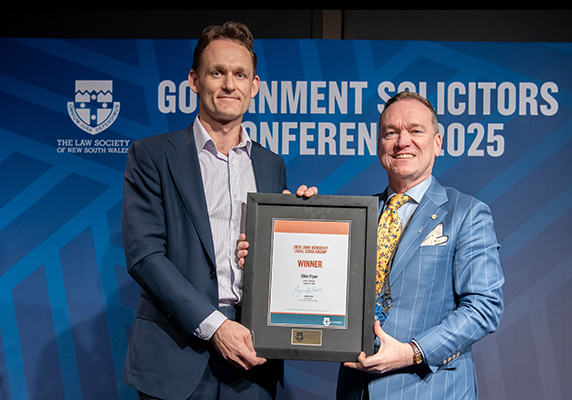
Winner of the Law Society of New South Wales’ John Hennessy Scholarship for 2025, Giles Fryer, spent eight months travelling around regional NSW investigating exploitative labour hire practices in regional NSW.
A lively coastal city on the NSW North Coast, Coffs Harbour is the centre of Australia’s lucrative berry industry. Social media and online job boards are filled with job ads for berry pickers. Enticed by attractive promises of “easy, well-paid farm work”, accommodation and transport, workers are lured to blueberry farms in Coffs Harbour and nearby regions.
Speaking to a migrant worker through an interpreter, Fryer details the experience of a young migrant worker chasing the “Australian dream”, and how quickly the dreams shattered as they were forced to live in mouldy and overcrowded conditions. Despite working long hours, workers often found themselves subjected to gruelling work for low pay that failed to add up.
When asked about his inspiration to investigate this topic, Fryer says he had seen how similar patterns repeated themselves, especially “shady employer structures, phoenixing activity, and directors abandoning companies mid-dispute”.
Fryer, who worked as a senior solicitor at the Workplace Rights Service at Legal Aid NSW for over five years, has helped hundreds of vulnerable migrant workers recoup unpaid wages and respond to unlawful treatment. “I wanted to understand how these operations actually work and why existing laws are insufficient to stop them,” he says.
“The scale of the problem is hard to overstate. In my team alone, we recovered $1.5 million for workers last year. We know that is just a fraction of the problem. …
“Multiple inquiries and reports over the last decade have found that rogue labour hire operators pose a serious risk of migrant worker exploitation, and the calls for stronger laws have been consistent,” he says.
He points out that NSW Parliament’s Modern Slavery Committee has spent the past year and a half investigating the risks faced by temporary migrant workers in regional NSW.
Fryer’s paper documents how a subgroup of labour hire providers in the horticulture sector systematically exploited temporary migrant workers in the Coffs Harbour and the Riverina regions. His research uncovered that operations were designed to exploit migrant workers and avoid regulatory scrutiny. He argues the labour hire licensing scheme in NSW should be based on Victoria’s. Fryer explains that the Labour Hire Authority in that state has reduced the total number of active providers in the horticulture industry through licensing refusals and cancellations. The system also operates on “full cost-recovery,” without financial assistance from the government.
Fryer travelled over 6000km across regional NSW and interstate, and interviewed workers through interpreters. He acknowledges that writing a paper for a more “general audience” took longer than he expected. “Getting the structure right, and resisting the urge to include everything, was the real challenge,” he says.
Fryer also gave evidence before the NSW Modern Slavery Committee on behalf of Legal Aid NSW. “Migrant worker exploitation is not a series of isolated incidents involving a few bad apples. Rather, there is a broader system of exploitation that targets migrant workers and is often hidden in plain sight,” he says.
“While licensing labour hire operators won’t solve everything, it will change the structure of the market. It keeps the worst operators out before they cause harm, rather than chasing them after the damage is done.”
He points out that licensing requirements will “penalise” businesses that participate in unlicensed labour hire and will also boost transparency and accountability.
“NSW is one of the last states without a scheme. It should not wait for exploitation to turn into tragedy to change that.”
To read the full paper, click here.