By Francisco Silva -
Director: Agnieszka Holland
Writers: Marek Epstein, Agnieszka Holland
Cast: Idan Weiss, Peter Kurth
I’m of the opinion that it’s almost virtually impossible to make a great biopic out of the life of a famous personality whose symbolism more often than not outlasts the work they’ve done. A Van Gogh, a Karl Marx, heck James Mangold found that out with his anaemic Bob Dylan biopic, and let’s not even get into this year’s Michael Jackson slop.
It’s an ungrateful task. Franz Kafka is the kind of personality whose character is bigger than the sum of its parts. Even someone who never read his work knows who he is and what he stands for. Kafkian is so banalised in popular culture, it completely lost its meaning. He is also continuously studied, argued, discussed and dissected by academics and artists, in a fruitless quest to figure out how to crack that one nut. As if a human could ever be so thoroughly figured out, let alone someone as complex as Franz Kafka.
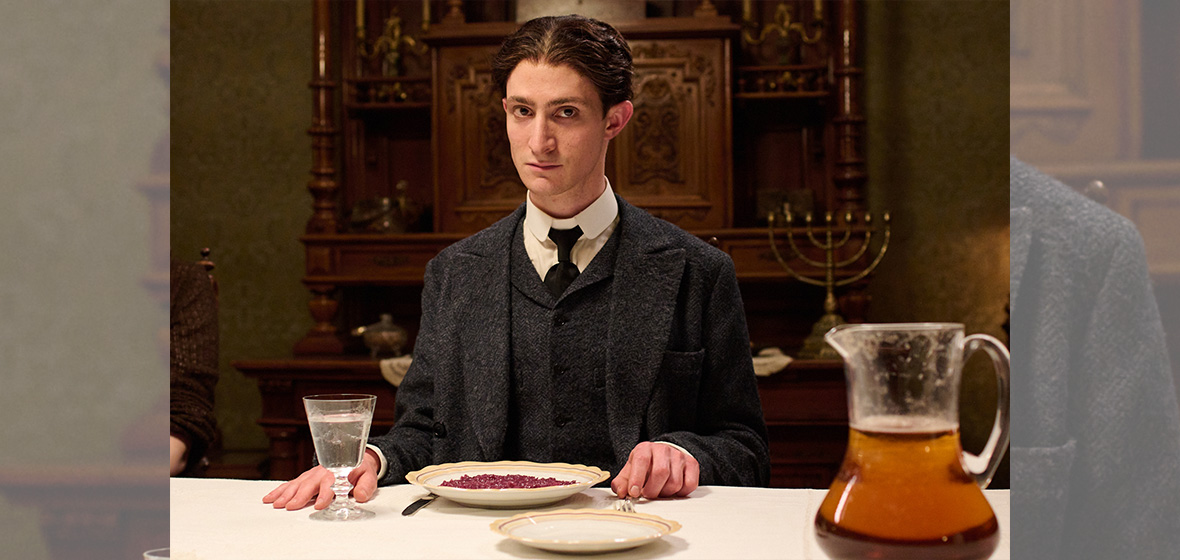
What filmmaker Agnieszka Holland does in this film is a curious exercise of intention. Holland is an incredibly experienced filmmaker with a flair for accessible experimentation. The script she wrote with Marek Epstein elevates that by jumping between different narrative frames. There’s Kafka as a child (Daniel Dongres), Kafka as an adult (Idan Weiss), mock talking heads of actors playing people in Kafka’s life explaining how they perceived them, parallel narratives and visualisations of Kafka’s stories and, in a motif that sometimes works and sometimes doesn’t, tour guides in modern Czechia telling tourists innocuous tales. The best of those is a Japanese tour guide showing “Kafka’s favourite place”, a piece of grass by the river where Kafka lied down after a swim (“we don’t know why?”), and the worst an American guide taking a group of tourists to a Kafka Burger restaurant (because Americans like burgers and people don’t really care about the writer, I guess).
The film mixes all these elements while piecing together the puzzle that is Kafka’s life, and it’s here that Holland and Epstein hit a roadblock. A lot of these events are narratively disconnected and only joined by a dwindling sense of psychological unravelling. Holland is curious about his relationship with his father and mother, the women in his life, how he’s received, accepted and derided by his peers, but doesn’t explore any of these issues long enough to extract any meaningful truths.
On the other hand, there are contradictory details left on the floor. Kafka’s politics are rarely explored, a fault when his books are at their core so political. A self-identified anarchist, he tended to despise the monarchy, so it’s confusing to see a scene where he tells an employee he wants to join the army to defend the monarchy. And even if he said that, the dichotomy between that statement and what he believed in, is a much more interesting idea than anything the film presents.
Unsurprisingly it all works as an experience. Holland is after all a terrific filmmaker, and I like how she incorporates Kafka’s relationship with his religion in the advent of the rise of Nazism that he fortunately never witnessed. Holland shoots most of the adult scenes with this swerving wide-angle lens that distorts a reality we assume as natural. She lets Weiss portray Kafka as someone with autism, an unproven theory about the writer but one that allows Holland and Weiss to approach the character through a more curious point of view. It’s completely different from Steven Soderbergh’s Kafka, with Jeremy Irons, that tried to convey visually and emotionally the incomprehensible world of the writer. If you’re a fan of Soderbergh’s film, this one may be too ordinary for you.
It makes sense the title alludes to Kafka’s first name and not the iconic surname. Another subtitle used in the same territories is Becoming Kafka which sounds redundant for a film that spans the entire life of the writer, but it also reminds us that he only becomes Kafka after he passes away and World War II. Franz is less about the story of the writer and more about our relationship with him. In which case mileage may vary.
Verdict: 3.5 out of 5
For big fans of Franz Kafka. Whether they like Holland’s take or not, they’ll have something to argue about, and I reckon nothing tickles Kafka-heads more.