By Francisco Silva -
Director: Kogonada
Writer: Seth Reiss
Cast: Colin Farrel, Margot Robbie, Phoebe Waller-Bridge, Kevin Kline, Jodie Turner-Smith, Hamish Linklater
My tolerance for sappy magical realism directly correlates to how self-aware the film is of its emotional bribery. In the case of Kogonada’s A Big Bold Beautiful Journey, I’m disappointed to say this film is not self-aware at all. In fact, it cranks up the whimsiness to such an extent that it goes beyond heartstring-tugging to reach a paradigm shift of sentimentality where sadness is only a state of mind for the pure at heart, weaponised to make me go “aww” but only making me go “urgh”.
How did we get here? Kogonada’s work looked to be immune to this kind of schmaltziness. Columbus was such a quiet and beguiling film about the healing aspect of connection in the face of family trauma on a backdrop of modernist architecture. It was so detached from the personal element that the characters were on the other side of a glass, so we could barely listen to their private conversation. Then After Yang was a heartbreaking modern science-fiction that went deep on grief and the significance of memory to what makes us human. Both films were measured, but in that slow-burning way: they hit the drums of our hearts with unprecedented intensity.
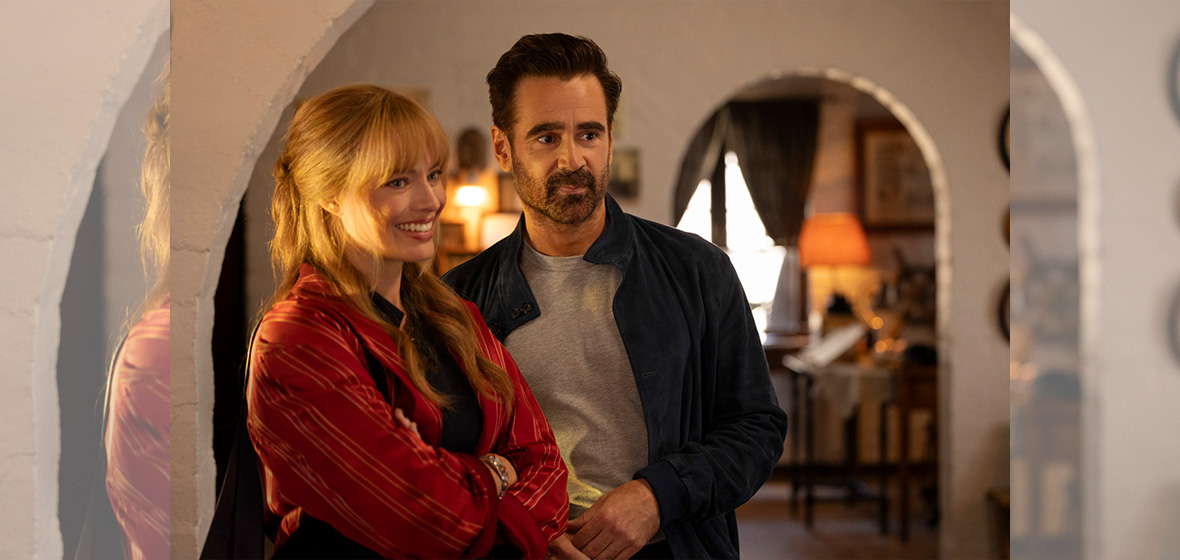
So why A Big Bold Beautiful Journey? This starts with David (a doe-eyed Colin Farrell), who rents a car from a mysterious and quirky car rental company, owned by two mysterious people (Kevin Kline and Phoebe Waller-Bridge with a fake German accent), to attend the wedding of a friend, where he meets Sarah (Margot Robbie), who also rented the car from the same company. The two flirt at the wedding, but it leads nowhere, mainly because Sarah admits she will eventually hurt David, and David is too stunted to even take a step forward.
But the following day, their car GPS (voiced by Jodie Turner-Smith) takes them on an adventure together, a long road trip through the countryside to meet several magical doors that bring them to essential moments of their lives. Moments like the day David was rejected by his high-school crush. Or a chance for Sarah to say goodbye to his dying mother, which she missed the first time because she was hooking up with a boy. The experience of sharing these important moments of their lives addresses the gaping wound both have to each other, and they may find love together.
Kogonada and writer Seth Reiss (who previously wrote The Menu) play with magic realism with a serious tone, which I suppose is the right way to go about these things. However, to be compelling protagonists, David and Sarah must be layered and complex characters. Instead, Reiss and Kogonada simplify them to the point of offence. David, an only child, is the product of overbearing parents who continuously told him he was a special boy (they struggled to have children before him), so that makes David hard to connect with when he is not the centre of attention. Sarah overcompensated for the absence of her father with oversexualisation, and always ends up cheating on her partners.
That’s it. That’s their crux. They are both trainwrecks. Charming and beautiful, but trainwrecks. What is shocking is how much more there should be to these people. I imagine Reiss sees some of David in him, because if he didn’t, he would’ve probably made him not only a spoiled brat, but one with unresolved anger issues or a tendency to emotional manipulation. After all, that’s the kind of guy he seems to be. Sarah wouldn’t just be a promiscuous lady with daddy issues, but one who embraced her liberation as her ethos, and not this martyrdom of “I will hurt you”, as if she’s doing him a favour.
Kogonada is a great visual director. Some of the shots here are meticulously done and evocative. However, there was subtlety in his other films that complemented his overtly beautiful style. Here, it adds nothing to a script that is already too bootlicking to its characters. It confuses darkness with tragedy. The private moments he avoided so well in Columbus are front and centre, and in the end, they bring nothing new to our story.
So, the conclusion is expected. David and Sarah need to learn how to surpass the tiny little knee-high obstacle in front of them, and realise their relationship is worth it, even if it doesn’t work. And honestly, I hope it doesn’t. I don’t think they learn anything from it.
It’s ironic that halfway through the film, I thought Kogonada would drop a sappy needle drop near the end, and lo and behold, Bright Eyes’ First Day Of My Life played. It is not a bad song; the indie millennials may remember the music video where couples listened to the song together and looked at each other in love and wonder. Maybe if you were a girl in university in the early 00s, a guy tried to set the mood by playing the song to you one night. It reminds me of Bob Dylan’s Don’t Think Twice It’s Alright, maybe because they’re usually at the same key and have two opposing sides to a journey. The first is about the beginning of a relationship (this is the first day of my life // I swear I was blind before I met you), while Dylan is about the end. And in a way, this would’ve at least been a gutsiest way to finish the film. “I ain’t saying you treated me unkind // you could’ve done better but I don’t mind // you just kinda wasted my precious time // but don’t think twice it’s alright”.
Verdict: 2 out of 5
For hopeless romantics who can overlook all the gaps for a good emotional payoff. Definitely not for those who liked Kogonada’s previous films. It’s as beautifully directed as those, but misses that measured subtlety. And what a difference that makes.
Ticket giveaway – The Strangers 2
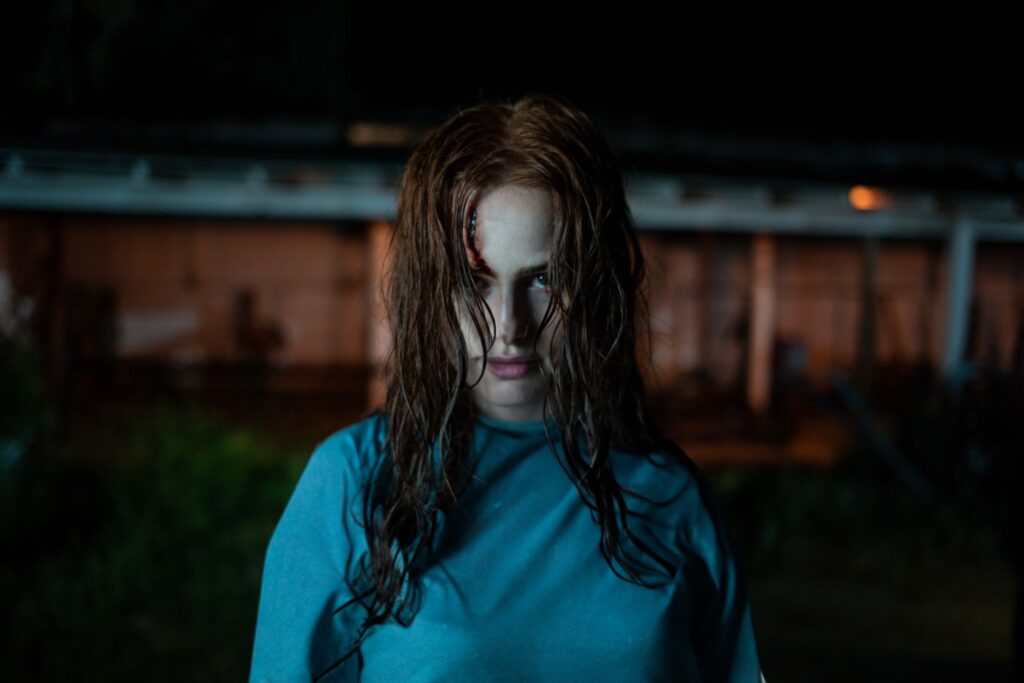
LSJ and Kismet films have 5 double passes for the upcoming horror film THE STRANGERS 2.
The Strangers are back to finish what they started. She survived the first night. But the absolute terror is just beginning. In cinemas 25 September. Watch the trailer here.
To win one of the double passes, email journal@lawsociety.com.au with the subject line THE STRANGERS 2 before the end of the day on Tuesday 23 September.