
By Simon Henderson -
For decades, civil society in Japan has been campaigning for greater dignity and equality, as part of efforts to combat discrimination and racism. However, these efforts have received limited attention outside of Japan. At the forefront of these campaigning efforts have been persistent calls for law reform and stronger institutional protections, bound by Japan’s international human rights law commitments.
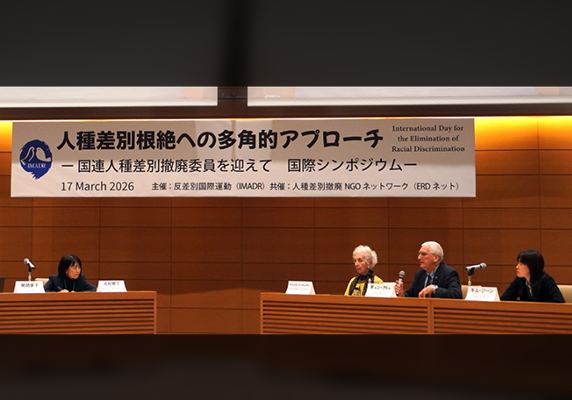
On 16 and 17 March 2026, civil society organisations from across Japan, representatives of the United Nations Committee on the Elimination of Racial Discrimination (CERD), as well as partner civil society organisations from South Korea, came together in Tokyo. The two-day meeting was organised by the International Movement Against All Forms of Discrimination and Racism (IMADR) in cooperation with the Japan NGO Network for the Elimination of Racial Discrimination (ERD Net). Its purpose was to commemorate the International Day for the Elimination of Racial Discrimination, the 60th anniversary of the International Convention on the Elimination of Racial Discrimination (ICERD) and the 30th anniversary of Japan’s accession to ICERD. The author of this article was invited to attend.
Legislative and policy gaps in Japan targeting racial discrimination
Racial discrimination against Buraku people, the Ainu people, people of Ryukyu and Okinawa, ethnic Koreans, immigrants and refugees, are prominent issues in Japan. Discrimination against these groups dates backs many decades, and in some cases centuries.
For example, the experiences of the Ainu people, an Indigenous ethnic group from the northern part of Japan, reflect that of many Indigenous peoples across the world, including in Australia. The Ainu people were subject to forced assimilation during the Japanese colonisation of Hokkaido since the late 1700s. By 1899, the Hokkaido Former Aborigines Protection Act was used to give legal effect to the assimilation process. Many Ainu people were forced off their land, unable to practice their religion, and forbidden from speaking their language. These practices led to widespread poverty and starvation, with a gap in living standards among the Ainu people continuing to persist. While the Japanese government has made efforts to protect and promote the rights of Ainu people more recent years, cases of discrimination against Ainu in employment, education, and access to public services continue. Meanwhile, gaps in the protection of land and natural resource rights, and the linguistic and cultural heritage of the Ainu people persist.
There also continues to be insufficient participation of Ainu people in policy-making processes concerning Ainu people. Notably, it was not until 1997 that the discriminatory Hokkaido Former Aborigines Protection Act was fully repealed, and until 2008 that the Japanese Diet (the nation’s parliament) passed a resolution recognising that the Ainu were an Indigenous people with their own language, religion, and culture. Recent legislative measures have highlighted the continuing gaps in ensuring that the dignity and rights of the Ainu peoples are protected and promoted in law. The passage of the Act on Promoting Measures to Achieve a Society in which the Pride of Ainu People is Respected in 2019 has attracted criticism, with Ainu peoples expressing concerns that the law concentrates on their cultural rights rather than their fundamental rights as Indigenous peoples.
… the growing use of xenophobic sentiment in various areas of Japanese society, including by political parties, has further spurred on the pressing need for legislative and policy reforms to be implemented.
It is in this context of structural discrimination and colonial legacies, that civil society organisations representing communities impacted by racism and discrimination in Japan have persistently advocated for much needed reforms. The accession of Japan to the ICERD in 1995 provided further impetus to ensure that the Japanese government abided by its international human rights obligations under the treaty. More recently, the growing use of xenophobic sentiment in various areas of Japanese society, including by political parties, has further spurred on the pressing need for legislative and policy reforms to be implemented.
Several key institutional measures to combat racial discrimination, that might be expected in a modern liberal democracy, are missing in Japan. Japan has no national human rights institution with a broad mandate to promote and protect human rights. The Japanese government has failed to enact comprehensive anti-discrimination legislation prohibiting direct and indirect racial discrimination, in line with articles 1 and 2 of ICERD. Neither is there a centralised independent individual complaint mechanism to assist in providing remedies. Furthermore, there is no national Japanese policy to prohibit and eliminate racial discrimination.
In 2016, the Japanese government adopted the Act on the Promotion of Efforts to Eliminate Unfair Discriminatory Speech and Behaviour against Persons Originating from Outside Japan (Hate Speech Elimination Act). While the Hate Speech Elimination Act was a welcome measure, it has substantial gaps which civil society groups have called to be addressed. The scope of the law is narrow, in that it is limited to hate speech towards persons “lawfully residing in Japan”. Furthermore, evidence to date has shown that hate crimes are not being consistently investigated and prosecuted, with public officials and private individuals continuing to remain unaccountable for racist hate speech and hate crimes. The lack of remedies, including specific penalties for violations, demonstrate the need for greater deterrence to combat racial discrimination.
In the space left by these national level gaps, some local governments have acted. In 2020, Kawasaki City introduced an ordinance penalising people who repeatedly use hate speech in public spaces, with potential fines of up to 500,000 yen. Yet, such measures remain limited across Japan. Meanwhile, hate speech remains a prominent issue. For example, hate speech against Kurdish people living in Japan has escalated in recent years, with several incidents in Kawaguchi, north of Tokyo, during public rallies. Ethnic Koreans, including those who are colonial-era migrants and their descendants, have also been a consistent target of hate speech. Many ethnic Koreans are considered “special permanent residents” and are not granted the right to vote. Arson attacks, racist graffiti, and harassment by nationalist and racist groups have persisted. Racial profiling of foreign nationals has also received a growing amount of attention, with data showcasing a stark divide. In a 2025 survey, about 70 per cent of foreign nationals in Japan said they had been subjected to police questioning on the streets in the past five years, nearly six times more than Japanese nationals. This has led to civil legal action by Japanese residents of overseas ancestry challenging persistent police discrimination.
Outcomes from Japan’s reporting ICERD reporting requirements
Japan’s last consideration before the CERD Committee was its combined tenth and eleventh periodic reports in 2018. The concluding observations from the CERD Committee highlighted how several recommendations from its previous 2014 concluding observations remain unimplemented.
One of the primary areas identified by the CERD Committee requiring action was the need for a legal framework on racial discrimination. Japan’s definition of racial discrimination in the Constitution is still not in line with article 1 of ICERD. Article 14 of Japan’s Constitution guarantees equality and prohibits discrimination in political, economic, or social relations based on “race, creed, sex, social status or family origin”. However, it does not explicitly include grounds of national or ethnic origin, colour, or descent. Furthermore, reflecting longstanding civil society concerns, the CERD Committee noted the ongoing lack of comprehensive legislation prohibiting direct and indirect racial discrimination, as well as a lack of a national human rights institution.
Recalling previous recommendations made towards Japan and General Recommendation 35 on combatting racist hate speech, the CERD Committee’s 2018 concluding observations called for the Japanese government to implement a series of further measures, such as:
- amendment of the Hate Speech Elimination Act to ensure that it has the proper scope, covers hate speech against any person and provides sufficient remedies for persons belonging to ethnic minorities;
- investigation and the application of appropriate sanctions for hate crimes, racist hate speech and incitement to hatred by private individuals or public officials, including politicians and media professionals;
- provide statistics on investigations, prosecutions and convictions, disaggregated by the national origin and ethnicity of the victims; and
- enactment of an action plan to eliminate hate crimes, hate speech and incitement to violence with concrete goals and measures and appropriate monitoring.
Reflections from representatives at the IMADR event on 16-17 March 2026
In December 2025, the CERD Committee published the list of issues prior for Japan’s combined 12th to 14th periodic reports under ICERD. This document provides a set of questions around specific human rights issues for Japan to respond to, as well as informing civil society organisations on the key issues that will be addressed during the review process. It was in this context that civil society representatives came together on 16 and 17 March 2026, consulted with CERD Committee representatives, made strategic plans, and considered how best to pressure the Japanese government to change its current approach. A diverse range of organisations were represented, such as the Human Rights Association for Korean Residents in Japan, the Citizens’ Diplomatic Centre for the Rights of Indigenous Peoples, Buraku Liberation League, Japan Association for Refugees, Japan Federation of Bar Associations (JFBA), the Japan Network towards Human Rights Legislation for Non-Japanese Nationals and Ethnic Minorities, Solidarity Network with Migrants Japan, among others.
Concerns as to how the ‘issue of foreigners’ was being discussed in the public sphere as a social problem featured prominently.
On the first day, civil society organisations discussed the slow progress towards the implementation of ICERD in Japan. The lack of action and political will by the Japanese government in addressing racial discrimination was a key focus. Concerns as to how the ‘issue of foreigners’ was being discussed in the public sphere as a social problem featured prominently. This was noted by participants as having a negative influence on local government policies, such as in the case of Ibaraki prefecture, where, starting in May 2026, a reward system has been introduced for tips on businesses employing illegal foreign workers. Additionally, the 2023 amendments to the Immigration Control and Refugee Recognition Act, which attracted concerns by United Nations special rapporteurs, were also highlighted. The legislative measures were introduced due to concerns of abuse of the refugee determination system, even though Japan’s refugee recognition rate remains extremely low. These developments were seen as a reflection of several retrograde steps by Japanese and provincial level governments.
Gün Kut, a member of the CERD Committee who attended the two-day event, highlighted the important role that the CERD Committee has in identifying the problem of racial discrimination and how best to ensure compliance with the ICERD, including drawing upon the comparative expertise of its members. Key to achieving change, according to Commissioner Kut, is “political will” to work on the elimination of discrimination. Commissioner Kut expressed concerns with how the Japanese government had dismissed recommendations from the CERD Committee as non-binding, rather that engaging constructively with civil society organisations on implementation of the CERD Committee’s recommendations.
On the second day of the event, attendees met at the International Convention Hall of the Parliament Members Office Building. It was marked by a greater emphasis on international comparative approaches towards tackling racial discrimination, considering examples in South Korea, Ireland, and across Asia. Representatives from the Office of the High Commissioner for Human Rights delivered an address, highlighting the indispensable role of civil society, working in collaboration with policymakers, researchers and educational institutions. Domestic stakeholders outlined the steps that they were taking to fight against racial discrimination. For example, the JFBA discussed their open letter calling for the enactment of legislation prohibiting discriminatory speech and behaviour based on race. The open letter highlights the need for the establishment of an independent specialised body, fact-finding investigations, online monitoring, litigation support, administrative sanctions and remedies.
The location of the second day’s event within the Parliament Members Office Building, provided an opportunity for politicians to attend. Several opposition members joined and provided short statements to the civil society representatives. Some of those representatives recognised the concerning rise in xenophobic statements in Japan, including by political parties and politicians. However, unfortunately, no representatives from the ruling party in government, the Liberal Democratic Party, was in attendance.
Civil society organisations concluded the event by issuing a “Declaration for the Future”. The Declaration for the Future outlines the growing concerns towards the increasing use of xenophobia in Japan. Highlighting the inadequate legal framework to prevent discrimination and exclusion by public authorities, it calls for legislative and policy reforms to ensure that their human rights are better protected. The Declaration for the Future provides a message of intent and ambition, ahead of Japan’s next reporting cycle under the ICERD.
Opportunities for strengthening Australia-Japan collaboration on combatting racial discrimination
While Australia has its own long-standing challenges when it comes to combatting racial discrimination, some of the institutional mechanisms that Japanese civil society are seeking are present in Australia. In 2026, as Australia and Japan celebrate the 50th anniversary of the Basic Treaty of Friendship and Cooperation, it is timely to explore ways in which Australian civil society, the Australian Human Rights Commission, the legal community, the Australia-Japan Foundation, and the Australian government, could share experiences in combatting discrimination and racism. Doing so would reflect the approach that the Australian government has taken towards racial discrimination in Japan. During Japan’s Fourth Cycle Universal Periodic Review in 2023, the Australian government called on the Japanese government to expand the scope of the Hate Speech Elimination Act to prohibit discrimination on the grounds of race, ethnicity, sexual orientation and gender identity. Additionally, the Australian government called on Japan to establish a national human rights institution, ensuring its full compliance with the Paris Principles. Exploring opportunities for greater bilateral cooperation, would be consistent with the intent and purpose of ICERD, which creates a legal binding framework for states to cooperate in the elimination of racial discrimination.
Conclusion
Japanese civil society has long been at the forefront of advocacy and campaigning for legislative and policy measures to combat racial discrimination. To date, this pressure has led to change, yet much needed legislative reform and policy changes have remained out of reach. Disappointingly, recent years have seen several steps backwards in efforts to eliminate racial discrimination.
Japanese civil society hope that the upcoming ICERD review provides a better opportunity to shine a light on their longstanding advocacy and campaign activities. The recent launch by civil society organisations of the “No to Hate!” campaign also aims to bring more attention on the need for legislative reforms and call upon the Japanese government to uphold its obligations under international treaties. The international community, including those in Australia, have greater potential to act as allies, providing support for Japanese civil society organisations in their struggle. Pressure on the Japanese government to abide by their international human rights obligations under ICERD will and should continue.
Simon Henderson is an international human rights lawyer, foreign policy analyst, and academic, with experience across the Asia-Pacific. He is a Visiting Lecturer at Chuo University in the Faculty of Law. Simon is a member of the Law Society of New South Wales Human Rights Committee.