

By Cat Woods -
This year, the National Justice Project teamed with Jumbunna Institute for Indigenous Education and Research to host LawHack 2026. The competitors spanned some of the biggest NSW firms, and included Shine Lawyers, Hicksons, Wotton Kearney and Macquarie University.
The National Justice Project, presently led by George Newhouse, teamed with Jumbunna Institute for Indigenous Education and Research. Located within The University of Technology Sydney (UTS), Jumbunna Institute aims to produce the highest quality research on Indigenous legal and policy issues and to develop highly skilled Indigenous researchers.
The winning pitch from Gadens took out the legal innovation challenge prize for their proposed climate justice compensation scheme that expands corporate liability for climate damage, providing emissions-affected communities with remedies.
Ashleigh Buckett and Emma Hearne are the Principal Solicitors at the National Justice Project (NJP). Buckett says, “The purpose of LawHack is to create a space that enables creative, bold, innovative legal strategy development to critical issues of our time, and LawHack 2026 brought together teams of legal professionals to develop strategies to advance climate justice.”
Teams were allocated one of six questions on the theme of climate justice and tasked with developing a legal strategy with the support of mentors, then pitching the strategy to a panel of experts.
The scheme proposed by Gadens simplifies the pathways communities have to claim compensation for the impacts of corporate emissions. This year’s winning team from Gadens comprised Partner, Matthew Taylor; Senior Associate, Sharna White; and lawyer Audrey Daoud.
The Gadens solution would involve amending the National Greenhouse and Energy Reporting Act to cover scope 3 emissions – indirect emissions from company supply chains. It would also broaden civil penalty provisions to hold more organisations accountable for climate harm.
“… that experience was shared around our firm, driving further interest and motivation from people wanting to get involved.”
Importantly, claiming compensation would no longer require communities to file individual suits through a regulatory compensation scheme, as is presently the case. Gadens’ proposed climate justice compensation scheme would require that funds from civil penalties would be held in trust and issued to local communities affected by emissions violations.
Matthew Taylor says, “Gadens has been involved in LawHack for some years now. Our experience at the previous LawHack, which focused on Indigenous Australians, was genuinely rewarding – and that experience was shared around our firm, driving further interest and motivation from people wanting to get involved.”
Taylor explains that the appeal of LawHack is both the opportunity to look beyond the day-to-day challenges of practice work, and the willingness of LawHack to tackle prescient and important issues, and that finding resolutions “challenges our legal thinking and exposes us to novel ways of driving reform.”
Gadens’ team took part in an event that has established trust and credibility in the legal and academic sphere over the last five years. LawHack was founded in September 2021, bringing together students and professionals to cooperatively provide practicable solutions to systemic injustice in Australia. The initiative was styled on the “hackathon” concept (hacking a problem creatively under marathon-like conditions), which typically focus upon competitive innovation within a day to two-day period. There are similar events globally, such as the EduX Oceania Hackathon, Disrupting Law (run by The Legal Forecast), or the US-based LegalTechTalk Hackathon.
Buckett says, “The National Justice Project created LawHack in lieu of an annual fundraiser event, with the hope of sharing our love of strategic thinking, strengthening our working relationship with our partner firms and coming up with tangible legal strategies that anyone can use to effect change. All of the ideas generated are open source and publicly available and we hope that they will be picked up and run with.”
LawHack 2026 unites great minds on troubling challenges
Buckett says, “It is easy to feel overwhelmed by the climate crisis and its human rights impacts but coming together to work on solutions inspires a sense of hope. The legal sector can and should play an important role in supporting impacted communities to seek accountability and effect change, and hopefully the information exchanged and ideas generated at LawHack can contribute to these efforts.”
Taylor says, “Gadens recognises the importance of climate justice, and the devastating impacts that climate change is having on disadvantaged communities both domestically and overseas, particularly smaller low-lying island populations. Climate change and disaster response is one of the focus areas of our firm’s new pro bono strategy, so when LawHack 2026 centred on the climate crisis, it was a natural fit.”
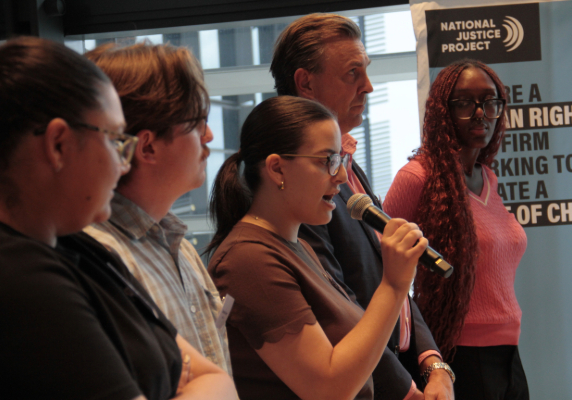
LawHack 2026 united 30 participants in an effort to provide solutions to the negative consequences of climate change. The teams comprised of legal experts from Hicksons, Gadens, Shine Lawyers, Grata Fund, Wotton Kearney, Macquarie University and the National Justice Project. They spent the day developing and refining ideas supported by a group of mentors.
Amongst them, experts Katrina Bullock, Professor Beth Goldblatt and Dr Keely Boom, worked alongside the participants to test ideas and offer insights to evolve and refine the final pitches.
Buckett says, “We are grateful to the law firms and institutions that support and participate in LawHack and hope it has been rewarding for them to engage with the topic and strengthen their relationships with the other participants. I think it is fair to say that as lawyers we all enjoyed the competition.”
Billable hours versus incomparable experience
As employees with billable hours, lawyers inevitably need to weigh up the investment of their time and efforts towards an unpaid competition. Audrey Daoud believes the value gained from taking part in LawHack is worth it.
She says, “Our firm actively supported our participation. Gadens recognises that initiatives like LawHack deliver value that goes well beyond billable hours – they sharpen our thinking, build collaboration across practice areas, and connect us with issues that matter to the communities we serve.”
The value the trio gained was significant.


“It stretches us to think creatively, work under time pressure on unfamiliar issues, and collaborate across disciplines.”
“We learnt lessons outside of the strictly legal doctrines we’re accustomed to in daily work, including understanding key environmental law reform bodies, how those organisations function, and how to effectively lobby governments for change. Having a great idea was one thing; being able to sell that idea to drive meaningful reform was quite another.”
She adds, “This kind of work builds better lawyers. It stretches us to think creatively, work under time pressure on unfamiliar issues, and collaborate across disciplines. That’s an investment worth making.”
The six pillars it takes to win
The pitches were ultimately presented to two judges, Dr Bal Kama and Dr Marcelle Burns, who are leading voices in human rights, law and climate justice. Kama has a well-established career in public law, constitutional law, human rights, and climate justice. Burns is a Gomeroi-Kamilaroi woman and the Associate Dean of Indigenous Leadership and Engagement in the Faculty of Law at the UTS. Over more than 25 years, she has championed First Nations justice as both a lawyer and an academic.
The judging criteria followed an appropriate acronym, “CHANGE”.
Change: Bold and strategic, showing potential to change the status quo (law, policy, culture and public perception).
Humility: Respects people with lived experience as experts, drivers, and catalysts of change.
Achievable: Clearly defined plan and strategy to make change.
Novel: Using legal action and advocacy in original, creative and innovative ways.
Grounded: Grounded in lived experience by addressing barriers of discrimination and injustice, in particular multi-layered disadvantage and discrimination
Evidence: Informed by research, data and evidence of need.
Of the diverse pitches, one team focused on the disproportionate impact of extreme weather on people with disability, so their pitch proposed legal pathways to improve access to evacuation, housing and recovery support.
Another team pitched a Climate Collaboration Hub to educate and support lawyers to layer climate-conscious thinking into their everyday work. Other teams explored solutions to break down barriers to justice for communities most affected by climate change, such as those on the poverty line, nearby to shorelines or in remote regions of Australia.
Good ideas turn into practical tools
Buckett recalls, “Our first hackathon in 2021 focused on disability justice. Some of the ideas generated inspired our work on Alternative First Responders, which is now a nationwide campaign led by NJP’s Projects & Innovation team calling for society to reimagine how we respond to people in need and to invest in solutions as diverse as our communities.”
Taylor explains that their winning scheme proposed targeted amendments to the National Greenhouse and Energy Reporting Act 2007 (Cth), expanding the definition of “emissions” to include scope 3 indirect emissions and creating a mechanism for affected individuals in close proximity to large-emitting facilities to access compensation from a fund.
The judges described the idea as “big, bold, and deeply informed by research”, and Taylor agrees that it has genuine potential to shape industry practice.
“We’re keen to explore the right channels to advance this work, whether that’s through engagement with government on legislative reform, contributing to broader policy conversations, or sharing insights at industry and academic forums,” he says.
“What LawHack taught us is that having the idea is only the starting point. Understanding the reform landscape – the key bodies, how they function, and how to effectively advocate for change – is what turns a concept into impact. We’re committed to keeping that momentum going.”
As a team, Taylor, Daoud, and White agreed that LawHack challenged them to step outside their usual practice areas and think differently about the law’s role in addressing systemic issues, and issues that are also pertinent to their practice.
“While most of our team came from our Construction and Disputes & Investigations practices, the challenge pushed us to engage deeply with climate law, international treaties, and legislative reform, areas we don’t typically encounter day-to-day,” says Sharna White.
The collaboration between the team members and their mentors was invaluable, too.
White says, “Working alongside mentors who are leaders in climate and Indigenous law – including Dr Keely Boom, Professor Beth Goldblatt, and Katrina Bullock – gave us access to expertise and perspectives that enriched our approach.”
LawHack also connected legal professionals from other firms and academia, building relationships across the profession.
White says, “From an innovation perspective, LawHack demonstrated that creative solutions emerge when you bring together people with different expertise and give them space to challenge conventional thinking. Our team considered multiple approaches before landing on the compensation scheme; including a statutory duty of care and leveraging existing legislation in novel ways. That process of testing, refining, and adapting ideas is exactly the kind of thinking that makes us sharper in our client work.”
As for future events, White is unequivocal in recommending the challenge to other firms and academics.
“We’re still talking about the experience, and we’d encourage other firms to get involved. It provides an opportunity to challenge yourself and come up with creative solutions to relevant and real human rights issues.”
The NJP has further information about LawHack 2026, prior events, and the pitches available on their site or by request. For lawyers and firms with an interest in how they can be involved in future LawHacks, please contact NJP at info@justice.org.au.