
By Karl Hoerr -
For decades, Karen Cox has been a fierce advocate for people living on the margins. After 25 years with the Financial Rights Legal Centre, she’ll soon step down as CEO. Cox has helped secure key protections and reform to financial services law and explains to the Journal why this area requires constant vigilance.
It’s a slightly cooler than average March day in Melbourne, where the Royal Commission into Misconduct in the Banking, Superannuation and Financial Services Industry is getting underway. It’s 2018 and there’s some light rain about on this Tuesday. Senior Counsel Assisting Rowena Orr QC is about to call the inquiry’s first witness, Coordinator of the Financial Rights Legal Centre, Karen Cox. The proceedings, inside Melbourne’s Commonwealth Law Courts Building on William St, are being live-streamed.
How does it feel? “To be honest, terrifying,” Cox now concedes. It’s just after midday when she enters the witness box, the inquiry having earlier heard opening addresses from Commissioner Kenneth Hayne AC QC and from Senior Counsel Assisting. The Royal Commission is the culmination of years of political pressure, countless examples of shameful corporate behaviour and diminishing public confidence in the sector. When she steps up to approach the stand, Cox inadvertently leaves her handbag behind. Inside the bag are her glasses.
“For quite a while, it didn’t matter at all, because by that time, I knew my own statement inside out. It was all stuff I knew pretty well anyway,” Cox explains. That changes when Orr refers the witness to a particular paragraph of her statement. “I was sitting there, turning pages … (paragraph) 37, what was 37 about? Because I was way too embarrassed and overawed by the circumstances … I never said, ‘I can’t see, my glasses are over there,’ which feels really silly in retrospect, but at the time, it just felt like that wasn’t an option,” Cox recalls with laughter.
Few people, if anyone, would have recognised there was a problem, as Cox continued to diligently deliver her evidence. She was in the hands of an inquisitor who would later be dubbed ‘Shock and Orr’ for her interrogation of banking and finance executives during the inquiry.
It was a moment of resilience and one of many during Cox’s lengthy career. From dealing with the confronting nature of domestic and family violence cases, to the fallout from a flawed housing assistance scheme, Cox has not only worked to advocate for the vulnerable and disadvantaged but pushed for fairer financial services for all Australians. It wasn’t a path easily forged and might never have happened, had she pursued a different interest.
Life on the Central Coast
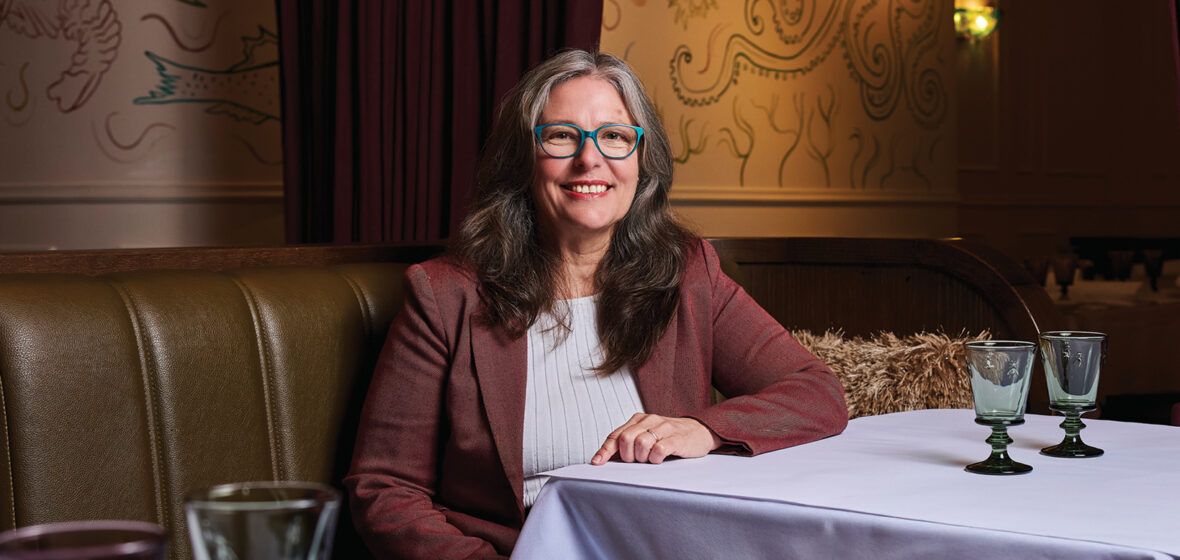
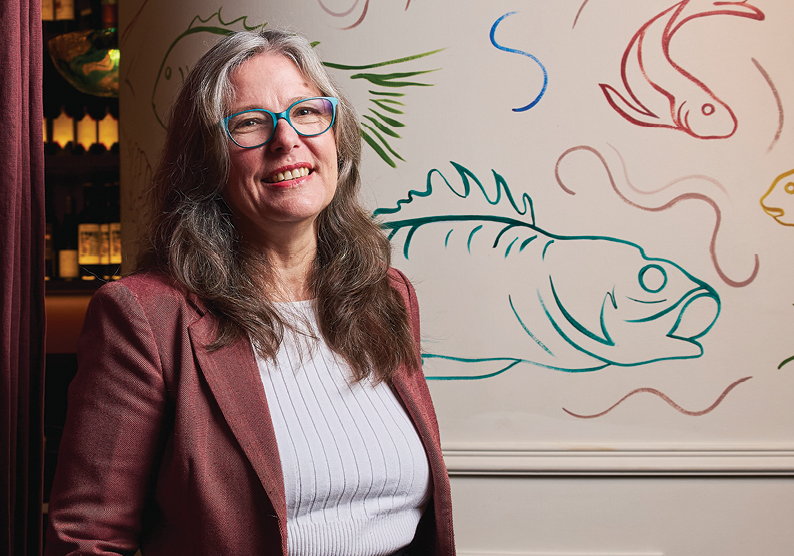
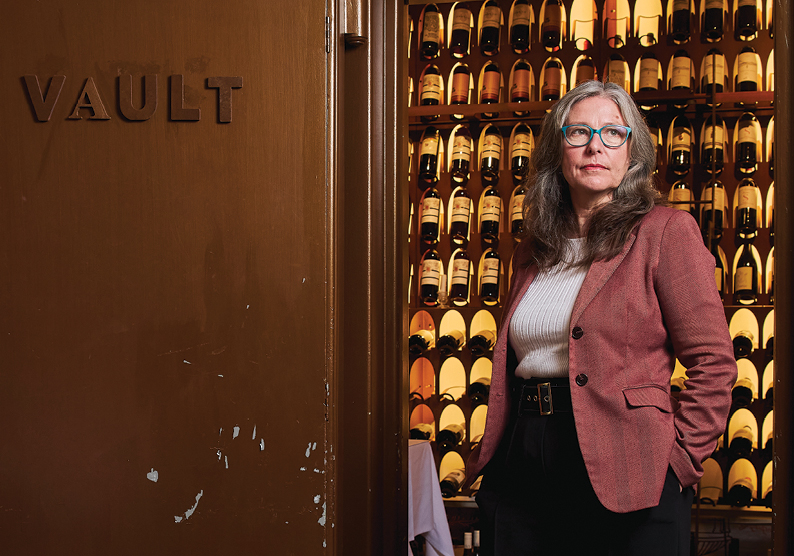
“We were at the beach all the time,” recalls Cox, while chatting to photographer James Horan during our shoot at La Riviera, the brasserie style restaurant on the ground floor of the Law Society building. When the site opened in 1969, this space was home to a branch of the Commercial Banking Company (CBC) and the vault at the rear of the space remains, now serving as storage for a vast wine collection and room for diners. Cox describes her mother as the sort of person who would do the housework at 5am, pack up the family, and have them at the beach by 9 o’clock. They would be there until 4 in the afternoon. Between photos, she and Horan delight at comparing notes on their favourite spots on the coast.
Later in our interview, Cox recalls how she had her heart set on studying science at university, until someone suggested a double degree, adding law into the mix. “My mum worked in a shop, my dad had been a truck driver who had worked his way up into the executive level of a fuel distribution company, so I didn’t have a lot of people around me who had been educated, certainly not tertiary educated,” she says. Her parents were thrilled at the prospect of Cox going to university.

Cox attended Gosford High School and for all the appeal of the region growing up, it was time to leave. “I was keen to get out of Gosford. (It) felt very stifling to me back then. I think it’s beautiful when I go back now, but (in) those days, I wanted to get away.”
During her year of exchange in Norway, a friend warned Cox she might struggle with science and law and recommended she change to arts. “I think she actually said something like, ‘you’re academically lazy,’” Cox remembers, laughing. “And she was right at the time. I was a bit of a ‘cruise through’ (person).”
She majored in political science and even up until her final year of law, Cox says she had no intention of pursuing a legal career. That was until she did a placement at the Kingsford Legal Centre. “And that was a turning point for me. I just suddenly went, ‘oh, if this is law, I could actually do that. This is something I can get my head around. (It) feels really worth doing’.”
Cox’s first legal job was at the Campbelltown Legal Centre, where she dealt with matters including credit and debt, social security appeals, housing, immigration and family violence. “We used to do the Apprehended Violence Order list at the Campbelltown Local Court, occasionally out at Camden as well. And that was tough,” she says.
Cox recalls how she became a community legal education officer after the birth of her first child. The role involved her and a colleague developing a training program for local community workers. “That was wonderful, but actually doing the list on the day was terrifying. I used to wake up and be sick, just with the nerves. And that was a combination of going to court, which was not something that I ever got comfortable with … but also just coming face-to-face with some fairly unsavoury characters, who were also in a corner, and not happy about the fact that they were being taken to court,” she explains.
“It’s given me a life-long admiration for the people, usually women of course, who work in that sector all their careers. It’s tough. Really takes its toll.”
Reflecting on how domestic violence matters were handled early in her career, Cox recounts the details of one case, where a woman had been untruthful about something. She says the police came down very hard on her. “She was driven by fear. She was trying to get someone to take it seriously and she later admitted what she’d done, and they laid charges, and it was like, yeah, if only you would act this quickly when there’s a perpetrator breaching an order,” she says.
“I think, in those days too, family violence was understood in a very narrow set of circumstances. Everyone understood that you might need to go to court and get a protection order. But in all the other areas that I now work, where family violence is actually a really important theme, like banking and credit and insurance, none of that was recognised.”
Cox’s work at Campbelltown began around the time of the recession of the early 1990s. It was a period characterised by high inflation, high unemployment and high interest rates. The difficult economic climate was certainly apparent for many of the people Cox was dealing with at the time. But in some ways, this paled into insignificance, when an even larger and more complex issue emerged.
HomeFund: well-intentioned failure
Encouraging home ownership has long been the aim of various government policies at the state and national level. These initiatives are often met with competing forces, as those same governments seek to manage their economies and protect the population from financial harm to the extent that they can.
In the 1980s, the NSW Government devised a scheme called ‘HomeFund’, which enabled people to borrow money to buy a home, with fixed interest rates of between 12 and 15.8 per cent, over a 25 to 30-year period. The initial repayments started low, not even covering interest, but automatically increased over time. The increase was designed to cover the ballooning debt created during the first decade of the loan.
As outlined by the Justice and Equity Centre, then known as the Public Interest and Advocacy Centre (PIAC), the scheme’s features were unusual and even saw 30-year mortgages aggressively marketed to elderly people in social housing, who would never be able to pay back the home loan in full. Borrowers were also stuck with high, fixed-interest rate loans, as commercial rates fell.
When serious issues started to emerge among those who were signed up to the loans, PIAC and Cox, in her role at the Campbelltown Legal Centre, were at the forefront of responding. “[A] lot of the people who were sold the houses were sole parents with young children who were not about to enter the workforce any time soon and in fact ultimately, what usually happened was their children turned 16 one by one and their income dropped,” recalls Cox.
“And so, there were all these people who were just accumulating huge debts, which effectively trapped them in their homes, because they couldn’t just sell up and move …” Cox says it also meant that borrowers who were experiencing family violence, were reluctant to leave.
Another part of the scheme gave those living in public housing the chance to purchase their current home. “Again, great idea, except for what it meant in practice was that people went from having to pay 20 per cent of their income for their rent in public housing, for which they got all maintenance done … to paying 27 per cent of their income, because that was how the loan worked, and being responsible for everything,” explains Cox.
The scheme ran from 1986 to 1993 and involved loans to around 57,000 low-income earners, more than 6,000 of whom ended up needing PIAC’s help. “So, people really, really felt very betrayed that this thing that was going to help them achieve their dream of home ownership had just put them into this huge debt trap.”
Cox recalls being asked to attend a gathering of one of the local action groups. “[W]hat I hadn’t seen coming … was they saw me as the enemy. They didn’t understand the role that I was there to play and so I copped a huge amount of anger from people. And it took quite a while to turn people around …”
HomeFund was eventually restructured by legislation in 1993, but the most disadvantaged borrowers were left without help and they no longer had the right to sue the government for breaching consumer law regarding the way the loans were sold. PIAC took the fight to the Federal Court and then the High Court, but it wasn’t until 2001 that a settlement was reached. Thousands of borrowers had their interest rates dramatically reduced and others who had sold their homes, had their debts waived.
Cox says the whole experience served as a valuable lesson. “It was really interesting, because it was my first introduction to what was going to become many government ideas about how to get people into housing that were all about tinkering with the demand side and never about fixing supply or tax systems or any of that, which is what is really required. You can’t tinker with the demand side and get people who can’t afford housing to be able to afford housing. The maths just never adds up.”
Huge need, few resources
Cox joined what was then known as the Consumer Rights Legal Centre in 1999. Asked what resources it had in those early days, Cox replies, “Not a lot,” followed by one of her characteristic laughs. It’s a response that gives the impression of someone who’s weathered more than a few storms. “I remember at one point, we got down to, I think there were three lawyers there, and I’m counting myself in that, and I think by then I’d become the coordinator.”
Cox recalls one client from a non-English speaking background, who had taken out a loan with poor terms, and signed a business purpose declaration, which those issuing the loan should have known was not true. “(He) walked in off the street with a CTTT (Consumer, Trader and Tenancy Tribunal) hearing the very next day. And we thought, ‘oh, I don’t know, do you think we can help him at this late stage?’”
Her colleague did appear for the man the next day and went onto win the case. Although Cox concedes it was on a technical point about whether the document had been signed before or after the loan. “None of the … actual stuff that I felt had any moral weight was relevant. It was entirely on the technicality.”
Cox’s earlier experience at Campbelltown had opened her mind to the work of financial counsellors and she recognised an opportunity for them to be brought into what had become the Financial Rights Legal Centre, to work in tandem with solicitors. “The whole idea of it was that every single person who rings our centre, to this day, could usually benefit from talking to a financial counsellor,” she explains.
“They know a lot of strategies for managing money, but they also know how to negotiate hardship processes at all the banks.” Cox says this approach is invaluable for any subsequent legal involvement. “[T]he financial counsellors are excellent at calming people down, letting them know they’re not alone, we’re talking to people every day who are facing one form of financial difficulty or another. And that there are … steps that they can take, there are things that can be done.
“And so that’s a really, really helpful process I think, in getting people back on track and meaning that if they do ultimately need legal assistance, they’re in a better place to engage with that.”

‘I call Ms Karen Cox’
No one was in any doubt about the momentous nature of the Hayne Royal Commission, least of all its first witness. “It was really scary,” Cox tells the Journal. “I felt like I had a lot of responsibility on my shoulders to try and impart how bad I actually think things had become, in terms of … just the attitude, I think, of the banks and other large financial services providers. That as long as they abided by the terms of contracts, then it didn’t matter how their customers were faring.”
Rowena Orr QC (as she was then known) was part of the team assisting the Commissioner. Cox met with her prior to the day she was due to give evidence. Cox describes Orr as very personable and nice but says you couldn’t get away from the very serious nature of the proceeding. She would become a huge fan of Orr’s, closely following the inquiry as it progressed.
The Royal Commission was stratospheric for Orr’s profile. She was named Victoria’s Solicitor-General in 2021 and last year, became a judge of the Victorian Court of Appeal.
To fully appreciate the impact of the Royal Commission and Cox’s involvement, it’s necessary to look back at her earlier advocacy, as well as the regulatory changes which had already been introduced, especially in relation to loans and credit cards.
Cox recalls a time when the issuing of credit cards was out of hand and the impact this wrought. “When I first started at Consumer Credit Legal Centre, a lot of clients were people, including pensioners, with tens of thousands of dollars in credit card debts. And over the years, it became people with tens of thousands of dollars in lots of credit card debts. Sometimes people would have eight, 10, 12 different accounts. And it was just outrageous the way money was being handed out.”
There were also issues with brokers, who Cox says were regulated in NSW at the time, under a negative licensing system. “[Y]ou actually had to get someone thrown out of the industry.”
“There were no barriers to entry and there were horror stories …”
She and others lobbied for tougher laws in NSW and were close to making this happen, when the Global Financial Crisis hit in 2007. Cox says this prompted the Commonwealth to step in and develop a national set of credit laws. She was one of three consumer representatives involved in the extensive consultation, as the legislation was crafted.
“[T]he big change there was that all lenders and brokers had to be licensed in a national system across the country, which created barriers to entry. You had to be a fit and proper person. You had to become a member of an external dispute resolution scheme,” says Cox.
The reforms included the introduction of what’s known as ‘responsible lending obligations’. These require lenders, brokers, lease providers and others to ask reasonable questions about a person’s needs, goals and financial circumstances and to take reasonable steps to check the information is correct.
Cox says it was hardly revolutionary. “That was essentially, really just taking us back to the way banks used to work when you had to go in, hat in hand and ask the bank manager for a loan and had to prove you could pay it. And we’d somehow left all that behind, as banks got bigger and bigger and wanted to do things in … giant sausage factory ways, which generated … enormous profits.”
But to Cox, there was unfinished business. “[T]here was a lot going on in the finance sector that was still appalling … and we often struggled to get any traction.”
Cox’s evidence to the Royal Commission went to a range of issues, including expenditure verification for home loans, upselling through broker-initiated loans, endemic problems in the car loan sector and the huge problems caused by credit card debt.
While she acknowledged improvements linked to the existing responsible lending laws in her evidence, Cox described the level of credit card debt among Australians as “frightening”. She explained that people were left with little to spend on living costs and savings were out of the question. “Certainly, building resilience to be able to meet unexpected expenses in the future becomes more difficult, because of that debt that they’re carrying,” she told the inquiry.
On the issue of home loans, Cox explained the impact of things going bad and people having to sell up and sometimes relocate, because they cannot afford to rent nearby. “[F]or a lot of people that we talk to, the loss of their home is very closely tied to family memories and aspirations and to their total sense of self-worth,” she told the Royal Commission. “[S]o they see that as a major personal failure.”
Impact of the Royal Commission
The Royal Commission resulted in 76 recommendations, having held seven rounds of public hearings over 68 days and called more than 130 witnesses. In 2019, the then Coalition government responded with a series of measures, expressing confidence that the community’s trust in the financial sector would be restored.
The changes included reining in brokers, banning trail commissions, toughening unsolicited selling provisions and measures to make banking executives accountable for failing to meet their obligations. The roles of the regulators were also clarified.
While financial experts will continue to debate the inquiry’s legacy, Cox says it has certainly resulted in more self-reflection in the financial sector. “[T]o my mind, the biggest thing that the Royal Commission achieved was to make that shift from … ‘it’s not can we do it, but should we do it?’. And I think that even for us in the community sector, it really gave us permission, in a way, going forward, to argue through a different lens.”
Cox says everybody understands the vital role of banks and other financial institutions, but some of their practices haven’t been in the interests of their customers or themselves. “[R]egardless of the fact (that) … we live in a capitalist world, we know that it’s all about profit, at the end of the day, what you want is profit that is earned from servicing customers, from servicing people.
“The people have to come out better off from the service than they went in. And so often, that’s not the case.”
First Nations focus
At one point, the Financial Rights Legal Centre received some additional funding because it ran the national insurance law service. They decided to allocate some of that money towards improving First Nations access, initially to provide advice on insurance matters.
So, the centre set up a free legal advice and financial counselling service for Aboriginal and Torres Strait Islander people across the country. It’s now known as Mob Strong Debt Help.
“[I]t had an immediate impact on the numbers of First Nations people who were actually coming to us, by having staff, by … having the service promoted by First Nations staff, First Nations branding and all of that, just made the world of difference,” explains Cox.
One of the many issues to attract attention during the Royal Commission was funeral insurance, particularly the Aboriginal Community Benefit Fund (ACBF), later known as Youpla. Cox says the fund had cases against it stretching back decades but benefited from a loophole. She and others knew that if the loophole was closed, the fund would collapse, and thousands of people would be affected.
“The truth was, not only were they misleading about it being Aboriginal owned and run, because it hadn’t been for the bulk of its existence. It was very misleading in that it was called a fund but it … effectively worked like an insurance product, in that there was no savings aspect to it. If you stopped paying, you didn’t get paid.”
The loophole was closed and by 2022, Youpla and three other funds had collapsed. By this stage, Aboriginal solicitor Mark Holden, a member of the Law Society’s Indigenous Issues Committee, and Aboriginal financial counsellor Bettina Cooper had both been recruited to the Financial Rights Legal Centre. Cox says the impact of the collapse was immediate. “We went from having … 60 calls a month for the Mob Strong Debt Help line to 1,700 calls in that first week, or first fortnight after the collapse,” she says.
“We had no idea how to manage them all. We had hundreds and hundreds of voice mails and yet our staff refused to turn off the voice mail.” They knew the callers couldn’t get through to the liquidators, so Mob Strong was the only place they could turn to.


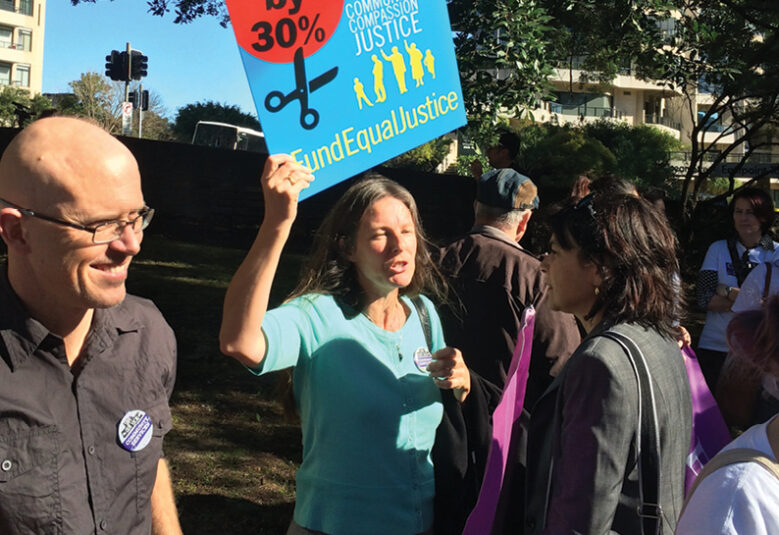
They relied on pro bono assistance to get through the huge volume of calls. A number of law firms sent volunteers to assist with call backs. Cox says it forged a strong connection with those who were impacted.
The Financial Rights Legal Centre became founding members of the Save Sorry Business Coalition, to lobby on behalf of those who’d lost money. Cox says it was an excellent campaign. “The Save Sorry Business Campaign, coordinated by Mob Strong, actually managed to get some funding and took a bunch of people who’d been impacted to Canberra. So, we were flying in people from Far North Queensland, Western NSW … put them up in a motel … and took them to Parliament House and actually introduced them to politicians of all different political stripes.”
Their approach paid off and eventually, an interim assistance scheme was announced. “At the time … our team knew of people, families, that had bodies in morgues that they couldn’t move, that they didn’t know what to do with, despite having paid for this insurance for years,” says Cox. “And that program allowed us to connect them up with the Treasury program and get the funerals happening and things moving.”
Later, the Youpla Support Program was secured to provide resolution payments to many of those affected. Cox says it was heartening to see a problem left unresolved for so long, finally addressed. “That was an amazing impact,” she says. “We had been going on about that for years … the problem of, if you close it down, you need to do something to help the people who are already signed up and got nowhere, absolutely nowhere. And yet Mob Strong and all our allies were very much able to get cut through where nothing else had.”
The job is never done
For all the progress on financial regulation and consumer protection, there have been continuing examples of corporate Australia doing the wrong thing by their customers. In June, the ACCC announced Optus had agreed to a $100 million penalty, after the telecommunications giant admitted engaging in unconscionable conduct under Australian Consumer Law, by selling goods and services to vulnerable and disadvantaged customers who didn’t want or need them, couldn’t use them or couldn’t afford them.
The alleged conduct involved manipulated credit checks and falsification of identification documents. In a statement at the time, ACCC Deputy Chair Catriona Lowe said, “We are particularly concerned that Optus engaged debt collectors to pursue some of these consumers after it had launched internal investigations into the sales conduct.”
And in 2021, Telstra was ordered to pay a $50 million penalty for unconscionable conduct involving the sale of mobile phone contracts to more than 100 Indigenous customers.
To Karen Cox, any illusion that you could somehow fix all these problems and do yourself out of a job, was shattered long ago. “It’s really, really clear to me now that there are just certain forces at work that mean that we have to be constantly vigilant,” she says.
“I’ve seen backsliding from the Royal Commission days in recent times already. Just after the Royal Commission, we used to get fabulous responses from internal dispute resolution in banks and insurers. Those days have already started to turn around. We’ve had some real deterioration recently.
“The biggest thing that the Royal Commission achieved was to make that shift from ‘it’s not can we do it, but should we do it?’ It really gave us permission to argue through a different lens.”
“They’re starting to … chip away at some of the changes in relation to remuneration that were so important coming out of the Royal Commission.” That’s not to speak of the emerging issues. “We’re finding people in prisons who are being de-banked and then … the tiny little bit of money they earn in prison, they’ve got nowhere to put it. They can’t access it to buy really basic things. And worse, when they’re let out of prison, there’s nowhere for their social security payments to go,” explains Cox.
She says First Nations communities have always struggled with identification, which affects not only their ability to engage banking services, but also access to superannuation. Cox acknowledges the super industry has cleaned up its act since the Royal Commission but says there’s a real absence of a good member services culture. That presents a particular problem for Indigenous Australians.
“They already have significantly lower super balances than most Australians. They already have a shorter life expectancy, so half the time they don’t even get to be old enough to access their super. It’s just money that’s gone, for them. When they do try and access it or their relatives try and access it, they run into so many barriers, in terms of establishing who they are and where the super is,” she says.
Recent advancements in technology have the potential to help people facing financial issues but also pose real challenges. “[I]f it was used really well, it could help with responsible lending assessments. Make that a faster, more automated process,” observes Cox. But she suspects the responses from internal dispute resolution at one of the major banks, have been written by or with the assistance of AI.
“We’re finding that … they’re not responding to the substance of the complaint properly or they’re responding to bits of it, and not all of it and that would be ok if when we push back, we actually got to a human and were able to discuss the issues but that’s not happening,” she says.
And with financial products now promoted on social media, it’s harder to identify problems and act on them.
“[U]nless you’ve got a person who’s taking screen shots and bringing it to us and saying, ‘this is what they said they could do’, or ‘this is why I went into this deal’, we can’t know the difference between the pre-sale claims and what’s in the actual agreement. It’s much more insidious in that respect.”
Cox is also concerned about the financial aspect to a growing wellbeing industry. “Time and again now, we’re seeing things that are … put out there, ‘improve your financial literacy’, ‘improve your financial wellbeing’. But again, it just turns out to be a front for another sales channel or a costly debt management service.”
Among the tasks for Cox’s successor, will be securing funding for Mob Strong Debt Help, which is due to run out next year. “[W]e’ve seen what can be achieved when you actually get First Nations people in, speaking for themselves and creating their own path. And it’s not easy to build up a service like that,” says Cox.
Coming full circle
So where to now after a quarter of a century with the Financial Rights Legal Centre and its predecessor, the Consumer Credit Legal Centre? Cox has gone back to the science degree she never did all those years ago, specifically botany.
“That is my big plan … to shift my focus to hopefully being outside a lot more and looking at the natural world. I have no doubt that I’ll end up going down a bit of a conservation advocacy route but that’s not the immediate plan. I just really love plants, and I am really loving the science degree. It’s tickling parts of my brain that I haven’t used in a very long time and the world is an amazing place, that I love to learn about,” she says.
But Cox concedes she’s still likely to be close to the consumer movement. Perhaps there’s more of a link between science and the law than we realise. For decades, Cox has worked to protect the financial rights of individuals and families, often weathering enormous strain. Now she’s turning her attention to plants, many of which would be facing their own vulnerability, due to climate change and other factors. Somehow, this pivot seems rather apt.