
By Wendy Yang -
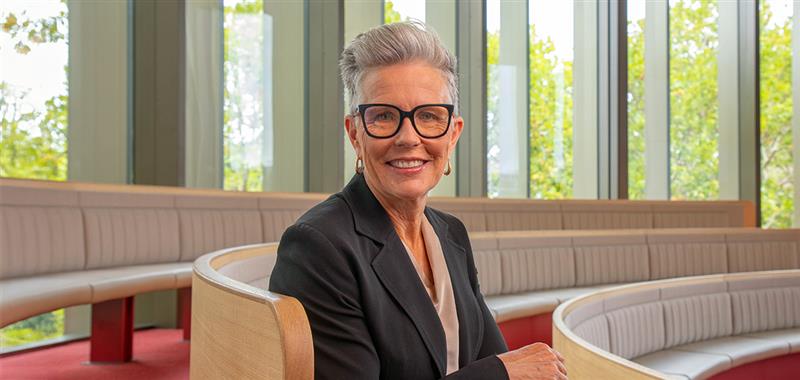
2025 marks five decades since Macquarie Law School was established. Speaking with LSJ Online, Dean of Macquarie Law School, Professor Lise Barry reflects on the law school’s beginnings, the effect of technology and artificial intelligence (AI) on education, and the skills she hopes law students will continue to hone as they embark on their legal careers.
Set in bushland, away from the bustling central business district, Macquarie Law School’s first graduating class consisted of only 51 students. Barry says it was different from the beginning. “[M]acquarie Law School, I think, was seen as a bit of an experiment. A bit of a counter to the city based G8 sandstone law schools, and instead we have Macquarie brutalist concrete out in the middle of paddocks,” she says.
In the early days, subjects were taught in a “small, seminar style debate” format rather than the lecture and tutorial format that students are used to today.
In the five decades since its inception, the law school has evolved with the changing social and legal landscape. Barry explains that since the 1970s, the law school has had a reputation for “being a hotbed of political debate around black letter law versus theory and contemporary ways of thinking about law and justice.”
Barry says while none of the law schools teach strict ‘black letter law.’ “[Y]ou can’t teach law without understanding the context in which it’s made in practice. So, I don’t think Macquarie is unique in that respect, but I do think it has a really important place in the Sydney law school environment.
“Each of our law schools has a different student catchment. … I think the Macquarie way is very contextual, very focused on social justice, … diversity of our students and … addressing access to justice issues as well …,” she says.
Nestled in the natural environment and positioned near a national park, Macquarie Law School has developed a strong reputation in environmental law, and it has the oldest centre for environmental law.
It has produced a number of graduates who have gone on to pursue careers in the field. “[W]e had quite a big cohort of environmental academics and of course the Chief Justice of the Land and Environment Court is a product of that emphasis and many of the lawyers in the Environmental Defenders Office are Macquarie graduates,” says Barry.
In recent years, universities including Macquarie, have had to become more alive to the financial viability of its courses and the subjects offered. As Barry explains, “[w]e used to be able to offer very boutique Masters units that might only have five students in them. Those days are long gone. [I]t’s fair to say that the teaching environment has gone from being very small and intimate to larger classes of 30 students and more.”
Role of technology in education
Another significant change has been the effect of technology and the role of artificial intelligence (AI) in education. Barry says one aspect the law school needs to address through their curriculum is the impact of technology. Rather than prohibiting the use of AI, the law school is experimenting with the different methods of using AI in both the classroom and in assessments. “[I]t’s affecting the profession, it affects us as educators. We have to help students understand AI, how to use it responsibly. We have to make sure that our assessments have integrity …,” she says.
When it comes to educating and training the next generation of lawyers, learning how to use technology and incorporating AI are just some of the skills needed. Barry says the challenge is to assist students to understand or appreciate the “value of hard work,” and that it is not possible to take “shortcuts to discover the law.” She points out that while you can use technology, including AI, to find the sources, students still have to peruse the sources.
She admits that five decades ago, there was a greater culture of reading and students were able to sit down and read texts for a few hours. This is no longer a skill that students are necessarily armed with by the time they attend university.
Barry says that a challenge for educators today is how to teach students with digestible material. “So, we have had to adapt the way we present materials. Present them in smaller bites … in more engaging ways, … they have that sort of history and culture of being distracted by the next shiny thing and needing those sorts of dopamine hits from reward. …
“[I] think the difficulty for academics now is helping students concentrate and engage, but one of the ways we do that is we get them into the classroom,” she says.
Barry explains that students, particularly the undergraduate students, are encouraged to attend tutorials and learn professional skills. She says attending classes in person provides students with the opportunity to make friends, and to engage and discuss topics with peers rather than learning and multitasking from behind a screen.
So, it’s not … just about training future lawyers. It’s about training future legal problem solvers.
She believes that teamwork is a vital skill for lawyers as they do not work in a vacuum. Although that can be a hurdle for socially anxious students. “So, it’s important we have them in the classroom. We engage with them in ways that help them to overcome some of those anxieties, learn to speak to other people … to ask questions … to make mistakes and bounce back from those in a supportive environment,” she says.
The Dean points out that these are skills that law firms look for in a junior lawyer. Firms want someone who is a team player and will ask questions when they are unsure of the answer.
When it comes to using AI and technology in legal practice, Barry believes it is about having the right ethical frameworks in place. “I think that the technology is sort of secondary to that. If you understand the ethics of what you’re doing, then that’s really at the heart of using any technology appropriately.
“It’s at the heart of understanding confidentiality, privacy, but also your responsibility to be accountable for the work that you produce,” she says.
Barry stresses that technology will evolve and change but the focus should be on the professional ethics underpinning its use. “[T]he legal ethics of professional ethics that underpins it is a constant. So that’s one way we approach that. The other is to give students and staff the skills to understand enough to know what the weaknesses are of technology as well, what the limits are,” she says.
While practical experience can be important for law students and provide a training ground for students to hone their legal skills before they commence their careers, Barry says that as a group of educators, the law school tries to encourage students to delay work experience until they are in their third, fourth or fifth year. However, she acknowledges that with the cost-of-living crisis in Sydney, there may be additional pressure on students to enter the workforce earlier.
“[L]aw firms don’t always appreciate how long it takes to develop those foundational skills in students … for us, it’s important to teach all of those foundational problem-solving, technological, critical thinking skills early and set them up for success,” she says.
To the Macquarie Law School Dean, one upside to technology is better access to justice. At Wallumatta Legal, the low fee family law firm set up by the law school in partnership with DLA Piper, technology has been used to assist with the onboarding process, complete administrative and other basic tasks to streamline the process and save time for the legal practitioner so they can complete other tasks.
The law school is coming up with creative ways to help students learn things like legal design and encouraging students to consider questions like how to get parties together to design their own solutions to legal issues. “Because not everyone can afford lawyers to solve their problems for them,” observes Barry. “So, it’s not … just about training future lawyers. It’s about training future legal problem solvers.”
Macquarie Law School has produced a number of well-known alumni including judicial officers, barristers, and three Presidents of the Law Society of NSW, including the 2025 President, Jennifer Ball. “When I first arrived through the gates of Macquarie University it was surrounded by green fields and roaming cows. It was my intention to complete my Bachelor of Science and then hopefully, transfer to USYD to become a veterinarian. I didn’t know then that I would not only fall in love with the law, but it would become an obsession.
“I still remember the inspirational lectures of Professor Denis Ong which led to my fascination and a passion for equity and trusts,” she recalls.
Ball describes Macquarie Law School’s 50-year milestone as a special one to her and says that she is grateful to its academic staff and her peers for equipping her with the skills to embark on a long career in law culminating with her Presidency this year.
“I congratulate Macquarie Law School, its Dean Professor Lise Barry and all its staff on this remarkable achievement,” she says.
Photos supplied by Macquarie University