By Francisco Silva -
Director: Benny Safdie
Writer: Benny Safdie
Cast: Dwayne Johnson, Emily Blunt, Ryan Bader
It’s not hard to understand why filmmakers like the world of fighting for sport more than any other artist. Visually, it has movement, drama and catharsis, like a dance fuelled by blood and sweat. But then there’s this unique emotional touch, where to buy someone who gets punched in the face for a living, you’d need to be wired to a different frequency, an affluence of ego that is eventually, almost every single time, taken aback by the eventual hubris. That’s why many boxing movies are based on the stories of real fighters. Why make up a story if the real thing already delivers the goods?
It’s almost impossible to watch a boxing movie (The Smashing Machine is not technically a boxing movie, but about wrestling and mixed martial arts, but the point remains) without comparing it to the indisputable king of the genre, Martin Scorsese’s Raging Bull, but in this case, it’s interesting how Benny Safdie made conscientious choices to take a different route. Bull starts with this stylised pristine black-and-white slow-motion shot of its subject (Robert DeNiro playing Jake La Motta) warming up to the tune of Pietro Mascagni’s Cavalleria Rusticana. Machine starts with a rough VHS sequence of a low-budget wrestling fight in what looks to be a mall in Brazil. Scorsese sets the camera right on the right, closer to the fighters, employing these tricks like putting a flame under the lens so the fluttering gas can add another dimension. Benny Safdie stays where the audience is, filmed with a TV broadcast camera and subsequently using a unique image treatment that made it both pristine and grainy (the footage is upscaled to 4k, then fed through a VHS player and finally upscaled again). Jake La Motta is a man driven by the sheer force of his own ego, whose eventual Icarus fall comes unexpectedly at the expense of his own pride. Mark Kerr (earnestly played by Dwayne Johnson) is almost a working-class hero, a man just doing his job, who only cares about entertaining. He sees his professional demise not tied to his morals but to the unfortunate consequences of the sport. It’s like Safdie is making a point that separates his film from the others. And he’s not wrong.
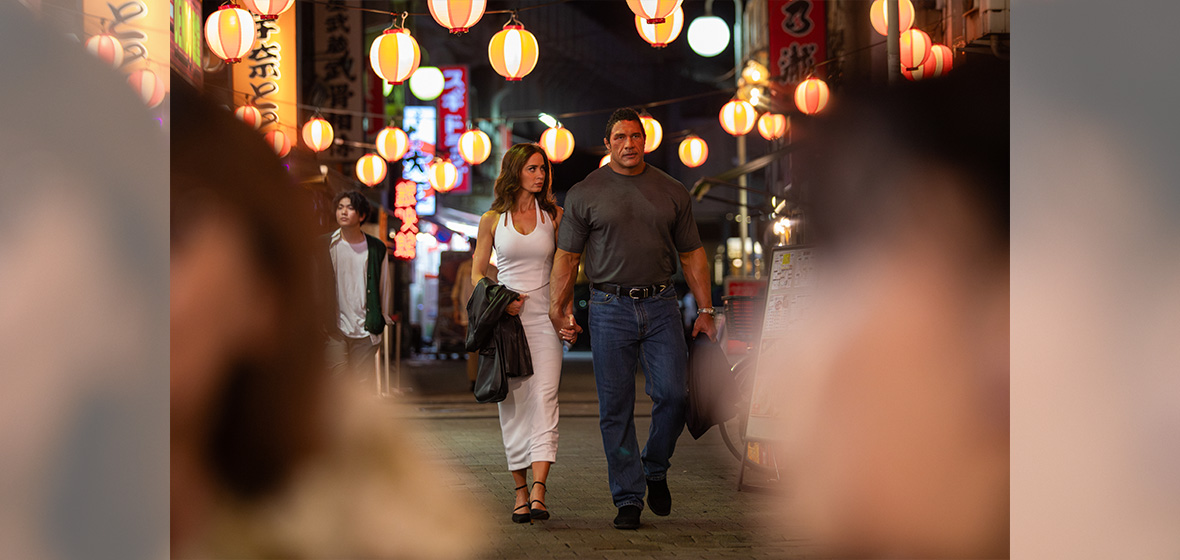
The Smashing Machine is set in the early days of UFC, when public opinion wasn’t favourable to the mixed-martial art style, and fighters had to rely on foreign tournaments. Kerr attends one in Japan where he’s treated like royalty. In a fight against Igor Vovchanchyn (Oleksandr Usyk), his opponent uses an illegal move that Kerr contests after the loss, leading to a no-contest. This decision sends him down a spiral of bruised physical and mental recovery, as he returns to the same tournament years later and secures a rightful victory against Vovchanchyn, with the help of his best friend and fellow fighter Mark Coleman (Ryan Bader). But the obstacle is, as usual in these films, a woman. Dawn (Emily Blunt), Kerr’s high-maintenance wife. Kerr succumbs to painkiller addiction and, after some close calls, signs up for rehab. On his return, there’s little to no support from Dawn, who continues her party lifestyle and seems to think Kerr is now, in her own words, “boring”.
The Smashing Machine is not the stereotypical biopic. It’s a time in Kerr’s life that defines his “will to fight”. A snapshot that Safdie doesn’t want to be lost. I’m not sure if it says much about Kerr; we meet him before he blows up in popularity, and after the film, he becomes one of the pioneers who made UFC the powerhouse it is today. Safdie finds Kerr’s matter-of-factness compelling, which makes him almost a working-class hero in his own way. I could see this being told by John Cassavetes with a buffed-up Peter Falk in the leading role.
This is also the first time Safdie has made a film without his brother Josh, after the resounding success of Uncut Gems and Good Time. So we can safely assume that Benny is not only the visual but also the class-conscientious one. All three films focus on working-class Americans with the candour of a journalist listening to the story of a subject. The graininess of his image reflects almost this DIY side of it, the camera frantically following everyone but lingering on them in little moments of empathy, of which there are so many. There’s a scene after the fight with Vovchanchyn, after talking with the organisation about the unfairness of the call, the Ukrainian fighter comes over to visit and check on him, and Kerr’s demeanour shifts to a friendly co-worker. Someone obtuse would think that Kerr was hypocritical, saying one thing to his bosses and another to his mate, but actually, it’s a genuine case of care for him, who, like a good working-class man, separates work from his friends.
It’s Johnson driving most of the conversation about the film. His transformation to Kerr, with his hard eyebrow lines and awkward posture, is impressive, especially in the film’s first half. I swear, as it nears the end, and the script demands a more nuanced, contained performance from Johnson, he slowly reverts to his own comfortable self. On the other hand, Blunt is miles ahead of Johnson, set somewhere between Drea Di Matteo in The Sopranos and a character in a Robert Altman movie. She complements Johnson perfectly, even if her character shows Safdie’s shortcomings. Unlike Julia Fox in Uncut Gems, who was rounded and fleshed out, Dawn is criminally underwritten to the point that the film is unfairly mean to her. She becomes the de facto villain of this story, and the only fight Kerr wasn’t equipped to win, keeping the analogy. Which is unwarranted as, like Kerr, she is also a victim of her circumstances, an addict in her own way, but without the emotional support Kerr has from his career and workmates.
The Smashing Machine is a valid addition to the fighting movie genre. There’s a genuine sense of righteousness, to the film’s benefit. The ending has a sublime breaking of the fourth wall that reminds the audience there’s a real person behind the actors, and that person is just one of us. Not “like one of us”. Exactly one of us. Flaws and all.
Verdict: 4 out of 5
For hard workers with a gentle heart and an interest in the history of combat sports.