By Francisco Silva -
Director: Oliver Laxe
Writers: Santiago Fillol and Oliver Laxe
Cast: Sergi López, Bruno Núñez Arjona, Stefania Gadda, Joshua Liam Herderson
The sense of dread in Oliver Laxe’s seminal Sirāt reaches deep like sand in storm. It clouds our judgement, leaves us hopeless and doesn’t let go. So even several weeks after this film, you’ll be forgiven if remembering it makes you curl into a ball of sadness longingly awaiting the end of times.
The word sirāt comes from Arabic mythology. It’s a bridge, thinner than hair and sharper than a razor, between hell and paradise that every person will need to cross come judgement day. Under it are the fires of hell, and only the worthy can cross it. Keep that in mind because the metaphor of Sirāt runs much deeper than the expected.
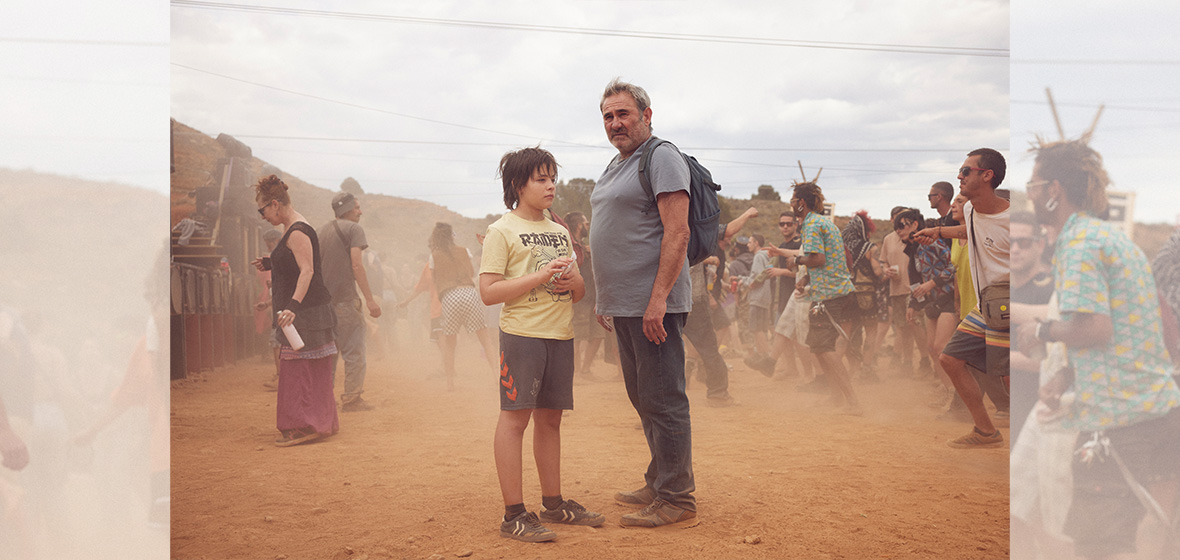
It starts with a father and his son looking for the daughter in the Moroccan desert. Luis (Sergi López), and his young son Esteban (Bruno Núñez Arjona) distribute pamphlets at a rave in the desert. No one in the crowd, mostly white European nomads, has seen her but the father and son, accompanied by their dog, show any sign to quit. When they meet a group of ravers who tell them that there will be another festival further south near Mauritania, maybe she’ll be there.
Outside of the desert political turmoil is brewing but for the convoy on their way south, this does not affect them. Like the trucks in Wages of Fear but where the dynamite is just existential dread.
Laxe builds the first half of his film like a cool hangout movie. It’s slow-paced but engaging. Occasionally, he reminds us that something bigger and more dangerous is happening in the rest of the world, but in the desert the group is focused on their mission. For the ravers is just the escapism of finding a new place where they can lose themselves to the thumping pulsation of electronic music. For Luis and Esteban is the hope that they’ll find Mar safe and sound.
But halfway through Laxe pulls the rug from the audience and forces us to deal with a shock we were not ready to. The silence it left the audience is only comparable to the audible noise of shock of how it happened, and yet it’s a seminal moment that changes not only the mechanics of the film but repurposes its thematic to one of grief and anxiety. What are we even doing here, I was asking myself. What is the point of us? Laxe makes us face the end of the world first and then leads us to cross that impossible bridge.
This all leads to the final 20 minutes, a self-contained sequence that would work on its own as a short film, but in the context of everything that happened in the 90 minutes before, it’s like a trip to the confinements of hell. Heart in your hand, anxiety so established it’s almost dizzying.
Sirāt is a hard but compelling watch. Every day it feels like we’re slowly heading towards our own apocalypse. There’s not much different from this than being on the edge of a nuclear war, financial ruin or environment catastrophe. Does knowing what happens do anything for us? Or are we just meant to stay focused on our goal, helping our family, or just partying in the desert? At the same time Laxe manages to address grief in a much more effective way that Chloé Zhao’s Hamnet, a film where grief is central to its ethos.
When the sand settles, Sirāt matches the frequency we’re all moving at in 2026. Foreboding trepidation. The kids will say “the vibes are off”, and they have been “off” for a couple of years now. If you’re looking for escapism, then this film isn’t for you, like sand, it lodges in the crevasses of our joints between our bones and leaves us with a never-ending sense of discomfort. But if you’ve been paying attention, that sense has been there for a while now, and hiding from it won’t make a difference.
Verdict: 5 out of 5
For anyone who has been feeling a worrying uneasiness about the world. Here’s two hours that validate it, which may either feel liberating or raise the anxiety levels, but in any case, it won’t leave you indifferent.