
By Francisco Silva -
Jimpa
Director: Sophie Hyde
Writers: Matthew Cormack and Sophie Hyde
Cast: Olivia Coleman, John Lithgow, Aud Mason-Hyde
Pillion
Director: Harry Lighton
Writers: Harry Lighton and Adam Mars-Jones
Cast: Harry Melling, Alexander Skarsgård, Lesley Sharpe, Douglas Hodge
Jimpa
We make the world we live in. That’s the preposition Sophie Hyde’s new film Jimpa explores. We curate our relationships, find the solace of our cocoon surrounded by those who love us, and if we do a good job, all we have left to do is to keep our garden safe and tidy. It may sound corny, but Jimpa is a balm for today’s flood of loud and abrasive intolerance. Find your people, it seems to say, thrive in your world.
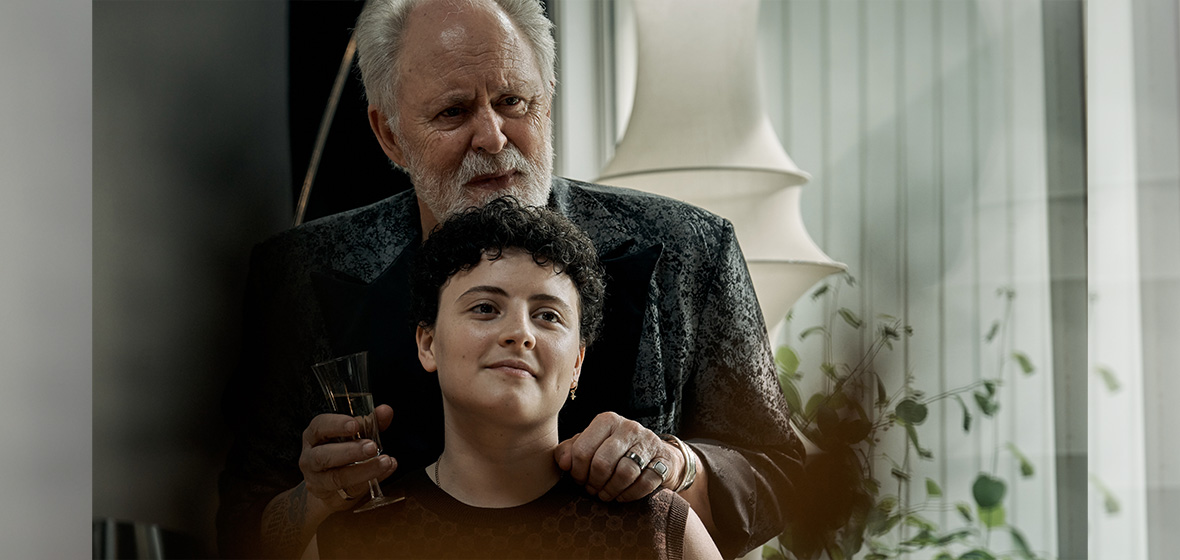
Hannah (Olivia Coleman) is a filmmaker currently trying to secure finance for her upcoming project based on her life story as the daughter of a man who came out of the closet and moved to Amsterdam leaving his wife and daughters behind in South Australia. Hannah and her family visit Jim in Europe, opening a chance for Hannah’s child Fern (Aud Mason-Hyde), a non-binary teen who idolises Jim for his role as an LGBTQ+ activist in the 80’s. Fern wants to move in with her grandfather and finish school there. Their parents disagree but Hannah hopes the exposure to Jim, whose charm can easily turn into bitter and contentious, will show Hannah that her grandfather may not be who they think they are. Jim, on the other hand, is elated having his family around as a distraction for his own issues, from age, health, an LGBT world that has expanded beyond his view, and the last days in his job at a local university.
All three generations father, mother and child, are stuck in static limbo before a new step in their lives. Hannah’s professional career is at stake as it merges with her personal life. She struggles to explain to producers and actors what the project is about, particularly that it’s possible to make a film without conflict (it is, but I don’t know if in the way that Hannah wants). Fern steps away from their high-school life where they are president of the queer group, and expands her universe, both physically, romantically and emotionally, hanging out with a group of Jim’s students from university. And then there is Jim, who is facing his own mortality and professional irrelevance, struggles to find his place in world that he worked so hard to control. It’s in him that lies the central secret of the narrative, the conflict Hannah tries to avoid, which when revealed it’s dealt with the quiet and measured demeanour of adults.
The fact that Jimpa is a personal film to Hyde, doesn’t come as a surprise, even when you don’t clock that Mason-Hyde is Hyde’s real-life child. Each scene is constructed with keen observation of what it means to the characters in the scene, in way that it could only come from the lived experience of an artist. It’s thoughtful, and open to question her own point of view (through Coleman) and the side of her father.
It’s interesting how Hyde let’s every actor be at ease with themselves and not boggled down by the cerebral imposing nature of interpretation. It says a lot that Hyde casted established thespians like Coleman and Lithgow and let them revel at their own leisure. How well it works. Everyone performs in their accent and it’s never distracting. Metaphorically it works at accentuating their differences (three people from three generations speaking the same language with three different nuances), but it also lets Coleman and Lithgow feel more relaxed and effective.
But it’s Mason-Hyde that holds the heart and soul of the film, and they rise to the occasion without even flinching. Everyone grows and changes, but it’s always more evident in the teenager. It reminded me of Timomthée Chalamet in Call Me by Your Name though Mason-Hyde doesn’t need a striking new wardrobe and make-up to signal growth, they can do it with their performance alone.
Jimpa is a quiet and effective film whose strength comes its personal and optimistic message. Nothing in it breaks boundaries, but that’s mostly because it’s not trying to convince the blind nor preach to the choir. It’s a conversation between a group of people, that touch in some important issues that the film only slightly touches and moves before it gets distracted from the family dynamic. Maybe it could be refined here and there, if we are to pick some nits, and the morality is boggled by a patronising sense of righteousness. But why not? It’s personal, it’s of its own world, and it’s emotionally true to itself. That alone is worth our time.
Verdict: 4 out of 5
For anyone in need of a simple film about family dynamics and how worthy it is to find a common ground between people.

Pillion
Harry Lighton’s Pillion is a brave first feature. Not just on the subject matter but on how visually Lighton is set to etch his name as a filmmaker who takes bold and risky swings. It’s a romantic story that plays by its own rules without having to explain anything to the audience, and if anyone accuses it of anything, Pillion bites back.
Colin (Harry Melling) is young gay bachelor from the small town of Bromley, UK. He’s a bit of an awkward nerd, part of a little barbershop quartet that performs in a local pub. His parents, Peggy (Lesley Sharp) and Pete (Douglas Hodge), welcome his sexuality but are concerned that he doesn’t have a partner, especially as Peggy is slowly dying and would like to see her son happy. But be careful what you wish for, Colin meets Ray (Alexander Skarsgård), a mysterious and attractive biker who from the start subjects Colin to power dynamic of dominant and submissive. Ray isn’t forceful and Colin is happy to comply, even if that means not talking a lot, or sleeping on the floor instead of the bed.
For the most part is endearing, if confronting. Colin shaves his head and puts a chain with a padlock around his neck, with Ray keeping the key around his. The two hang out with Ray’s group of bikers who all have the same dynamic with their partners, and it feels like a community that Colin appreciates and is easily accepted by. It’s down to us, the audience, to accept this as it is without prejudice. Lighton is aware of this but, to his benefit, he doesn’t give in. Halfway through Ray surprisingly accepts an invitation to go for lunch at Colin’s parents, and Peggy notices something different in the relationship that she does not approve. As a protective mother, she confronts Ray for the way he treats her son only for Ray to accuse her of outdated intolerance. Peggy, a conduit for the audience, is still coming to terms with it as well.
Melling and Skarsgård’s chemistry are tremendously effective. It’s easy to believe what does Ray see in Colin and vice-versa. Millennials would say they match other’s freak, but there’s something else. There’s almost a primal attraction that it’s heightened by how both actors give themselves physically to the role. Colin is fragile and meek, but he complements perfectly Ray’s towering personality. And Lighton uses this for his benefit visually, the sex scenes are provocative and challenging, but through the eyes of Colin they are also endearing.
The central conflict is a terrific complexity. Without spoiling, Colin rebels against the status quo he lets create and demands from Ray a change. Ray, on the other hand, is faced with a conundrum he never faced: What if he enjoys being just emotionally and romantically involved with Colin? What does that say about himself? What does that say about Colin as well? It’s a fantastic conclusion that Lighton controls with the assuredness of an experienced filmmaker. At the end, he earns the uniquely optimistic conclusion.
Verdict: 4 out of 5
For anyone comfortable with different approaches to love.
How to Make a Killing – ticket giveaway to preview screening

LSJ and StudioCanal have 10 double passes for the preview screening of the upcoming Glen Powell comedy HOW TO MAKE A KILLING
Disowned at birth by his obscenely wealthy family, blue-collar Becket Redfellow (Glen Powell) will stop at nothing to reclaim his inheritance, no matter how many relatives stand in his way. In Cinemas March 5. Watch the trailer here.
For a chance to win one of the double passes for this special screening on March 2 at the Palace Norton Street Leichardt, email journal@lawsociety.com.au with the subject line HOW TO MAKE A KILLING before Tuesday 24 February 2026.