

The purpose of this article is to encourage solicitors any of age – but particularly those newer solicitors - to consider living and working in regional New South Wales. Having recently returned from 12 months' work in Dubbo, in my view, regional living can provide new solicitors with the opportunity to not only accelerate their careers, but perhaps put down roots for life.
I was appointed a judge of the NSW District Court during November 2023 after being a solicitor for nine years and a barrister for 16, spending my entire career working in Sydney’s CBD, with just the occasional trial in Parramatta or regional NSW. It was partly for that reason that when the Chief Judge of the District Court, Justice Sarah Huggett, sought a volunteer to be the resident District Court judge in Dubbo for 2025 I said I would do it. But not only because it would give me the regional Australia experience itself, but because I knew that sitting in a regional court as the sole judge would help me become more efficient in dealing with every aspect of judicial work from managing the list, running trials, dealing with sentences and appeals from the Local Court (of which I ultimately did 195). Sitting an extra hour a day to accommodate this workload would give me the chance to accelerate my own learning by about 200 hours (or about 45 days) more time on the bench than if I had stayed in Sydney or just bounced around another judge’s court complex.
For those who may not know, Dubbo is 390km from Sydney, being about five-and-a-half hours’ drive (for me at least) or 50 minutes by plane. Early on a local solicitor described Dubbo to me as a “Government town”. His explanation was that Dubbo is the regional hub for healthcare, education and public services, particularly for indigenous health and related issues. Construction is also enormous with the Orana Renewable Energy Zone said to generate $5.2 billion in investment over the next few years.
From a legal perspective, Dubbo has two permanent magistrates (who also service smaller surrounding communities) the Federal Circuit Court, the Drug Court which sits weekly and a full time District Court.
The timing of my move to Dubbo was not ideal for my family. My wife is a senior school teacher in Sydney and couldn’t move to the country for a year. Our son was in year 12 and also unable to move and our youngest daughter was in year 11 and was on track to compete for Australia in aerobics and needed to stay in Sydney to continue training. Consequently, I would be going to Dubbo alone. Well, not quite alone. I was allowed to take our three-legged rescue greyhound, Reggie, for company and my eldest daughter was able to do a placement for her nursing training at Dubbo Base Hospital for a month. As it turned out, our son was able to do 6 weeks of unskilled labouring work in Dubbo after he finished high school, such is the desperate need for employees.
Dubbo’s opening of law term dinner in February 2025 and the subsequent Church service gave me my first opportunity to meet many of the local practitioners, including Jennifer Spear, President of the Orana Law Society and her deputy, Timothy Cullenward, both of whom were in private practice. My impression of the Orana Law Society was that it was very active, organising not only a Continuing Legal Education (CLE) event in March but a number of other events during the year – including a Christmas in July event. It has also produced a fantastic document called the “Guide to living and working in the Orana region”. It sets out a lot of information about life in and around the area and the nature of regional practice. I encourage anyone interested in a career in Dubbo or its surrounds to consider it.
I knew Dubbo had a large Office of the Director of Public Prosecutions (I later learned it had the second highest caseload of homicides outside of Sydney) but there are also large Legal Aid and the Aboriginal Legal Service offices – the three services that I would deal with almost daily.
“The Dubbo legal community has 70 practitioners, with a significant number not involved in crime but commercial law, property, wills and estates and family law.”
However, that criminal litigation was really just the tip of the iceberg in terms of legal work. The Dubbo legal community has 70 practitioners, with a significant number not involved in crime but commercial law, property, wills and estates and family law. One senior local practitioner took me on a tour of the many solar and wind farms around Dubbo which he had a hand in negotiating between local landowners and energy companies – a new and lucrative area of work which simply didn’t exist a decade ago. What became obvious to me in my court, was that because the solicitors knew one another and generally appeared to get along fairly well, matters ran very smoothly. There was a significant degree of cooperation and there was not a single trial that could not run because of some last-minute problem, a credit to both ends of the bar table. I suspect that some of this cooperation occurred because practitioners realised that if they were difficult or misleading in their dealings with one another, their negative interactions would soon become known amongst the profession.
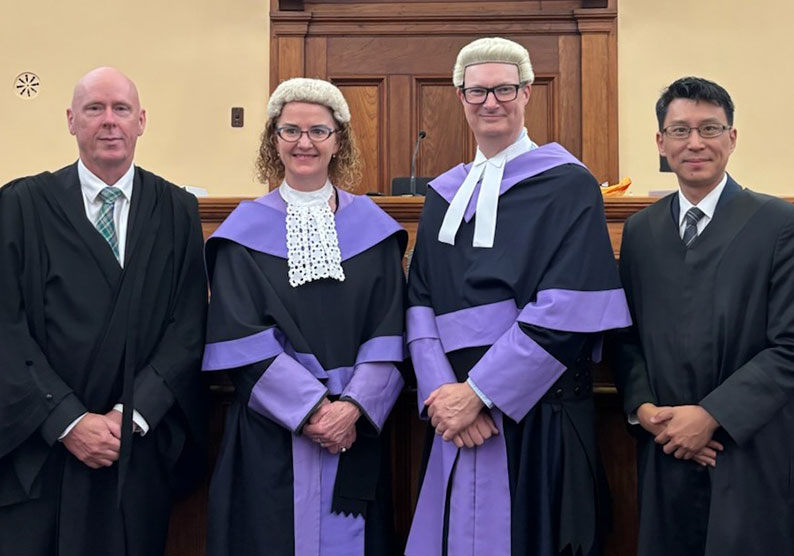
Most of the practitioners who I dealt with in court on a regular basis were around 30 years of age, although there were older and more experienced solicitors supervising them back in their respective offices. Some practitioners had rural backgrounds, but several had come to Dubbo from Sydney because it enabled them to get a job in an organisation they wanted to work at, but which had not been available to them in Sydney. As I learned, it was difficult to recruit people to Dubbo and consequently, there are opportunities for younger or newer solicitors, some of whom had been in Dubbo for a year or two and planned to return to Sydney after gaining experience, while others had moved to Dubbo and enjoyed the rural lifestyle so much (cheaper property, significantly shorter commuting times and more leisure time) and had no intention of moving back to the city.
I can only speak to my experience in Dubbo, but I imagine this would apply to other regional cities of a similar size. It should not be considered a hardship posting.
One of the biggest challenges I thought I would face in Dubbo was trying to occupy my time on the weekends when I was not returning to Sydney, which I only did every third weekend. I was determined not to be regarded as a FIFO judge and I liked nothing more than bumping into the practitioners I worked with “in the wild” over the weekend, be it at the supermarket, gym or football. Apart from talking Reggie for works morning and night, I joined the local pickleball club (a new sport for me), the Dubbo Roos rugby team (as a supporter only), two film clubs, and sometimes pub trivia with the registry. Playing pickleball did cause a problem once when I had to discharge a jury after two days of a trial when I eventually recognised him from the Monday night competition.
Dubbo has a Conservatorium of Music which regularly put on concerts, the cinema was good (often showing Indian films to cater for a substantial Indian population in town) and there were regular yearly events like the rodeo in nearby Geurie, the Molong Races the Dolly Parton Convention down the road at Narromine. There was also the Dubbo Show. At the encouragement of my eldest daughter I entered Reggie in the dog competition, where she won both Most Beautiful Pet and Best Retired Dog, although it was a little embarrassing when I realised I was the only adult who had entered the competition.
As my 12-month term in Dubbo came to an end, I was asked how I felt about my time there and whether I would miss it. I did seriously consider staying an extra year, but it was tough being away from my family, so ultimately I did not take up the opportunity. Prior to commencing in Dubbo, I had been warned that being a regional District Court judge would be hard because it is quite isolating, but I never felt that. In fact, on the contrary, I felt the local solicitors and I had a shared goal of being as efficient as possible and working together as a small legal community to ensure as many matters could be finalised. One of the best experiences was watching the young and slightly nervous solicitors who appeared before me in February, developing into excellent advocates as the year progressed, not only improving their technique but their confidence.
For anyone thinking about regional living, particularly at the start of your career, I would encourage you to do it.
The Hon. Judge Troy Anderson SC, Judge of the NSW District Court. Prior to his appointment his Honour was a Deputy Senior Public Defender of NSW and author of the textbook Commonwealth Criminal Law, the Fourth edition of which was published during September 2025. Main image, Judge Anderson with his dog Reggie. (Photo supplied)
Legal opportunities across rural, regional and remote NSW can be found at the Law Society’s Careers in the Country website.