
By Karl Hoerr -
At the recent Law Society of NSW Opening of Law Term Dinner in Sydney, the emerald green in the room did not go unnoticed by Chief Justice Andrew Bell. “I wonder where that came from?”, he quipped. In the audience was not only the Irish-born 2026 President of the Law Society, Ronan MacSweeney, but also Ireland’s Attorney General Rossa Fanning SC.
Fanning’s visit came in the 80th year of diplomatic relations between the two countries and is only the second visit by an Irish Attorney General to Australia.
In a busy schedule, which included meeting Regional Law Society Presidents at the Law Society building, Fanning found time to sit down with LSJ Online, saying “[I]reland and Australia are in political and legal terms, siblings”.
Fanning points out that at a time when his own country is bound by the legal framework associated with membership of the European Union, Australia’s common law system is still especially familiar to the one that prevails in Ireland.
“[I]t is nonetheless, I think, very striking that even to this day, a legal dispute that is fought in a NSW court in Sydney, bears an awful lot of similar hallmarks to a legal case that is fought in a courtroom in Dublin,” he says.
“[W]e can find examples as recently as 2025 in the Irish Supreme Court where Australian judicial decisions are being cited to guide the Court as to how the case ought to be determined, and the converse.”
“… the legal systems of Ireland and Australia are common law systems that are mutually intelligible …”
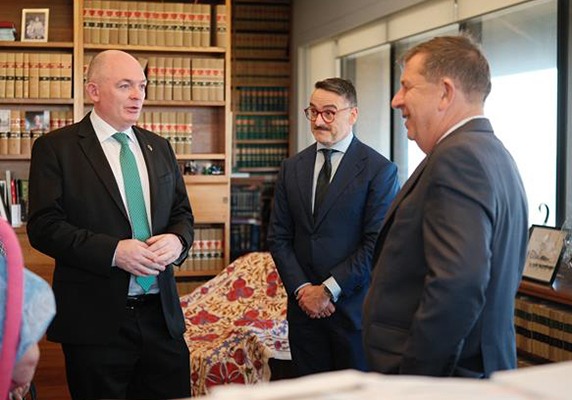
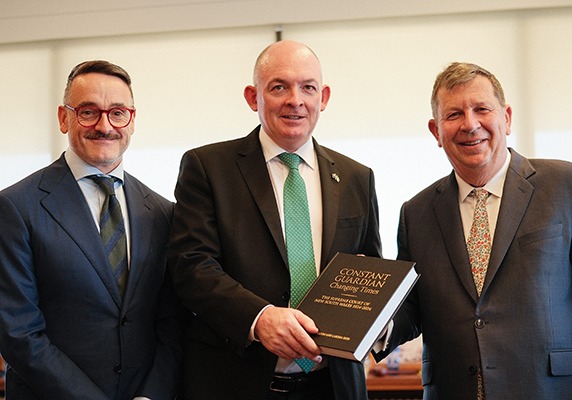

Although the historical ties are well documented, Fanning believes the contemporary ones are equally meaningful. “It isn’t just that a lot of Irish people came to Australia 200 years ago and left an imprint on the legal system, though that is also true,” he explains. “It is that even to this day, the legal systems of Ireland and Australia are common law systems that are mutually intelligible, and there can in fact be useful cross-fertilisation of ideas at a policy level, and of course, we are similarly minded countries grappling with many of the same difficult policy questions.”
“Foreign business will not locate in a jurisdiction if it doesn’t have confidence in the legal system …”
The business of law
For Ireland, the law is no longer merely a noble tradition. Its Ireland for Law initiative leverages the country’s position as the only English-speaking common law jurisdiction in the European Union, following Brexit, to attract international legal services work.
“Foreign business will not locate in a jurisdiction if it doesn’t have confidence in the legal system and if it doesn’t have confidence that contracts or commercial transactions that it enters into can be enforced,” says Fanning.
“Ireland for Law was in part based on a perceived opportunity for Ireland in a post-Brexit world to take some of the commercial contract work that would historically have preferred London for jurisdiction and choice of law clauses, to Dublin.”
Opportunities for NSW
The relevance of Ireland’s experience to legal practitioners in NSW is the opportunity to attract legal services work to our shores, and “to promote NSW as a legal jurisdiction of choice within the Asia-Pacific region”, a stated priority of Law Society of NSW President Ronan MacSweeney.
“Trade in Ireland’s legal services has eclipsed the international exports of Jameson Irish Whiskey and Guinness combined,” notes MacSweeney. “With a rule-of-law reputation that’s globally respected, and just short of half of Australia’s legal profession, NSW is at the cusp of being able to make a similar impact in our region of the world.”
Fanning says he has heard about the high regard for the judiciary in NSW and the administrative efficiencies of the Supreme Court. “And that may well be, from a NSW point of view, a good selling point in encouraging people, businesses and law firms, when they’re entering into commercial transactions and advising their clients to choose NSW as a suitable forum for the resolution of disputes,” he says.
Trade and social media ban on the agenda
Among the entries in the Attorney General’s diary during his visit was a lecture at ANU, meetings with Chief Justice Andrew Bell, Fanning’s Commonwealth counterpart Michelle Rowland, Attorneys General from NSW and the ACT, Trade Minister Don Farrell (to discuss Australia’s free trade agreement with the European Union) and eSafety Commission Julie Inman Grant.
Ireland is one of many countries across the world observing the progress of Australia’s social media ban for under 16s. Fanning says he won’t comment on where Ireland and the EU will go in a policy sense, but the exchanges on the issue during his visit have been informative and useful.
“The world is watching on with significant interest to see, I suppose firstly, whether the ban will be, in a very significant number of cases, capable of being enforced, and secondly, assuming it is capable of being enforced, what the downstream consequences of the ban will be,” he says.
“And these are issues that are occupying the minds of policy makers in my country and across the European Union, certainly.”
Proof that relations between Australia and Ireland extend well beyond our shared common law systems.
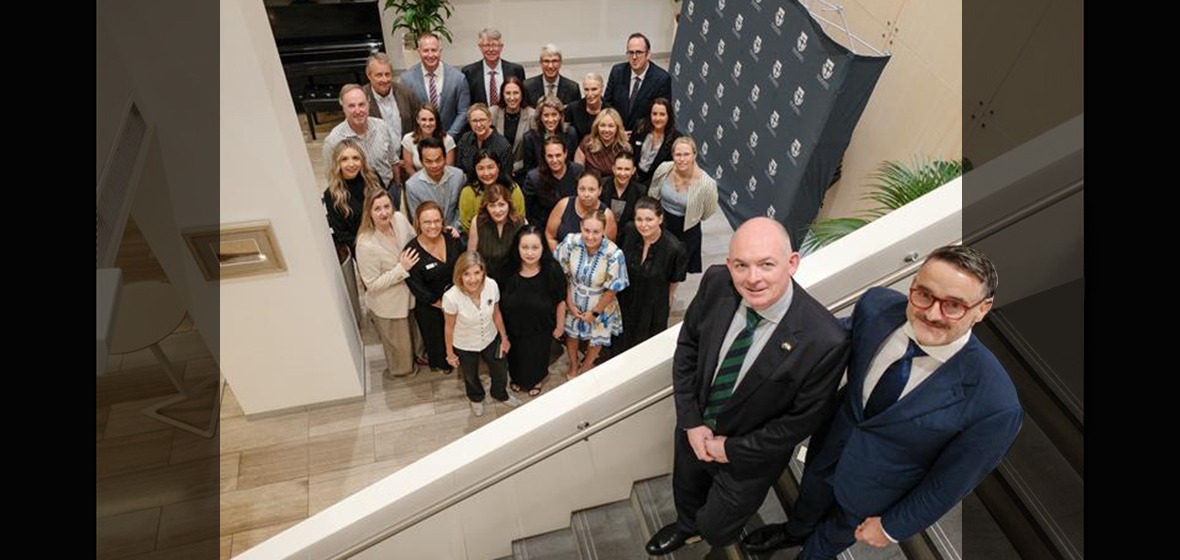
Main image, Rossa Fanning SC with Ronan MacSweeney and Regional Law Society Presidents. (Photo, Henry Ea)