

By Amy Dale -
It has been a year since NSW became the first state in Australia to criminalise coercive control: a major step in addressing insidious behaviour that is all too often at the root of a subsequent homicide. As police and family violence experts weigh in on the new laws, the Journal also asks: what does it mean to be a good domestic violence lawyer?
NSW Police Assistant Commissioner Peter McKenna is sitting in his office at the headquarters of the Metropolitan Sydney area command on the fringe of the inner-city. Around him are photos, accolades and keepsakes reflecting a decorated career in policing.
“I’ve been in the police for just coming up to 35 years. How we police domestic violence has changed dramatically in that time,” McKenna tells the Journal. “It’s [no longer] just about looking for a black eye or a bloody lip. It’s about seeing that someone’s genuinely in fear and [that] they’re being controlled, and then we need to be able to intervene and do something about that.
“When I first started, we would turn up to a domestic incident and we would literally ask the victim if they wanted anything done, and we put all the pressure on them. No surprises, quite often, they would say no because they felt under this pressure, and then the offender, usually the male partner, could then take it out on them if they pressed charges.”
McKenna speaks at length about the work underway in the force to address domestic violence. This includes training that begins at the police academy in Goulburn, and the reviews of the previous day’s incidents that are done every morning in every police station in the state.
Outgoing NSW Police Commissioner Karen Webb described domestic violence reforms as one of the highlights of her three-year term.
“It’s taken a team … and the work in domestic violence is not just police, it’s a lot of work with our partners. And there will always be work to do in that space, unfortunately,” Webb told the Sydney Morning Herald in an interview following the announcement of her retirement in May.
The relationship between police and the greater domestic violence sector has historically been an uneasy one. Yet both sides readily acknowledge that it is officers—often inexperienced or probationary constables— who are the first line of response to incidents. On average, NSW Police respond to a domestic violence call every four minutes.
All those the Journal speaks with point to the remarkable shift in the police response to domestic and family violence in recent years. This is most apparent in the process for apprehended domestic violence orders (ADVOs).
In the 1980s and well into the 1990s, the majority of such applications were taken out privately by the complainant themselves. Now, almost 100 per cent are taken out by the police on the complainant’s behalf.
“In central metropolitan region [in inner-Sydney], where I’m sitting as the region commander, the legal action rate is at 82 per cent for domestic violence assaults, which is probably the highest it’s ever been,” McKenna, who is also the NSW Police Corporate Sponsor for domestic and family violence, says.
“Because the police know how seriously we need to take this crime and how much it is scrutinised. The cops know we’ve got to get it right, because it’s going to be the most scrutinised [callout] that officers go to.”
Working in the domestic violence sector, whether in a legal, investigatory, or support role, and sharing observations, can be paradoxical.
On one hand, in recent years the change in both societal attitudes and the criminal justice response has been nothing short of transformational.
“We take it so seriously now that it is the number one crime we review every morning. In every police area command and police district, every morning, they have a daily crime review,” McKenna says.
“Every police station does this across the state. What we look at is: what has happened overnight or in the last 24 hours? And what action was taken? Was it appropriate action? And if not, is there follow up to be done immediately?”
However, such a shift in the police and legal response sits alongside crime statistics that reveal the ongoing prevalence of domestic violence, and near-weekly news reports of the murder of a woman at the hands of a current or former partner.
The latest annual report by the NSW Domestic Violence Death Review Team was published in August 2024, analysing deaths from the previous two years. The report’s foreword by Magistrate Teresa O’Sullivan, the team’s convenor, notes that although there has been a “gradual decline in domestic violence homicides” since 2010, “the downward trend has stalled, and a number of recent cases have drawn into sharp focus the unacceptably high rates … of homicide.”
The team’s research has found that almost one-third of all murders in NSW from 2000 to 2022 occurred “in the context of domestic and family violence.” Around two-thirds of those homicides involving current or former intimate partners occurred during the separation process. In close to one in four cases, there had been no history of physical violence prior to the murder.
“I think we often get stuck with thinking about all the things that still need to happen [and] that can become very frustrating working in this area,” Jane Wangmann says, the bookshelves of her university office stuffed with texts on family violence.
Wangmann’s career began in the community legal sector, but today she is an Associate Professor in the Faculty of Law at UTS. Her extensive research has spanned topics from the experience of self-represented litigants in the family law space when allegations of family violence are present, to the concept of ‘good lawyering’ in the domestic and family violence space, and the criminalisation of coercive control. More recently, she has begun to research how law schools are teaching students about the complexities of domestic and family violence.
“Because I have been around for a long time, I have seen significant change and improvements in the police response to domestic violence across my time. I started out as a solicitor doing AVOs. The police used to always just flick [AVOs] to the chamber magistrate. And so even though there are obviously lots of things that still need to improve around policing, I think that shift is really significant.”

Coercive control
Last year, NSW became the first state in Australia to introduce laws which criminalised coercive control. The Crimes Legislation Amendment (Coercive Control) Act 2022 carries penalties of up to seven years in gaol.
Under the legislation, someone is found to have committed the offence if they “[intend] the course of conduct to coerce or control the other person” , and that a reasonable person would consider there to be “a serious adverse impact on the capacity of the other person to engage in some or all of the person’s ordinary day-to-day activities.” The offence only applies in the context of current or former intimate partner relationships.
“The course of conduct may be constituted by any combination of abusive factors,” the Act states.
In his foundational 2007 book, the late American sociologist Evan Stark described coercive control as a situation where “the victim becomes captive in an unreal world created by the abuser, entrapped in a world of confusion, contradiction and fear.”
Queensland’s coercive control laws have also just come into effect, following their introduction in the aftermath of the 2020 murder of Hannah Clarke and her three children by her estranged husband, Rowan Baxter.
In the aftermath of her murder, Clarke’s family spoke of their anguish over Baxter’s “anger issues” and controlling behaviour, which could not be adequately addressed by existing laws.
Amidst their immeasurable grief, Hannah’s parents addressed NSW Police officers as part of their training on coercive control.
“Even through his demands made us uncomfortable, we didn’t know it was a sign of true danger,” ABC News reported her father, Lloyd Clarke, as saying to the officers seated before him.
Assistant Commissioner McKenna believes the training of the new generation —”It’s been face to face training with every police officer, which they get through the police academy” and its embedding into the curriculum, will continue to improve the officer response at callouts.
“We have trained our whole organisation over the last 12 months, [and it] is now starting to reap rewards, because we are getting more and more incidents of coercive control being put to us, or we’re recognising it,” he says.
Those within the legal profession and the wider support sector all believe the increased coverage of coercive control is seeping into public consciousness.
However, communicating the elements of the offence, and how to report it, remains an ongoing issue. This is especially true when it comes to reaching vulnerable cohorts, like culturally and linguistically diverse communities, or victims who may be living in extreme fear and isolation.

“Typically, someone who is a victim of coercive control has been cut off from their support systems, or there are steps being taken to do that and for those reasons they may be less likely to report,” solicitor Trudie Cameron, an Accredited Specialist in criminal law, says.
“With time and increased awareness and conversations in the community, there will become an even better understanding about it. However, I still don’t think it’s where it needs to be.”
Legal Aid NSW domestic violence solicitor Anna Baltins also thinks community understanding is improving steadily. “I think [the volume and nature of] our work really reflects that greater public awareness around coercive control and non-physical forms of violence,” she says.
“We are seeing many more women who are talking to us about non-physical forms of violence, about coercive and controlling behaviour. Women coming to us and saying, ‘I didn’t understand before that my experience was one of domestic violence’.”
There is not even a full year’s worth of data available on the workings of the new law, but early indications are of a relatively low charge and conviction rate. Those in the sector remain optimistic those numbers will grow.
“What we’ve seen since its implementation is a shift in NSW’s response to domestic and family violence and the opportunity to expand the justice system’s focus from incident-based to patterns of abuse,” Delia Donovan, CEO of Domestic Violence NSW, the state’s peak body, tells the Journal.
“We are operating in a rapidly changing landscape, so there is always more that can be done to improve the public’s understanding of coercive control. While it’s far too early to understand how the laws are working in reality, we are committed to ensuring the feedback collected from our members and victim-survivors will be incorporated into reviews of the legislation.”
The first review of the legislation will begin next year, two years after its introduction, with the report to be tabled in NSW Parliament the following year, in July 2027.
When asked how coercive control offences are tracking, McKenna says “[as of April 2025] we’ve had five prosecutions so far.”
“We’ve had one conviction on a plea of guilty. We’ve had two matters that we withdrew because we didn’t think there was quite enough evidence there. We’ve got another two matters before the courts, and we’ve got other matters now that are building out of those.”
Coercive control and its courtroom application
Given the prevalence of domestic and family violence in the community, some the Journal speak with question whether fewer than one prosecution a month, even in the first 12 months of the law being in effect, is enough.
Trudie Cameron is the Practice Director at Armstrong Legal. In the course of her extensive criminal practice, she has come to understand the many forms and drivers of family violence. Cameron was the expert guest on the Law
Society of NSW and LiSTNR’s Lawfully Explained podcast unpacking how the criminal justice system responds to allegations of domestic violence.
“There is obviously a limited number of prosecutions for coercive control. I’m not sure why that is,” she tells the Journal.
“Part of it might be because the laws are not retrospective, so they only capture conduct which occurred after the commencement of the provision [in July 2024].
“[It may also be] because the nature of the offence itself requires a pattern of conduct. That might be one reason why there’s not many prosecutions.”

It is nonetheless an observation she has seen in her own practice. “I have had at least one matter come across my own desk where I’ve read the police fact sheet and looked at the charges and thought ‘why haven’t they charged this person with coercive control’?” she says.
“Obviously, I didn’t raise that with the police because it’s not in my client’s best interest to do so, but I have wondered if there is a low rate of prosecutions in part because some police are not charging coercive control in circumstances where perhaps they should have.
“One other reason may be because coercive control is an offence which is going to be quite difficult to prove from an evidentiary standpoint. Police may have laid other charges instead.”
For many working within the family violence sector, the United Kingdom nations have been held out as the gold standard. This is particularly true of Scotland, which introduced coercive control laws in 2018 and accompanied them with a wealth of training for the police and the judiciary. “We brought some Scottish police and prosecutors back to Australia when we built our training,” Assistant Commissioner McKenna says.
As of mid-2024, Scotland’s legal system had a conviction rate for coercive control of 85 per cent. It is a strong result and a hopeful sign for NSW. However, even in Scotland the proportion of domestic violence incidents declared as coercive control remains very small: only 5 per cent of all domestic violence incidents recorded by the police.
“I have noticed that there’s been a concerted effort by the bench [in NSW] to be able to identify instances of coercive control, even if there’s not a specific charge before them, and to deal with the matter with [that] in mind,” Cameron says.
“It’s quite often that I will be in court, whether it’s for my own matter or I am observing another matter where a magistrate will raise coercive control in the context of a bail application or an AVO, or [address] certain risk factors that are being considered on sentence. I think the education, training and the implementation by the bench has been very good.”
Technology, tracking and abuse
Many instances of coercive control now extend to technology-facilitated forms of abuse, such as installing tracking apps or using location services to monitor someone through their phone or other device, often without their knowledge or consent.
“[A finding] that has markedly increased in prevalence … is the intersection of separation and stalking in [intimate partner violence] homicides … the significant increase may reflect the greater availability of surveillance tactics and new technologies that are readily accessible by abusers to extend their power and control and deprive victims of privacy, autonomy, and a sense of safety,” the Death Review team found in its most recent report.
In May, the eSafety Commission released new research about the prevalence of tracking apps, with the Commissioner Julie Inman-Grant warning that the frequent and well-intentioned use of such software by parents “has anaesthetised young people to this whole idea of being monitored or surveilled.”

The Commissioner’s research, drawn from a survey of 2046 participants, found almost one in five young adults (between the ages of 18 and 24) believed it was reasonable to expect to track a romantic partner’s movements.
“Agreement that ‘wanting you to be constantly available to respond to their texts, calls, or video chats is usually a sign of care from a partner in an intimate relationship’ (19.1 per cent total agreement) was significantly higher for men (26.3 per cent) compared with women (11.8 per cent),” the report found.
The coronial inquest into the murder of 21-year-old water polo coach Lilie James by her ex-boyfriend found he used the tracking feature of Snapchat to follow her movements, both in the days prior to her death, and on the evening he killed her inside St Andrew’s Cathedral School, where they both worked.
“We have seen an increase in stalking offences or offences where that involve(s) people installing tracking devices [or devices like] air tags,” Trudie Cameron observes to the Journal.
The widespread use of location-sharing apps, especially among younger people, is a matter of concern for those in the sector because, unlike other warning signs of domestic violence, awareness of its dangers appears to be not as well understood.
“We know that 57 per cent of 157 incidents of coercive control reported in the first six months of the new offence, involved harassment, monitoring or tracking. Yet we’re increasingly seeing young people normalise ‘red-flag behaviours’ in their relationships, such as location-sharing via popular social media apps. This is just one example pointing to clear gaps in understanding between which behaviours are ‘normal’ and which could lead to abuse,” Domestic Violence NSW’s Delia Donovan says.
“There is a huge opportunity for further education and prevention initiatives to bridge this gap. But increasing awareness of coercive control is just one piece of the puzzle.”
A crucial part of successful implementation is training: not only of the police and the judiciary, but the wider legal profession too.
“We also know it’s really difficult for [those who have experienced domestic violence] to navigate all the different systems they need to tell their story multiple times to multiple people and that can be really retraumatising when you are in crisis.”
A multi-pronged approach
Before the dozens working inside Legal Aid’s Domestic Violence Unit (DVU) have even turned the lights on to begin their working day, the phone calls for help are underway. The unit has around 80 staff working in nine offices around NSW, including Wollongong, Lismore, Dubbo and metropolitan Sydney.
The unit is an interdisciplinary team composed of lawyers, caseworkers, mental health workers and financial counsellors. The unit’s Director Anna Baltins explains its work is “bridging the gap” through which complainants and their children can fall “between state based domestic violence system and the federal family law system, and then again with the state-based child protection system.”
It is estimated that more than 80 per cent of family law matters involve an allegation of domestic and family violence. In the state’s fractious child protection system, domestic violence remains the number one reason behind reports of risk of significant harm (known as a ROSH report).
“Our service bridges the gaps for those systems and we know that women who have experienced domestic violence come with multiple and intersecting complex legal and non-legal problems,” Baltins says.
“We also know it’s really difficult for them to navigate all the different systems they need to tell their story multiple times to multiple people and that can be really retraumatising when you are in crisis.”
Baltins, who is also a member of the Death Review Team, says “I think it’s also really important we are conscious that we are not contributing to systems abuse or the use of the system to further commit violence against a woman. How we respond to someone who discloses violence to us will have a significant impact on how that client engages with us and engages with the system.”
At the 2024 Law Society Member Awards, Baltins was crowned Government Solicitor of the Year in recognition of her work as a leader in the domestic violence sector. “We would really love to have a bigger footprint, and we are strained,” she says.
“We start every day with women waiting to speak to us. But we will call every woman back and we have a really rigorous triage process to make sure that we can assess risk and urgency.”

Best practice ‘lawyering’
“What makes a good domestic violence lawyer? In many ways, it’s what makes a good lawyer,” Wangmann says.
The paper Wangmann co-authored on ‘good domestic violence lawyering’ focused on the perspective of specialist services across Australia. Research conducted in 2019 by the Law and Justice Foundation of NSW found people who had experienced domestic violence in the past 12 months were 10 times more likely to also have other legal problems, stretching across employment, financial issues, housing, personal injury and government payment concerns.
Wangmann and her team also looked to international papers, finding that in some US surveys many complainants navigating the system said they felt belittled, patronised, railroaded, like their allegations were diminished, or that they were pressured into agreeing to orders they considered to be inadequate or unsafe. Similar findings have been documented in Australian research and inquiries.
“Increasingly there are multiple calls in Australia and overseas for legal system actors to become trauma-informed and to adopt trauma-informed practices,” the research of Wangmann and her co-authors found.
The judiciary, and the legal profession have all taken significant steps in recent years to improve their training practices and collaboration.
“We recognise efforts have been made to improve the legal system’s capacity to respond to coercive control in the context of domestic violence, but there is still a long way to go,” Donovan tells the Journal.
“We must ensure that all facets of the justice system better understand the drivers of domestic violence.”

Wangmann draws on an example from her research and reveals what she has heard from complainants.
“We know that some women and also some lawyers describe behaviours of defendant lawyers that seem a bit like bullying … as though they’re taking on the behaviour of the person that uses violence,” she says. In her study on self-represented litigants, victims of domestic violence reported receiving excessive amounts of communication to deplete their funds, the bringing of unmeritorious claims, and hostile correspondence.
“I think that that goes against kind of professional ethics overall. You have a responsibility to the court. It’s not all for your client. But I’ll give you some examples of defence lawyers I’ve seen who have done a really good job. The self-representation project we did, we did some observations at courts in three states. I remember interviewing one woman who was a self-represented litigant. The lawyers for her former partner would always make sure that the parties arrived at different times and that she left safely. They still represented their client to the best of their ability, but they did these things to make sure that safety was being ensured at court. And I think that’s kind of an exemplary example of fantastic practice.”
For Cameron and her colleagues, such practice is business as usual.
“It’s something that defence lawyers have been quite good at and mindful of for a long period of time,” she tells the Journal.
“It doesn’t just coincide with coercive control. For years we’ve had matters in tiny local courts … where we know the relevant witnesses and complainants to a matter, and our accused client, are all going to turn up at court within the same half hour of each other.
“I think criminal defence lawyers are quite good at liaising with either the police or the prosecutors and managing that; of ensuring that a complainant and an accused aren’t sitting within a metre of each other waiting for the lawyers and the prosecutors to arrive.”
“I remember interviewing one woman who was a self-represented litigant. The lawyers for her former partner would always make sure that the parties arrived at different times and that she left safely. They still represented their client to the best of their ability, but they did these things to make sure that safety was being ensured at court. And I think that’s kind of an exemplary example of fantastic practice.”
Upskilling the entire profession is critical too: both Wangmann and Baltins point to examples when responding to allegations of domestic violence has fallen outside the remit of the common practice areas of criminal and family law.
Baltins draws on one example of the unit’s power in an area that would not normally be considered a touchpoint of domestic violence: school enrolment. In this case, a woman the unit refers to as Thi, moved to Australia from Vietnam after marrying Sam (not his real name). The violence began soon after their marriage, and Sam persistently threatened Thi with his ability to have her deported from Australia, which she feared would mean never seeing her daughter again.
After a particularly violent episode, the police took out a provisional ADVO on Thi’s behalf, and she was introduced to the DVU when attending the safe room at her local court. The duty lawyer was able to secure a grant of legal aid to represent Thi in family court proceedings, as well as to Legal Aid’s immigration team who could assist her with an application for permanent residency. Thi’s temporary visa status complicated her attempts to enrol her daughter in school, however she was able to be assisted through this process with the work of the domestic violence unit, as well as securing safe housing.
Baltins explains that at a time when Thi was focused on trying to escape violence and keep herself and her daughter safe, it is an issue like school enrolment that can become overwhelming.
“I wanted to share this story because things could have been really different for Thi if she was in a local court where a DVU duty lawyer was not there,” she says. “By having a DVU duty lawyer there … she was also able to be linked in with a DVU financial counsellor and a DVU caseworker who could provide her with that ongoing specialist support during her family law proceedings.”

The insidious impact of alcohol has in the past 12 months become an emerging conflict within pockets of the sector; some believe the effects of alcohol have been underplayed amid an overly concentrated focus on tackling gender inequality. As much as domestic violence is an offence that transcends socio-economic divides, the intersection between allegations of violence and child protection concerns cannot be ignored.
“A good domestic violence lawyer will have a good understanding of civil protection orders, family law, child protection, and other areas [of law] too,” Wangmann says.
“Say, AVOs: it’s seen as a simple area of law, and it is, in a legal sense. However, its complexity comes from understanding the nature of domestic violence. You need to know the law, but you also need to have this really deep and complex understanding of the nature of domestic violence.”
Phrases like trauma-informed practice—founded on principles like trustworthiness, safety, choice, collaboration and empowerment—have become commonly used, yet the meaning may not be understood completely. Lawyers themselves, so often absorbed in the casework of their clients, must recognise the relentlessness and difficulties of this particular work. “Trauma informed practice is also about acknowledging that doing this work is hard for lawyers,” Wangmann says.
“We’ve also got to talk about lawyer wellbeing, about working in this area. Because you can’t be a good lawyer in this area if you’re also not taking care of yourself.”
An ongoing matter of resourcing
In the midst of a Federal Election campaign earlier this year that veered from debates over the rights of public servants to work from home, to Medicare and proposed tax cuts, responding to violence against women was often absent from the political agenda.
Throughout the five-week campaign, at least five women were killed in acts of violence perpetrated by men; yet it was noted by the domestic and family violence frontline that little was promised by either major party to address the issue, short of reaffirming support for the current National Action Plan on Labor’s part, and some promises by the Coalition of investment in accommodation and crisis hotline services.
Service delivery remains primarily a function and funding responsibility of state governments. From the NSW perspective, Domestic Violence NSW has called for a significant funding boost as specialist services struggle to meet the demand for support.
In last year’s Budget, the NSW Government committed more than $245 million to respond to domestic and family violence, including renewed investment in the Staying Home Leaving Violence program, which supports victim-survivors to remain safely in their own homes, as well as almost $50 million to support children and young people living in refuges and $45 million to improve bail laws and the justice system’s response.
The government also continues to toughen up its criminal justice response: a strategy that is met warmly by police, victims and families and many in the sector, and more cautiously by others in the law reform space.
Public and media condemnation of the judiciary followed the April murder of Central Coast woman Audrey Griffin, her death allegedly at the hands of a man who was placed on an 18-month community corrections order in January for serious domestic violence offences. The accused killer was later found dead in his jail cell in non-suspicious circumstances less than a week after Griffin’s murder.




In addition to murder, he had been charged with more than 10 fresh domestic violence offences.
“I won’t mince words. We get frustrated by it. You know the use of intensive correction orders and community correction orders to both the victim and the offender, that’s a not guilty because they’re just walking out the door,” McKenna says.
In June 2024, the government passed new laws that tightened bail conditions for those charged with domestic violence, making it more difficult for them to secure conditional release.
Those now charged with serious domestic violence offences must ‘show cause’ for their release, which reverses the onus of presumption of bail being granted.
The new laws also expand the use of electronic monitoring, with judicial officers now also asked to consider “red flag” behaviour when making their bail decision. That conduct includes coercive control, abuse or violence towards animals, stalking and intimidation.
The appointment of six new Magistrates, who were sworn in at the start of this year, was also announced as a measure to support the NSW Local Court, the busiest jurisdiction in the country and the one where the majority of domestic violence matters in the state are heard.
“The truth is specialist DFV services are struggling to meet the demand for support. Without increased funding, frontline workers cannot effectively support victim-survivors experiencing coercive control. This not only exposes people to harm but also risks undermining the intent and efficacy of the new offence,” Domestic Violence NSW’s Donovan says.
“It’s like sending a paramedic to a major emergency with just one ambulance – forced to make impossible choices about who gets help and who is left without life-saving support.”
The paradox remains: for every example of best practice, for every woman who is supported through the system, there remains another who cannot be saved.
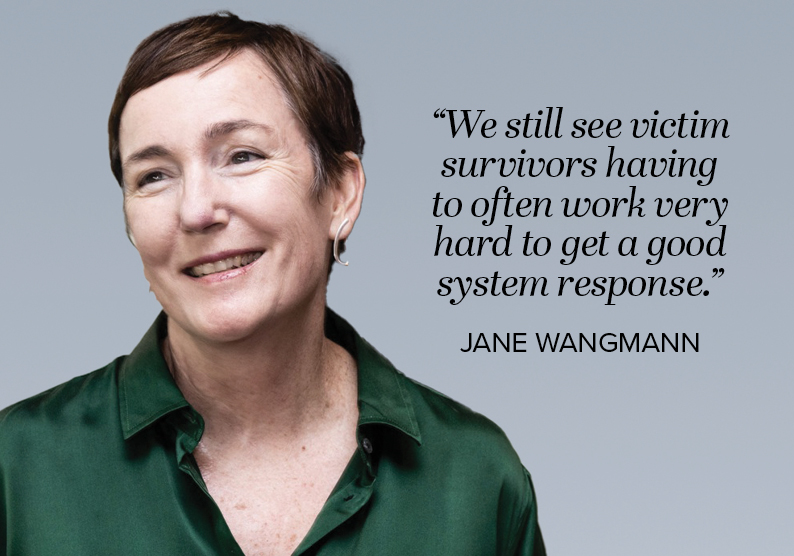
“We still see victim survivors having to often work very hard to get a good system response, despite some of our movements. We call it a system, but sometimes we’re kind of just patching it together a little bit.”