By Henry Ea -
The NSW Government introduced the Terrorism and Other Legislation Amendment Bill 2025 (Bill) today aimed at tightening gun laws to reduce the risk of mass violence, prohibiting the display of terrorist symbols and boosting police authority during public protests. The move follows the recent Bondi Beach terrorist attack and a rise in community tensions.
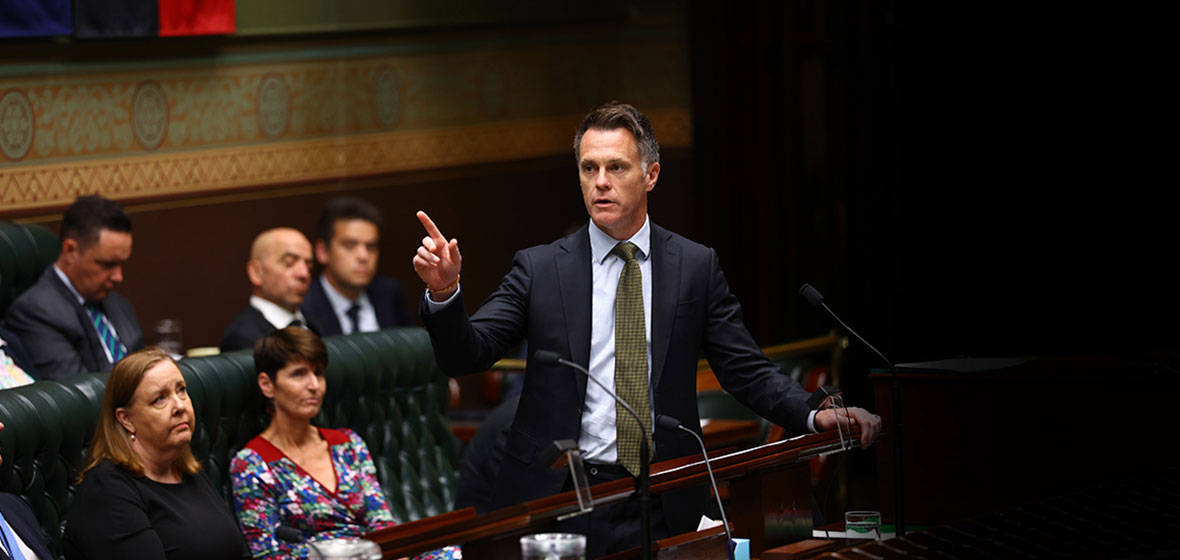
NSW Premier Chris Minns and Opposition Leader Kellie Sloane spoke during a condolence motion in the Legislative Assembly on Monday morning, paying tribute to the 15 victims of the tragic event at Bondi on 14 December.
Minns stated that while the “poison” of antisemitism is difficult to eradicate, the Government must do everything possible to fight hatred and confront those promoting violence. He characterised the new laws as the first step in a long-term safety strategy, noting, “I bear a deep responsibility for that as Premier; we must make those changes.”
Sloane told Parliament, “How can we say we’re a country of the fair go when our Jewish community faces such hate? The task for all of us as Australians is to stand up and say, it is all of our jobs to fix this.
“[H]ate and extremism will come for all of us, if we do not fix this.”
Gun ownership: “a privilege, not a right”
In what is being called the most significant tightening of gun laws since the 1996 Port Arthur reforms, the NSW Government is moving to drastically reduce the number of firearms in the community, as well as tightening licensing application and renewal requirements.
Under the proposed laws, most individuals will be limited to four firearms — with exemptions for other licensees, such as dealers and collectors, with a maximum of ten firearms for primary producers. High-capacity magazines will be reduced to five or ten rounds, depending on the firearm. To support these changes, a state and federal buyback scheme will be launched to remove newly prohibited items, such as belt-fed firearms and certain high-capacity magazines, from circulation.
Minns acknowledged that while gun reform is not a total solution for extremism, the state must still restrict access to weapons that can facilitate mass violence. “We cannot undo what happened in Bondi, but we can act decisively to reduce the risk of this ever happening again,” he said, emphasising that the reforms are focused solely on “protecting people.”
The reforms go beyond limiting physical weaponry, by tightening the requirements to obtain or keep a firearm. To ensure more frequent background and suitability checks, the standard licence term will be cut from five years to two.
The Government is also closing existing loopholes by replacing unlicensed shooting range exemptions with a formal permit system. Persons are also required to meet particular storage and safety requirements before they are authorised to acquire a firearm. Furthermore, eligibility will generally be limited to Australian citizens, with a specific exception for New Zealand citizens who are resident in Australia and perform specified roles, including primary production.
Police and Counter-terrorism Minister Yasmin Catley emphasised that the new legislation prioritises community safety above all other considerations. Defining gun ownership as “a privilege, not a right,” Catley argued that the reforms strike a necessary balance between individual access and the “overwhelming need” to protect the public.
Restrictions on public assemblies
In addition to firearms reform, the Government aims to restrict the authorisation of public assemblies in designated areas following a terrorist incident, to protect community safety and social cohesion. Under the proposed reforms, the Police Commissioner can make a 14-day “Public Assembly Restriction Declaration” restricting the holding of public assemblies in a specific area, where such assemblies are likely to cause a reasonable person to fear harassment, intimidation, or violence, or cause a risk to community safety, effectively barring the authorisation of protests in a specific area following a terrorist attack or likely terrorist attack. These measures, which Minns characterised as a necessary step to prevent the “weaponisation of fear”, are accompanied by a crackdown on terrorist organisation symbols and expanded police powers to demand the removal of face coverings.
The Bill proposes to give police officers the power to direct persons participating in protests, demonstrations, processions or assemblies to remove face coverings if the police officers reasonably suspect the person may have committed, or are likely to commit, an offence.
Currently, police can only require someone to remove a mask or face covering to confirm their identity if they are under arrest or suspected of a serious (indictable) offence.
Display of terrorist organisation symbols
Individuals face up to two years in prison or a fine of up to $22,000, while corporations face penalties of up to $110,000, for the public display of prohibited terrorist organisation symbols, such as ISIS flags. Minns stressed that the state would no longer tolerate conduct that “glorifies violence or causes fear.”
The Government confirmed that “reasonable excuse” provisions will remain for the display of symbols done reasonably and in good faith for an academic, artistic or educational purpose, or for another purpose in the public interest.
“Hate speech or incitement of hatred has no place in our society,” the Premier said. “These laws send a clear message that hateful conduct will not be tolerated. We are allowing NSW Police to focus on preventing harm.”
Attorney General Michael Daley echoed these sentiments, describing hateful slogans as a “scourge” that causes real fear among vulnerable groups.
“This Government is determined to do whatever is necessary to ensure community safety and cohesion after the horrific events at Bondi,” Daley said.
The Attorney General has tasked the Legislative Assembly Committee on Law and Safety to conduct an urgent investigation into other hateful statements to be included in expanded hate speech laws, expected early next year.
“These reforms are designed to protect the community, prevent intimidation, and allow NSW Police to focus on keeping people safe,” Minns said.
Header image credit: DOMINIC LORRIMER/AAP Image