
By Francisco Silva -
A far-right protest in front of NSW Parliament, on Saturday, 8 November brought attention to the expression of hate speech in public. LSJ Online has spoken to three experts about the rise of Nazi sentiment in Australia and possible approaches to address the issue.
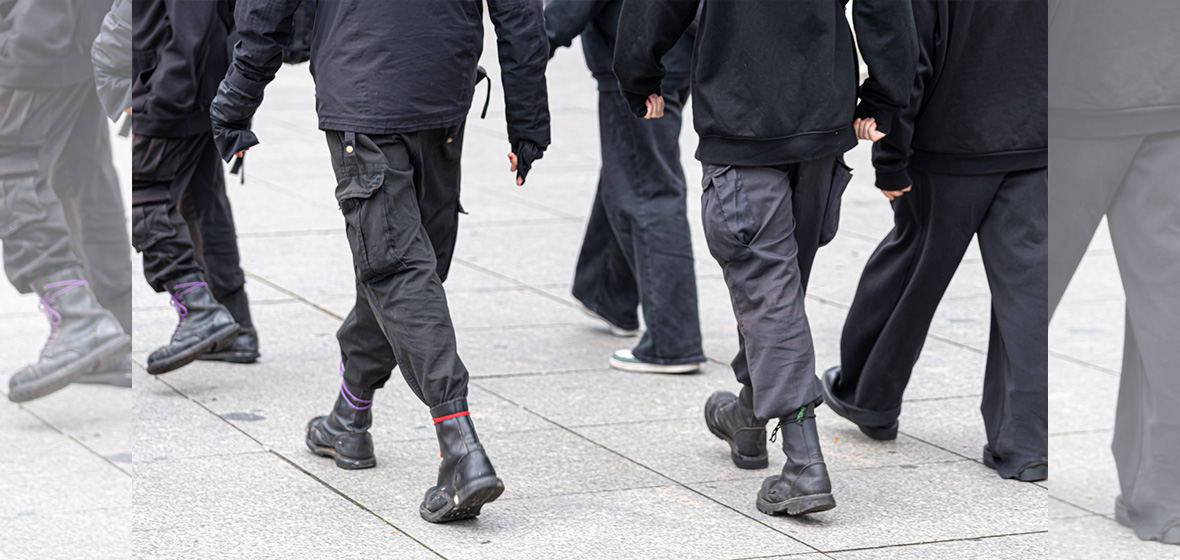
The protest, that lasted over 20 minutes, gathered around 60 members of the Nationalist Socialist Network, an openly neo-nazi political organisation led by Thomas Sewell. Dressed in black uniforms, the group held a banner that read “Abolish the Jewish Lobby” while speakers with megaphones spread anti-Semitic tropes, calls to “fight for a white Australia” and condemned both the government and mainstream media. Throughout the rally, attendees also repeated a Hitler Youth chant, “blood and honour.”
How did we get here?
After the protest, Police Commissioner Mal Lanyon and NSW Premier Chris Minns promptly reacted to the event. According to Lanyon, a group called “White Australia” filled a “Form 1” notice five days earlier, to express the intention of holding a rally in front of state parliament. Lanyon noted that due to an internal communication error, he and the Premier were not made aware of the protest. Later, NSW Police Deputy Commissioner, Peter Thurtell, told the Sydney Morning Herald it was an oversight not to pass on the information to Lanyon.
“The police area command needs to make an assessment on what’s on the Form 1,” Lanyon said.
Minns also addressed the protest, confirming he considered the messages and chants to be distressing, and accusing the gathering of being a “display of hatred and racism and anti-Semitism.”
“We need to send a clear and unambiguous message that that kind of behaviour will not be tolerated,” Minns said.
“It’s likely the case that we need to give the police more legislative powers to stop this kind of naked hatred and racism on Sydney’s streets.”
The Crimes Amendment (Inciting Racial Hatred) Act 2025 passed in February increasing the penalty for inciting hatred against a person or group in public. Under this law, individuals face up to two years in prison, or a fine of up to $11,000.
Author, journalist and researcher of far-right extremism at the University of Sydney, Dr Milly Stilinovic, says this protest and others in Victoria, give an impression of an emerging, rather than existing risk. “It is something that has been there and quite embedded into our social fabric for quite some time,” she says.
“[W]hat we’re seeing now, which is perhaps slightly different to classic modes of far-right extremism that we’re more accustomed to, is this globalised element of the far right.”
Back in August, far-right Neo-Nazis gathered in front of the Victorian Parliament, for the second time in two years. To Stilinovic, the event in NSW was not surprising.
“And so when we say this emerging thing … it was really already there,” she explains. “It’s pushed into our faces now because of the Hamas Israel war, providing a platform for these groups now to speak up as counter narratives to the protests that are happening on the other side of the spectrum.”
“[R]egulation of hate speech doesn’t necessarily achieve its intended purpose and often has unintended consequences.”
Felicity Graham, Black Chambers
Action from the government
Only ten days after the protest, the Minns government confirmed a plan to introduce a new amendment aimed at public displays of Nazi messages, that would give police and courts more powers to hold far-right extremists accountable.
The plan is to amend the Crimes Act 1900 to include a ban of exhibiting Nazi imagery in public without reasonable excuse, including Nazi chants and slogans.
“The deplorable stunt we saw outside NSW Parliament has no place in our society,” said NSW Attorney General Michael Daley. “Nobody should be subject to this vile hatred because of their background or faith.
“We are giving police and the courts additional powers to hold Nazi extremists to account for their abhorrent views.”
While hate symbols are banned in NSW, the government wants to further strengthen the law. This includes stronger penalties for committing such an offence close to synagogues, Jewish schools or the Sydney Jewish Museum.
The Crimes and Summary Offences Amendment Bill would also give the police stronger powers to remove suspected Nazi symbols. Those who refuse to comply face a fine of up to $2,200 and up to three months of imprisonment.
The Bill clarifies that these penalties and charges for the exhibition of Nazi symbols, and incitation of racial hatred, can be applied even if public assembly was authorised.
Finally, the proposal removes the three-year sunset clause for inciting racial hatred. The clause, introduced in February of 2025 by the Coalition and the Greens, had been opposed by the Government.
Daley concluded “These new laws are complemented by the suite of legislation the Government has already put in place to protect against racial vilification and hatred.”
Existing laws
Talking to LSJ Online before the Government’s announcement, Luke McNamara, Professor in the Faculty of Law and Justice at the University of New South Wales, expressed caution about additional laws. He says hate speech laws already exist, and one failure to act on those laws is not a reason to add more.
“I don’t think it’s good public policy to say … we need to make sure we’re constantly tweaking the criminal law to make sure that every eventuality is covered.” McNamara says. “And we need to recognise that criminal law is only one … relatively small part of the solution to these problems.”
To McNamara, it’s better to have a measured response, rather than what he describes as “knee-jerk” reactions. “We’ve shown that we’re good at evidence based consultative law reform. Why wouldn’t we apply the same logic in the context of racism or protest laws?” he says.
Barrister Felicity Graham also believes the banning of chants and messages could end up having damaging effects. “[R]egulation of hate speech doesn’t necessarily achieve its intended purpose and often has unintended consequences,” she told LSJ Online before the Government’s announcement. “For example, I’m aware of cases under the current provision banning the public display of Nazi symbols that have been used to prosecute people for expressing anti-Israel sentiment, and they’re not neo-Nazis.”
“So these types of laws are often vulnerable to being used to target people who are not actually engaging in the behaviour that is primarily of concern.”
Graham points out at the case of R v Kahtan Abdul-Wahab where a man is accused of public display of a Nazi symbol without reasonable excuse. In this case the Nazi flag superimposed with the Israeli flag and the words “the irony of becoming what you once hated.” The accusation was not that the defendant equated Israel with Nazi Germany, but that the symbol was displayed. The defence on the other hand argued the current law penalises peaceful and anti-war protests if a Nazi symbol is displayed in that context. The defendant claimed this has “a very chilling effect on political speech.” The court disagreed and the defendant was found guilty.
Physical vs online space
For Stilinovic the amendments only address what she calls, the physical space of these manifestations. “[E]ven ASIO itself has said that the online activities of these neo-Nazi groups are dwarfing (those in) physical spaces,”she explains.
She believes this is a global issue that cannot be curbed by making certain phrases or images illegal. Neo-Nazis are being recruited online, from websites and message boards where the messages spread from different countries to Australia. Stilinovic says we should remember how Christchurch shooter Brenton Tarrant was radicalised online, and Anders Breivik, who committed the mass shooting in Norway that killed 69 people and spread his manifest online.
Can the government control these online spaces? Stilinovic says to some extent, it already does. She gives the example of how extremist Islam groups now find it difficult to propagate their message online.
Stilinovic elaborates on the securitisation framework, where she says issues are framed differently to justify extraordinary measures. The War On Terror, she argues, was a good example. For Stilinovic there’s been a failure of securitisation to deal with the far-right in New South Wales and Australia.
“Instead of saying, ‘This is terrorism’, we’re asking, ‘Is this terrorism?’” she explains. “We’re potentially looking at gun laws or hate speech or questioning using labels such as lone shooter or lone wolf, or going back into the history of this person’s mental illness, as though to say that someone who is mentally ill will cause these particular acts.
“And we see that happening today in the sense that Neo Nazis have basically stood out the front of a building that is emblematic of democratic processes. And we’re still questioning, is this terrorism, or was it a protest?”