
By Cat Woods -
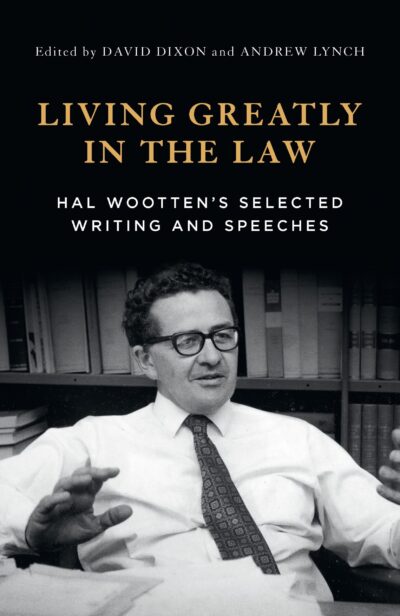
A new collection of unpublished work, speeches and essays by UNSW Faculty of Law founder and lawyer Hal Wootten is being released.
The book is being released by New South Publishing, edited by Andrew Lynch, Dean at UNSW Faculty of Law & Justice, and David Dixon, professor at UNSW Law and Dean for 10 years to mid-2016.
A Supreme Court judge, Royal Commissioner, and Chair of the Australian Press Council, Hal Wootten was tireless in his commitment to transparency, truth and justice.
Lynch tells LSJ, “It is hard to pick out a favourite chapter in this collection, but the one that I have known and drawn on longest, and to which I inevitably return time and again in my role as Dean, is Hal’s reflections on the creation of the law school at UNSW. His vision for legal education endures. This chapter includes Hal’s conception of what it means to enter a profession, and that this brings with it not just individual benefits and status, but also a responsibility to use one’s skills to serve society’s needs.”
“At a time when law schools here and abroad find themselves subject to attack, the freedom of lawyers in the US to represent clients is met with government retribution while constitutional norms generally are put under substantial pressure, Hal’s insistence that quality legal education is ‘fundamental to the liberal, democratic, secular society under the rule of law’ has never been so important.”
Wootten died in July 2021. Though he collected countless significant achievements afterwards, it was his role as founding Dean of the Faculty of Law & Justice that has shaped the way many NSW lawyers and law students experience a legal education and appreciate the guiding principles of justice. On March 1, 1971, Professor Wootten joined UNSW and the first 219 undergraduate students in the faculty, now in its 54th year, and since renamed “Law & Justice”.
Wootten’s vision was a legal education that did not exist in a vacuum of text and theory alone. Rather, he wanted students and teachers to cooperate in the experience of understanding the law within a broader social, economic, and political context, and – importantly – to recognise the power of the law to pursue, and achieve, justice for those most marginalised or penalised for a lack of wealth, education, or social status.
His letter to the inaugural class of 1971, under the chapter “A new law school”, stated:
“We [the faculty] share the belief, too, that law is not an end in itself. It is to be judged by the extent to which it promotes the well-being of the people living in society. We believe that the study of the law should never lose sight of the social problems that law exists to deal with, and that lawyers should always be ready to criticise and reform the law. We believe that a Law School should not exist in an ivory tower. Staff and students should build and maintain contacts with the practising profession, and with the real world in which lawyers work. On the other hand, the Law School should be a good vantage point from which to stand off and look at the law and the profession with a detachment the practitioner can seldom enjoy. One of the advantages of a Law School on campus is that the staff and students can mix and work with those of other faculties. We would like to see this interdisciplinary contact manifest itself in a meaningful way within the Law School, as well as in the varied societies and activities of a great university.”
In 1973, Wootten departed UNSW to join the Supreme Court of New South Wales and served for 10 years, followed by his role as both Chairman of the Australian Press Council from 1984 to 1986, and President of the Australian Conservation Foundation from 1985 to 1989. It was during that period that Wootten served as one of five commissioners to lead the Royal Commission into Aboriginal Deaths in Custody between 1987 and 1991. That experience informed his commitment and determination to First Nations peoples as Deputy President of the Native Title Tribunal between 1994 and 1997.
In the early years after Wootten was appointed Dean at UNSW in 1970, some Aboriginal men approached Wootten to relate their experiences of police harassment at the Empress Hotel in Redfern. The constables were provoking Aboriginal men then charging them with a trio of: [being] drunk in a public place, assault police and resisting arrest, with no bail granted. Wootten’s students duly showed up at the Empress to act as observer witnesses and later instructed pro bono lawyers in their defence.
Wootten recognised the need for a dedicated legal service for Aboriginal people, resulting in the founding of the Aboriginal Legal Service, of which Wootten was the first President. He said:
“We are anxious that our service will provide justice in an area where it has often been sadly lacking, but we hope to do much more than this. We believe that the existence of the service will greatly increase the confidence and self-respect of the Aboriginal community, and thus indirectly contribute to Aboriginal advancement in many areas.”
He went on to be a Deputy President of the Native Title Tribunal.
In 1990, he was awarded a Companion of the Order of Australia for services to human rights, to conservation, to legal education, and to the law.
More than 50 years since Wootten began etching his legacy into the history of Australian law, his concerns remain pertinent, front-page matters: protections for media freedom to report, Indigenous students’ access to law school, and establishing Australia as a welcome place for Palestinian academics (he began the Palestinian PhD program at UNSW).
Indeed, Wootten saw the world of academia as a collegiate one, in which universities – and law schools particularly – ought not to compete, but to cooperate. The Hal Wootten annual lectures reflect that spirit. Last year featured Professor David Heilpern, former magistrate and Dean of Law at Southern Cross University, while previous eminent speakers have included the Hon. Chief Justice Susan Kiefel AC, Jennifer Robinson, Noel Pearson, Elizabeth Broderick, Bret Walker SC, and Julian Burnside AO QC.
David Dixon tells LSJ Online, “Hal’s widow, Gillian Cowlishaw, contacted me in 2023 to say she had a digital archive of Hal’s writings, speeches, and essays. After that, we did a complete trawl of the things that he’d had published. One of his big things was climate change and conservation, and I realised I needed to look at publications outside of the legal ones to find his writings on the natural world, the Australian bush, birds and animals.”
Together with Cowlishaw and Lynch, Dixon worked diligently to curate this collection of Wootten’s work, reflective of concerns that were pertinent in the 1970s through to this very moment.
Dixon says, “He was such an extraordinary character. He finished his law degree at the end of the Second World War, began doing regular work in a legal firm, but then ended up working in Papua New Guinea, living in a community on Manus for about six months. He later wrote about Australia’s role and responsibility when Papua New Guinea became independent. These are still concerns today.”
Dixon says the easiest choice of papers to include was ‘Living greatly in the law’, a lecture that addressed Wootten’s career and his philosophy.
“That’s the heart of the book,” says Dixon.
That lecture concludes with an encouragement to students “not to let the bastards get you down”, and to focus on climate change, a major concern for Wootten throughout his professional life.
Dixon says, “We hope to encourage students to read this book. What Hal says, even though he was a man born in the 1920s and writing during his 80s, is so remarkably fresh and relevant to today.”
Living Greatly in the Law can be purchased here. Header image supplied by Andrew Lynch.
From L-R: Garth Nettheim, Tony Blackshield, Hal Wootten, and Richard Chisholm at an UNSW Law staff meeting in 1970.