

By Henry Ea -
On the morning of 17 June 2025, a burst water main on Sydney’s Castlereagh Street seemed a localised disruption but swiftly became a pivotal crisis for the New South Wales justice system. The water damaged the plant room and grid substation of the Downing Centre, causing an immediate power failure and emergency evacuation of the state's vital judicial hub.
Chris D’Aeth, Deputy Secretary for Courts, Tribunals and Service Delivery for the Department of Communities and Justice (DCJ), recalls that even in those early moments, the scale of the event felt unprecedented. While a typical outage might last hours, this incident resulted in a six-week wait for power restoration. More critically, the flood destroyed a 40-year-old mechanical switchboard responsible for the building’s climate control. Without heating, ventilation, or air conditioning, the acoustically engineered courtrooms became unusable, with temperatures reaching levels that posed a genuine health risk to occupants.
“[W]ithout air conditioning available … you cannot operate. You can’t work in them … you’d have people passing out,” explains Katherine Tollner, Executive Director of Infrastructure and Assets with DCJ.
An overnight logistical crisis
The sudden closure of a facility with 40 courtrooms created an overnight logistical crisis. To keep the justice system functioning, DCJ approached relocation like a “giant jigsaw puzzle” that demanded swift coordination among judicial officers, listing teams, and agencies such as Legal Aid and the Aboriginal Legal Service (ALS).
“[W]e can’t close one of the busiest court houses in the New South Wales justice network with 40 courtrooms and not notice it … there was clearly going to be an impact, but it was about how do we minimise that impact?” says D’Aeth.
“I don’t think you can lose sight of the fact that it’s not about any one person being the most important person. There is a triage process, of course, but for everyone going through a criminal justice process or even a civil justice process, it’s important to them.”
Simultaneously, judicial colleagues—such as those at NCAT in John Madison Tower—restructured their hearings and moved them to alternative sites, freeing up space within that building for cases displaced from the Downing Centre.
High-priority cases, including ongoing jury trials, custody matters, and urgent bail hearings, were promptly moved to other venues such as Darlinghurst Court House and King Street Courts. The team even looked beyond the CBD, adapting sites like Penrith with urgent, low-cost improvements for temporary trials. Many of these enhancements have brought ongoing infrastructure benefits to regional locations. Through this rapid adaptation, D’Aeth notes that no significant impact on “time to justice” metrics has been observed, underscoring the legal community’s resilience.
“[T]his really was a whole of community effort.”


Navigating a heritage minefield
At the same time, D’Aeth explains that clear communication remained critical during the crisis. Yet the earliest days following the Downing Centre’s closure were marked by unavoidable uncertainty.
“[T]here was always that moment at the very beginning where we were trying to be really clear with our communication, but we didn’t have answers,” says D’Aeth.
Providing the legal community with definitive timelines was an “impossible task” because officials lacked immediate answers on Ausgrid’s power restoration and the lengthy manufacturing and testing cycles required for specialised equipment, such as the parts needed to fix the 40-year-old mechanical switchboard.
“[T]his isn’t a Bunnings repair, this is not something you can pick up quickly and easily from the hardware shop on the corner,” he recalls.
The complexity was heightened by the building’s age – as a century-old “grand old dame,” as D’Aeth describes it, any structural intervention often revealed new challenges that could alter the project’s trajectory. This lack of clarity led to community frustration and forced the department to clarify that restoring power was merely the first step and that significant internal damage would require additional equipment replacement.

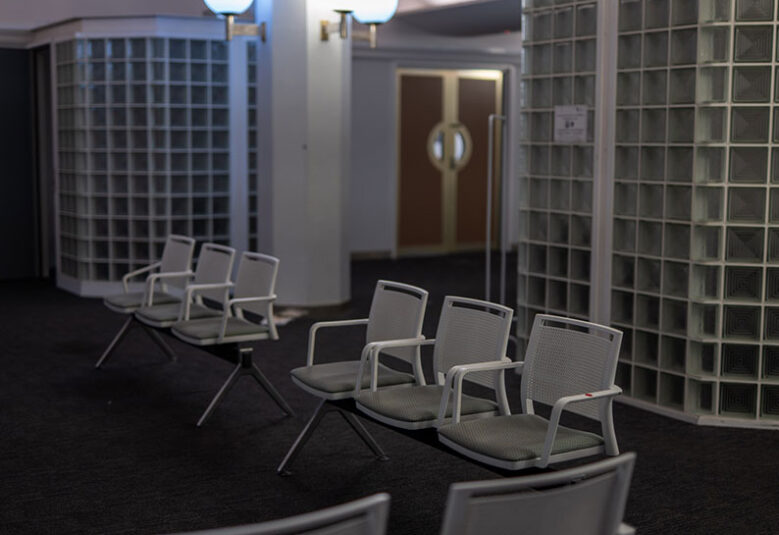
Tollner explains that the team managed “the stuff you can’t see”, including pervasive risks like asbestos, lead paint, and hazardous dust. Every intervention could reveal new hazards, such as water pressure damage to the plant room walls. To navigate these, the team used a highly conservative health and safety approach. At the peak of construction, more than 100 people were on-site installing modern audio-visual systems and digital cabling.
The department established a rigorous communication structure. What began as daily emergency meetings evolved into a sophisticated network of weekly steering groups and fortnightly high-level briefings. D’Aeth emphasises that once the technical team had a clear picture of procurement and manufacturing lead times, they made a firm commitment to the government and the judiciary to be back in the building by the end of the year. From that point on, the team was “laser-focused” on delivering the project on time.
“It was going to be the end of the year, come hell or high water,” says D’Aeth.

A transformation grounded in trauma-informed design
Rather than treating the six-month closure as merely a setback, the team used the crisis as a catalyst to accelerate 18 months of maintenance and transform the facility’s long-term purpose.
“[W]e never get an opportunity to close the Downing Centre for this extended period of time,” D’Aeth observes.
“[I]t was also an opportunity to think imaginatively and reimagine the space in a way that was going to be closer to the vision of what we want courts to be in New South Wales.”
With that in mind, their goal shifted to replacing a mismatched “patchwork” aesthetic with a consistent environment that incorporates trauma-informed design—prioritising emotional safety and well-being—and neuro-inclusive features that accommodate diverse sensory needs.
One of the most dramatic physical changes occurred on the ground floor, where the team removed a two-meter-deep ceiling bulkhead. This removal allowed for a significantly higher ceiling and an influx of natural light, creating an “airy” and modern atmosphere designed to reduce user anxiety. This design philosophy was applied throughout the building to provide consistency, helping people navigate the space more comfortably during high-stress moments.
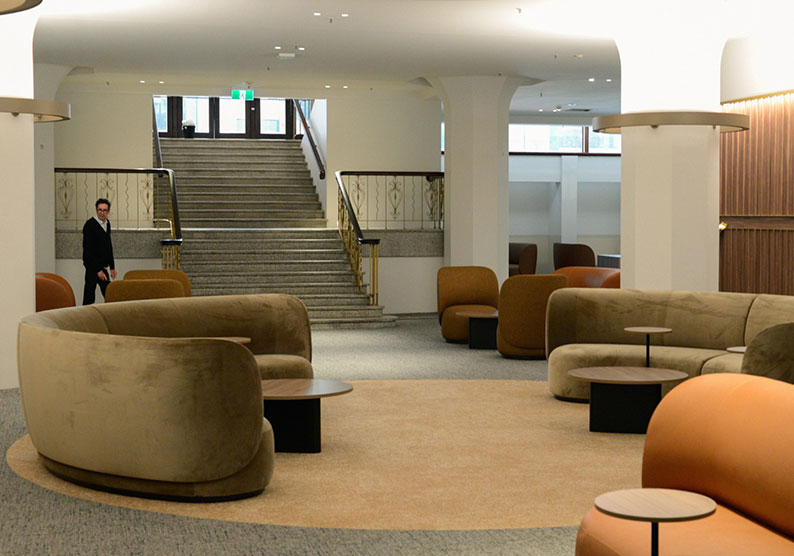
“All of this comes down to trauma-informed design and neuro-inclusive design – the more you can make things look and feel consistent, but also different, so that it helps with navigation, it reduces anxiety,” Tollner notes.
She explains that there is a clear psychological link between the environment and the way people interact within it. When a space feels “beaten up, threadbare, and dirty,” it can inadvertently encourage a lack of respect or even destructive behaviour.

In contrast, Tollner describes the new Downing Centre as warm, calming, and well-lit, featuring artwork in public spaces where there were once only blank walls. This shift toward a more dignified environment is intended to serve as a flagship model, demonstrating that when the justice system treats people with respect through the design of its buildings, that respect is often returned in kind.
“[It’s] about creating an environment that is respectful and not assuming the worst of people when they come into the place,” Tollner says.

The most profound change, however, is the building’s new dedication to the diverse community it serves. For the first time in the history of the New South Wales court system, the Downing Centre now houses dedicated multi-faith rooms for both men and women, providing a safe, fit-for-purpose space for prayer and reflection. Additionally, the introduction of a dedicated parents’ room acknowledges the practical needs of modern legal professionals and court users, ensuring that parents, particularly mothers, no longer have to compromise their needs while attending court.
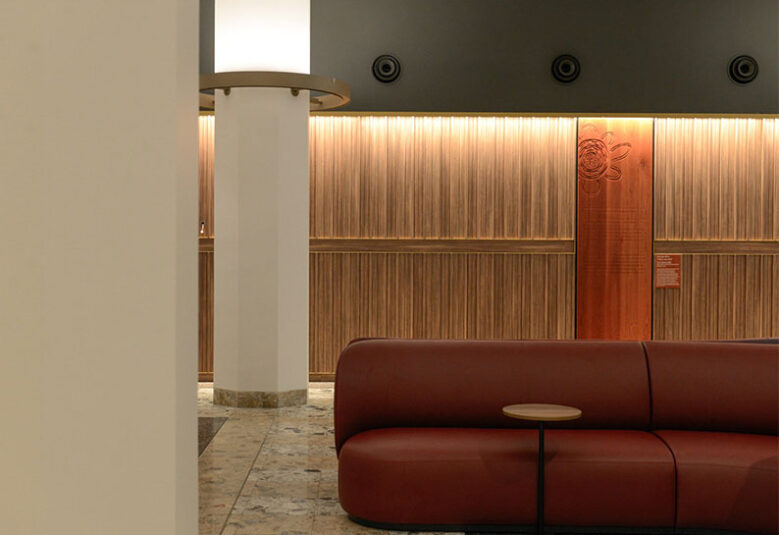
The renovation sought to weave a “Connection to Country” into the very fabric of the building, recognising that the Downing Centre sits on Aboriginal land. This is physically manifested in a beautiful Acknowledgement of Country carved into Sydney Blue Gum, a culturally sacred timber, located in the foyer. Before reopening, the entire building underwent a smoking ceremony to cleanse the space, signalling a fresh start for the “grand old dame.”
“It’s not just a tokenistic gesture to recognition of culture and country. It is really ingrained in the building,” Tollner says.
The team also placed a high priority on sustainability and resource efficiency. Tollner notes that while some furniture was irreparable, high-quality pieces, particularly public bench seating, were salvaged and redistributed to other courtrooms to minimise landfill waste.
This eco-conscious approach extended to the building’s infrastructure, with the installation of LED lighting, energy-efficient plant equipment, and modernised water and waste management systems.

A flagship vision
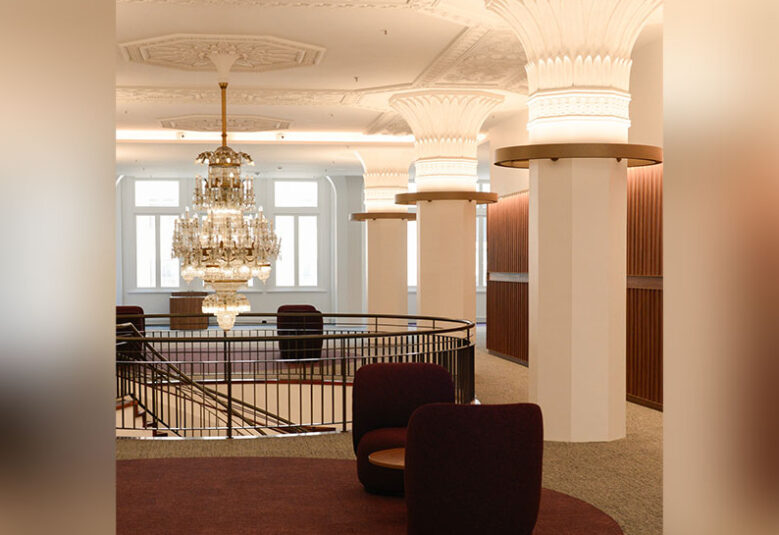
For those who have spent time within the Downing Centre, the transformation is more than a simple coat of paint; it is a fundamental shift in the building’s soul. D’Aeth, who has frequented the centre for over 20 years, found himself struck by a strange sense of amnesia when he first walked through the completed works.
“I couldn’t remember the old Downing Centre,” says D’Aeth. He explains that the change was so dramatic his memories of the old corridors were effectively erased. While the building remains familiar, the new environment is so different that it almost demands a side-by-side comparison to truly grasp the scale of the evolution.
“There’s a great deal of thought and research that’s gone into the therapeutic design of court spaces. And the intention now really, is for the Downing Centre to effectively be a flagship or a model of what our future court upgrades could be,” says D’Aeth.


Lessons for the future
Tollner clarifies that despite public scepticism and rumours suggesting the project would not reopen until mid-2026, the team remained committed to the deadline.
She attributes their success to a mix of proactive planning and favourable conditions, noting that they were fortunate to avoid the lengthy heritage-related delays, such as the discovery of protected sandstone, that often stall similar historical renovations. “We got far more done than we really hoped. But we know there’s more things there still to be done,” Tollner says.
The Downing Centre crisis has redefined how DCJ manages its strategic assets. Tollner observes that while a six-month shutdown is never ideal, it proved that taking major facilities offline for high-impact upgrades is possible through careful coordination. This realisation allows the department to move from reactive repairs to proactive, scheduled maintenance for other key courthouses across the state.
DCJ says the project demonstrates that a sensible, targeted spend can deliver enormous benefits. By prioritising accessibility, digital readiness, and human-centred design, the Downing Centre has evolved from a flood-damaged heritage site into a flagship model of what future court upgrades can, and should, look like in every corner of New South Wales.
D’Aeth says provided implementation is balanced against the practical realities of funding and project timelines, “There’s no reason why what happens in the Downing Centre can’t also be the experience in regional and remote courthouses across the state.”
The Downing Centre reopened on 19 December 2025.
All images courtesy of DCJ.