
By Henry Ea -
The NSW Supreme Court has delivered a landmark judgment that ultimately invalidates the systemic strip search practices of NSW Police at music festivals, awarding $93,000 in damages to the lead plaintiff, the largest class action ever brought against an Australian police force.
The judgment delivered a blow to the routine police practice of using drug dog indications or mere suspicion of drug possession to justify a strip search.
In 2018, the lead plaintiff Raya Meredith was unlawfully strip-searched by NSW Police at the Splendour In The Grass music festival. Meredith was searched after a drug detection dog sniffed in her direction and then moved on, a common precursor to searches that rarely resulted in finding illicit substances. The “degrading and humiliating” experience that followed, included being directed to remove her clothing, a tampon, and having a male police officer enter the searching area while she was undressed.
Justice Dina Yehia ruled that the strip search of Meredith was unlawful and that there had been “a flagrant disregard for the rights of the plaintiff” which resulted in “significant harm” to the plaintiff’s privacy, liberty and dignity.
Crucially, the finding strongly suggests that thousands of similar searches conducted between 2016 and 2022 were also illegal.
William Zerno, Senior Associate in Class Actions at Slater and Gordon Lawyers, which jointly led the action with the Redfern Legal Centre, said the Court had made it clear that “indications by police drug dogs, or a suspicion of drug possession, are insufficient to justify a strip search by police.”
Yehia found that the power to strip search, an extraordinary measure intended only for “serious and urgent circumstances”, was being abused.
“The evidence led in this proceeding was that the NSW Police undertook searches on an industrial level at festivals and with little or no regard to the legislative safeguards,” Zerno stated. He also highlighted the Court’s condemnation of the force’s internal systems, finding that the “training, education and supervision” provided to officers conducting searches was “wholly inadequate.”
These findings are expected to have wide-ranging implications, likely rendering thousands of strip searches conducted on young people at festivals, and potentially other settings, to be unlawful.
In a statement following the decision, Meredith said her experience would “haunt” her, but expressed pride in her actions. “I can say with absolute honesty that I am glad it’s over. It’s been harrowing and traumatising, yet at the same time I am incredibly proud of myself and my bravery,” she said, adding that she hoped the case would “bring an end to the practice of unlawful strip searches.”
Zerno praised the courage of Meredith and said, “Raya bravely stood up for her rights, and in the process has been successful in leading the largest ever class action against police.”
The Court awarded Meredith $93,000 in damages including general, aggravated, and exemplary damages, partly due to the State of NSW’s “hard-fought litigation strategy” which included months of unsuccessful legal applications to dismiss the class action. Meredith was the only person to give evidence at trial, as “not a single police officer” testified to defend the practice, according to Zerno.
With the lead case now determined, Slater and Gordon is urging the NSW Government to settle the claims of the more than 3,000 people who have registered for the class action, covering incidents between July 2016 and July 2022.
“Slater and Gordon is now urging the State to bring this shameful chapter to a close by negotiating a settlement for the remainder of the group,” Zerno urged, warning that refusing to settle would result in “far higher” costs to the State.
Samantha Lee, Supervising Solicitor at Redfern Legal Centre, emphasised that the action was driven by the resolve of young people.
“The case sends a clear message to NSW Police – hands off young people and children’s bodies,” Lee said. “You can no longer ask a young person to take off all their clothes, stand naked in front of strangers with firearms and make them squat and cough on the suspicion of minor drug possession.”
While acknowledging the decision does not remove the trauma, Lee said it provides “a path to monetary compensation and a sense of justice” by formally acknowledging that the state’s actions were wrong.
“I sincerely hope that this case brings an end to the practice of unlawful strip searches and in the future police powers are only used in the circumstances intended by parliament,” Meredith concluded.
Slater and Gordon has also confirmed it is investigating the prospect of bringing a further class action for persons strip-searched at festivals since July 2022.
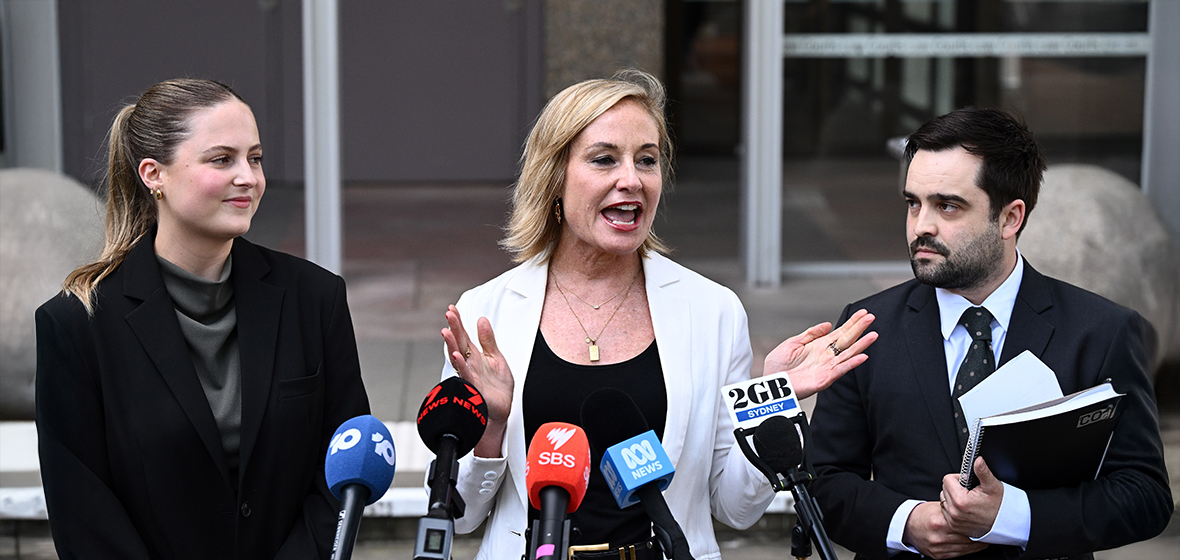
Header image: Redfern Legal Centre Supervising Solicitor Police Powers and Administrative Law, Samantha Lee (centre) and Slater and Gordon Associate, Class Actions, William Zerno (right) address media outside the New South Wales Supreme Court, in Sydney, Tuesday, 30 September, 2025. (AAP Image/Dan Himbrechts)