
By Cat Woods -
The NSW Police Association has proposed US-style night courts to free up frontline officers and holding cells. This was put on the agenda during a recent conference in Wollongong. The proposal is a court system that recognises "24-hour policing".
Forty years ago, a night court was trialled at the Blacktown Local Court, but it failed to last and was ended after one year. LSJ Online speaks to a criminal lawyer about whether a night court would benefit or disadvantage those arrested and the lawyers who would be called in to defend their clients overnight.
Avinash Singh is the Principal Lawyer at Astor Legal. He says, “At face value, the proposal for night courts is a sound one. Many defendants are currently forced to spend a night in a police cell if they miss the 3pm cut-off to be brought before a Local Court Judge. If night courts were available, then these persons could theoretically be spending less time in custody and be released.”
It would also reduce the impact on police resources as fewer people will be held in cells, according to Singh.
“When I was appearing on a bail application earlier this year, I was informed that the application could not proceed as the police did not have sufficient space in the cells to hold all of the people who had been arrested. The introduction of night courts should eliminate problems like this from occurring.”
A costly endeavour
In 2018, the Victorian Government revealed that its after-hours court, extended to 9pm nightly, cost about $3.7 million in 2017, having heard more than 1,200 cases, at an average of three a night.
To date, no cost modelling has been undertaken for an overnight court system in NSW. However, the cost to clients of employing a private lawyer for an out-of-hours hearing comes at a premium. The Law Society of NSW lists NSW criminal lawyers who operate out of hours, but clients are advised to discuss with those lawyers what additional costs they would incur from employing that lawyer outside of usual working hours.
President of the Police Association of NSW, Kevin Morton, tells LSJ Online, “The proposal is not a night court; it is extending the hours of the existing AVL bail court. All bail matters are dealt with remotely, via AVL.”
This court would not extend to hearings and only deal with persons in custody for the determination of bail, he explains.
“The proposal would not change the number of matters before the courts, nor significantly increase the cost of the court. The proposal merely seeks to have an appropriate number of AVL bail courts available when there is significant demand – starting and finishing later in the day.”
Morton says: “50 – 60 per cent of accused persons are admitted to bail at their first application.”
He attributes this figure to BOCSAR, which indicates a number closer to 63 per cent as of December 2025.
“It is unfair, unsafe and costly to hold these persons overnight or longer, merely as they cannot be listed in the bail court after midday, if midday is the right time.”
He argues that extended court hours would help to protect vulnerable prisoners and police who have to take care of them in “not fit for purpose facilities”.
Morton says, “The cost would be negligible, with the main expected cost to be potential shift penalties for practitioners and court staff. Extended hours, using remote AVL appearances would also allow flexibility for a more diverse workforce in the judiciary, court staff and practitioners.
This proposal creates no extra demand for resources but applies existing resources when they are needed.”

Does the late hour unduly influence magistrates’ decisions?
Night courts in Victoria have provided at least one example of where the decisions made overnight can vastly differ from those made in the light of day.
On 8 March 2017, Kyle Stewart was due to appear before Sunshine Magistrates Court to face a charge of unlicensed driving. Police had arrested and held Stewart in custody the night before, but did not take him to court as required. Consequently, the assigned Magistrate Kaye Robertson, who had expected Stewart at around 10.30am, stated her dissatisfaction with police and ordered the defendant’s release on bail, adjourning the case to 28 March.
Instead, police kept Stewart in custody throughout the day, then ushered him to the newly established Night Magistrates Court, where a different magistrate decided to refuse bail and remand him in custody. A hearing the next morning confirmed that decision.
On 10 March, Stewart’s lawyers filed an application in the Victorian Supreme Court accusing police of abusing court processes and wrongfully imprisoning their client.
Supreme Court Justice Kate McMillan ultimately ruled that police had unlawfully contravened the magistrate’s order to release Stewart and ordered his immediate release.
She stated, “I am satisfied that the action of police in continuing to hold the plaintiff in custody after his hearing before Magistrate Robertson at approximately 10.35am on 8 March 2017 was unlawful.”
In Victoria, an individual has the right to make an application for bail via a court or a bail justice if police refuse bail.
After arresting and charging a person after 9pm, police have the power to remand them overnight until they can see a magistrate the following morning. However, an individual who’s been charged after-hours can apply for bail before a bail justice in an out-of-court session.
During previous periods where NSW and Victoria operated night courts, the use of volunteer bail justices as an alternative to calling upon Judges for overnight cases was also contentious.
Singh says, “While the implementation of volunteer bail justices may seem appealing at first blush, there are real concerns about whether volunteer bail justices would be properly qualified to step into the role of Local Court Judges running a busy bail list. Given the high stakes of any bail application for the prosecution, defendant and the community at large, the government should be very wary of using volunteer bail justices who may not have the training or experience of seasoned Judges.”
Ultimately, Singh opines that while some lawyers may be willing to volunteer to appear at night court, “the majority of lawyers – particularly experienced lawyers whose services are in demand – are unlikely to want to appear at a night court.”
Further, he points out, criminal defence lawyers spend most of their day in court, so it would be asking a lot of them to then spend further time in court at night, before then appearing at court again the next morning.
There is also the question of what the financial cost of operating night courts would be if they were to be restarted, and whether the cost to the government would consequently sacrifice other court and justice reforms that the legal industry sees as more of a priority in the budget.
Singh says, “If night courts were restarted, the most significant cost to the government would be staff. To run a night court, you would not just require Judges; there would need to be court officers, court monitors, sheriffs, corrective services officers, as well as prosecutors and legal aid lawyers. Given the hours that the night court would operate, it is likely that there would be penalty rates that may need to be paid.”
Last year, the 2025-26 NSW budget involved an additional $100.5 million in funding for Corrective Services NSW, a $145 million spend on reforming the NSW court system and an extra $227 million in funding for the NSW Victims’ Support Service.
The reforms focus on supporting victim-survivors of domestic, family and sexual violence. But while changes that enhance services and assistance for the victims of violent crime have been welcomed, the cost of operating overnight services would potentially result in funding towards victim support and rehabilitation efforts to address reoffending being sacrificed.
The 2025-26 budget allocated Corrective Services NSW an additional $100.5 million to address rising demand in the correctional system. The media release claimed: “Community safety is a top priority for the Government and our tough new domestic violence bail laws have seen record numbers of alleged offenders held on remand.
This funding will ensure Corrective Services NSW is resourced to supervise offenders and will support their rehabilitation and reintegration, in line with community expectations.”
Singh says, “The money that would be spent on staffing a night court could potentially be better spent on reforms relating to greater access to justice for regional Australians as well as vulnerable members of the community, such as domestic violence survivors and Indigenous Australians.”
Systemic studies highlight that expanding operational hours to nights or weekends presents major operational challenges, including the heightened risk of burnout and secondary traumatic stress among Australian judicial officers.
While adequate funding and resources are a given when it comes to operational success, night courts ultimately demand professionals who are willing to show up and provide the same quality of work that they’d provide in typical business hours.
But the system is already under pressure. Associate Professor Kevin O’Sullivan, from the Law School at The University of Western Australia, wrote of the mental health toll on Judges for The Conversation on 5 August 2025.
A study O’Sullivan coauthored in 2024 with researchers specialising in law, sociology and psychology was based on a survey of 602 judges and magistrates from all states and territories across Australia, which revealed 38.4 per cent registered either moderate or high levels of distress.
More than one-third of them had trauma symptom levels high enough to warrant a formal assessment for post-traumatic stress disorder (PTSD).
O’Sullivan wrote: “All of our studies so far have found that both the prevalence of psychological distress and of systemic challenges is significantly greater in the Magistrates Courts (which handle the vast majority of cases) than in the District, County or Supreme Court (which handle matters that cannot be heard in the Magistrates Courts).”
There’s no doubt that NSW prisons, courts, and police are under pressure. March this year saw the highest number on record of adults in prison (14,070), according to the Bureau of Crime Statistics and Research (BOCSAR). Between November 2025 and March this year, the remand population rose by 802 people to an all-time high of 6,650; and people in prison for domestic violence offences rose by 459 people to a record of 3,944.
Morton says, “If NSW is serious about improving access to justice, reducing the number of people in custody and the time they spend in custody, and addressing the vulnerability of many accused persons, they should start removing the roadblocks to timely bail hearings.”
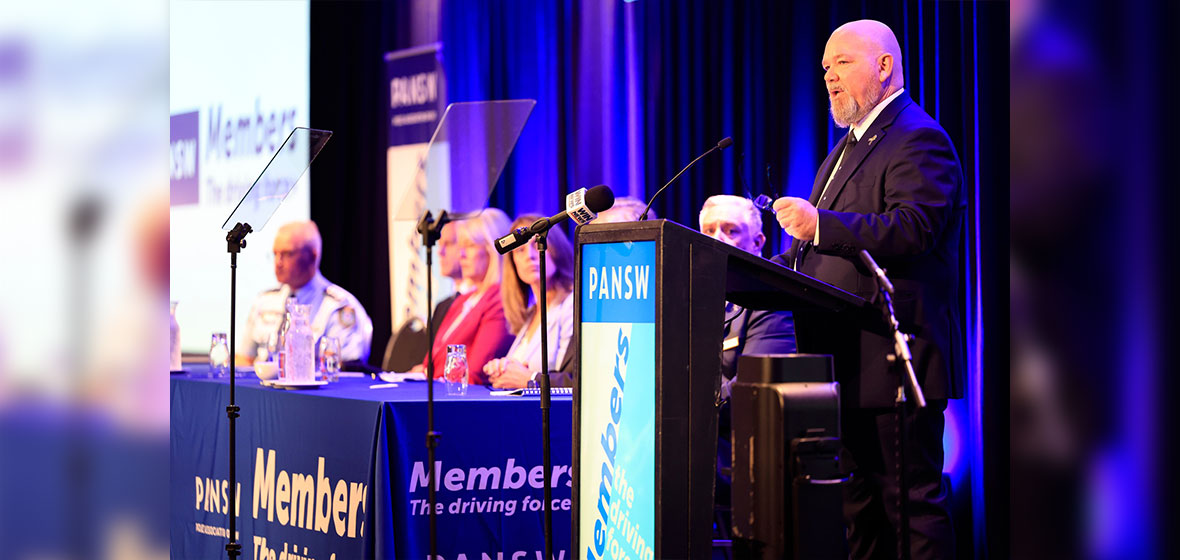
Header image: Kevin Morton, PANSW President (provided by PANSW)