
“That’s a big change. And while [it’s] … still a couple of years before that’s intended to be effective, people are going to have to think very carefully about how they’re going to structure their arrangements moving forward”
By Francisco Silva -
Signalling a new tax policy the federal government hopes will reduce the inequality gap, Treasurer Jim Chalmers handed down the 2026-27 Federal Budget with seismic changes. What do some of the experts say?
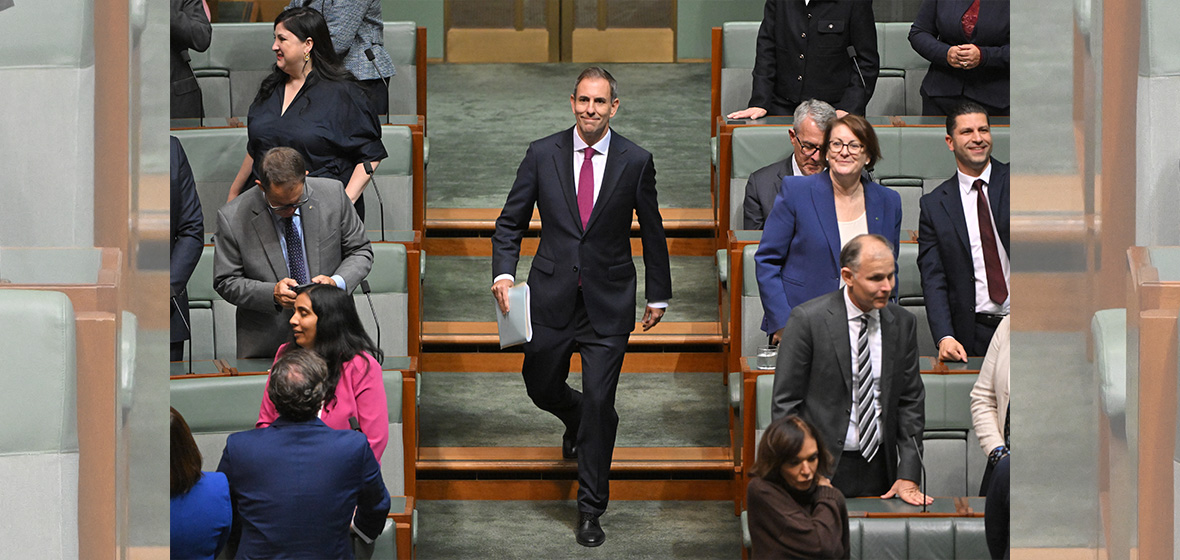
On 12 May 2026, Jim Chalmers delivered his fifth budget as the nation’s Treasurer. In his speech in Parliament, Chalmers described it as “the most important and ambitious Budget in decades”, that arrives in the midst of high inflation driven by war in the Middle East, and the warnings from the Reserve Bank of Australia.
Central to the tax reforms is the changes to negative gearing and the end of the capital gains tax (CGT) discount, controversial measure implemented by the Howard government, that many economists claim to be the key reason for the housing affordability and rental crisis Australia is experiencing today. Under the changes, the 50 per cent CGT discount is replaced by a discount based on inflation and a minimum 30 per cent tax on gains. Negative gearing will be limited to new builds, though current arrangements are grandfathered in.
With these changes, the governments hope to address worsening intergenerational inequality and open the door for 75,000 new first home buyers over the next decade.
“Since 1999, house prices have risen over 400 per cent, more than twice as fast as average incomes,” Chalmers said in his speech in Parliament. “Our tax changes will help about 75,000 Australians achieve the dream of home ownership.
“These changes will level the playing field for workers and first home buyers, and support investment in productive assets, including new housing supply.”
Discretionary trusts are also affected, with the introduction of a minimum 30 per cent tax, with some exceptions.
Reactions
It’s no surprise that the reforms have triggered a wide variety of responses. “[These changes to negative gearing] break the whole fundamental basis of taxation in an unsustainable way,” says Professor Peter Swan from the School of Banking and Finance, UNSW, pointing out the Treasurer Paul Keating, 40 years ago, and New Zealand, tried to do the same thing and had to reverse the changes because of the damage caused.
Swan is concerned about the changes to negative gearing, fearing they could reduce housing supply, rather than fix the problem. He says the measures do not address domestic expenditure, something that could lead the RBA to increase interest rates again.
On the CGT reforms, Swan is more cautious. He says the changes could affect housing investment and push more people towards superannuation and retaining their assets for longer. “There’s nothing wrong with the principle of fully indexing capital gains tax rates,” he says. “It’s just that Australia has by far the highest capital gains tax rate [between the US, Singapore and New Zealand], so if you were an entrepreneur, you’d be very wise to shift your location to one of those places.”
But other economists see these reforms as instrumental to fixing Australia’s inequality. “This is probably the single best thing in the budget,” said Greg Jericho, Chief Economist at The Australia Institute. “It will have a lasting positive effect for so many people.”
The Canberra-based policy think tank has been advocating for scrapping negative gearing and the CGT discount to lift home ownership and affordability.
But the Australia Institute had pushed a measure that wasn’t supported by the government, a 25 per cent gas export tax. It argued this would have negated the need for cuts to the NDIS. “This would have raised more than $17 billion a year and made the savage rate cuts to disability support unnecessary,” said Matt Grufnoff, Senior Economist at The Australia Institute.
 Geoff Stein, Brown Wright Stein Lawyers
How this affects tax lawyers
Geoff Stein, a partner at Brown Wright Stein Lawyers who specialises in commercial and tax law, has told LSJ Online, “all changes bring work” to solicitors.
He reminds us the changes will be subjected to a consultation process. “It’s a cliché to say it, the devil is in the detail, but there’s going to be a lot of questions about what’s excluded and what’s fair,” he says.
Stein is interested to know how the Treasury will conduct the rollover to the new law, especially if there will be a relief period to give people enough time to restructure their affairs.
These still unknown details are what can make all the different to tax lawyers. Stein notes that when similar changes were made for non-residents, there was an opportunity of re-evaluation. For example, partitioning taxable capital gains before and after the changes came into effect.
Stein admits he has received a couple of calls from clients concerned about the budget changes, but on the information currently available, he doesn’t believe they’re as drastic as many fear.
For the changes to negative gearing, Stein wants to know if the laws will apply to current assets or current borrowings. “If you got the asset and you’ve paid it down, and then you re-borrow against the security of that asset, how does that go?”
Another point Stein wants to clarify is about merged facilities. For example, if two people owning property together through a company, borrow to buy shares in that company, will the provisions extend to prevent them negatively gearing the shares? “On the text of the release, the answer is no, but [for] what the government is trying to achieve, yes it should,” he says.
The biggest change, according to Stein, is taxation of trusts. “It’s going to be significant to many principles of legal practices,” he concludes. People distributing income to a company from a discretionary trust, can have their effective tax rate go as high as 77 cents.
“That’s a big change. And while [it’s] … still a couple of years before that’s intended to be effective, people are going to have to think very carefully about how they’re going to structure their arrangements moving forward.”
Until then, all people can do is wait for the details.