By Henry Ea -
It takes roughly three and a half hours to drive from Orange to Sydney—or it used to.
Since early March this year, the journey has become an exercise in uncertainty. The Great Western Highway, the main artery connecting the Central West to the coast, is closed at Victoria Pass. A 194-year-old convict-built causeway cracked, buckled, and gave way. And for the communities on the western side of the mountains, there is no end date in sight.
At the same time, a fuel crisis, sparked by geopolitical turmoil in the Middle East and the disruption of the Strait of Hormuz, has sent diesel to over $3 a litre and left regional service stations running dry. Freight carriers are withdrawing from regional routes. Farmers are watching their autumn planting windows close. And the businesses of the Central West are staring down costs that have climbed, by some accounts, by 30 per cent.
For Orange-based solicitor Kirsty Evans, it is not one crisis or the other that weighs on her. It is the combination of both, arriving at precisely the wrong time.
“We now, as regional businesses, have two compounding events facing us,” she says, referring to the closure of the highway and the fuel crisis. “On both fronts, they’re compounding issues for regional businesses and practitioners.”
For regional practitioners, every trip to Sydney involves a calculation: road or air, cost versus time, always with the client’s bill in mind. That calculus has been upended. With the highway closed and fuel costs surging, Evans’s firm has begun leaning on Sydney-based junior barristers to attend hearings and mediations on their behalf, a practical workaround, but one that comes at a cost she feels keenly. “It really does take away that face-to-face contact, which we actually really appreciate,” she says. “That court involvement, it detracts from our practice areas.”
“We are feeling it, and we’re feeling it from the Blue Mountains to wider Central West,”
When the road runs out
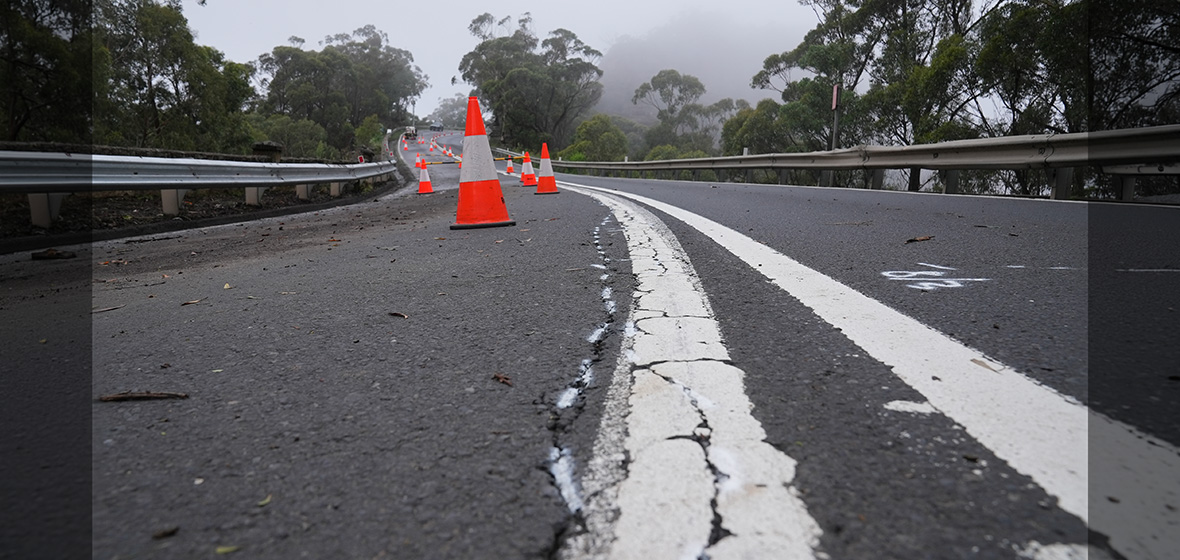
On 5 March 2026, Transport for NSW discovered a defect in the road surface at Mitchells Causeway, known as the Convict Bridge, a heritage structure that has carried traffic over Victoria Pass since 1832. The eastbound lane was closed, monitoring began around the clock, and initial geotechnical tests were cautiously positive. By the morning of 8 March, further stress fractures had formed on the westbound lane. Both lanes were shut immediately.
The cause, engineers confirmed, was not a landslip or sinkhole but structural movement in the fill material between the sandstone walls of the causeway—a slow, invisible failure that had progressed beyond the point of no return. Specialist engineers confirmed the closure would remain for at least three months. Under the most optimistic scenario, geotechnical testing and 3D imaging alone would take a fortnight, with any remediation requiring at least two further months after that.
There is no tunnel underneath. There is no bypass. There is only the detour: a route via Chifley Road and the Darling Causeway, suitable only for general traffic and light freight. Larger vehicles, the Performance Based Standards Level 2 and Level 3 trucks that carry the bulk freight, keeping regional communities supplied, are restricted or excluded entirely. Some freight operators have already pulled out of servicing the region.
“We are feeling it, and we’re feeling it from the Blue Mountains to wider Central West,” Evans says. “Freight is running days behind … And some freight carriers have pulled out of servicing the region entirely. It just drives up costs in addition to everything else.”

The cost of two crises
Evans tells LSJ Online that she has been working closely with Business NSW, which recently completed an impact survey of the region. The results were stark: 98 per cent of respondents said they were affected or would be affected by the closure.
“When you’re looking at a 30 per cent increase in costs,” Evans says, “that’s the difference between viability and closure. It’s quite astronomical.”
That figure reflects the combined effects of the highway closure and the fuel crisis, each of which compounds the other. Longer detour routes mean more fuel burned per delivery.
Higher fuel costs mean higher freight surcharges. Higher freight surcharges are passed through directly to the prices of everything from inputs to finished goods. For businesses already carrying the weight of rising inflation and interest rates, the margin between survival and insolvency is narrowing by the week.
“We’re seeing renegotiation of leases, which is a big one,” Evans says. “And employment termination … which has ongoing effects for the community.”
The Business NSW Impact Survey, released the day prior to our interview, puts a timeline on that fear. According to the survey, multiple businesses warned they would be forced to terminate staff and close permanently within three to six months without immediate government intervention.
The legal picture is equally complex. Under normal circumstances, a business suffering losses from a natural disaster might draw on government disaster relief funding. But Mitchells Causeway is not a flood or a fire. It is an infrastructure failure, and that distinction matters enormously.
“Where we have an infrastructure failure, it doesn’t fit neatly into the category of disaster relief,” Evans explains. “We can’t have businesses call on government funding relief. We don’t have any relief on leasing issues if businesses need to close. And we’re starting to see employment and contractual obligation disputes arise.”
Evans has been working with Business NSW to advocate for policy change, to test whether the existing frameworks can be stretched to cover what is, in all but legal name, a regional emergency. “The next stage,” she says, “is policy advocating to government to see if we can fit within the boundaries of that relief.”
The Autumn window
If the business impact is serious, the agricultural dimension is potentially catastrophic, and its consequences will be felt far beyond the Central West.
Evans knows this crisis personally. She and her husband farm at Trundle, an hour and a half west of Orange, and their fuel comes from Forbes. Forbes has been running dry. When deliveries were promised, they were redirected to buyers who could pay more, leaving properties like theirs without the diesel to run a tractor, turn a machine, or get a crop in the ground.
“We have farmers who are about to miss crop windows,” Evans says. “They are holding off planting right now because of the fuel crisis and the availability of fertiliser being shipped from port. And in some cases, there are real, hard decisions being made as to whether they are actually going to put a crop in the ground this year.”
Evans is clear-eyed about what that means for everyone, not just the farmers.
“We are going to see food supply disruption later in the year because of that,” she says. “No one knows that better than our farmers who are sitting out here right now trying to get crops in the ground, and we can’t get things there on viable terms.”
The irony is bitter: in prioritising fuel deliveries to farmers during sowing and seeding season to protect crop security, the crisis has laid bare just how fragile that security already is. The government has acknowledged it. The farmers are living it. And the connection between a failed causeway west of the Blue Mountains and the price of bread in a Sydney supermarket in November is more direct than most city-dwellers would imagine.
“This is an infrastructure failure. It’s not a natural disaster. It is a lack of government foresight and funding, and it’s just really hard to swallow.”
A tale of two roads
It’s hard not to compare the scenarios: if a major bridge in Sydney’s network had cracked and buckled and been declared unsafe for at least three months, with no reopening date, and no alternative for heavy freight, would the response have been the same?
“Absolutely not,” Evans says. “And the biggest thing in seeing that is that in 2023, both state and federal governments pulled funding from that part of the road. The state government relocated the funding elsewhere. The federal government withdrew something like $2 billion worth of funding, it had 50 infrastructure projects that it cut, and regional New South Wales bore the brunt of that huge infrastructure cut.”
The road, Evans notes, was classified as not being of national significance. Standing in the aftermath of its failure, with freight blocked, farms unplanted, businesses closing, and no end date on the horizon, that classification reads as a dark joke.
“I just can’t believe that we’re sitting here with a road corridor that we need for fodder coming out to us in the regions, to be able to plant for our food and our economy, and there is no end date,” she says. “How is anyone meant to plan? How are these businesses meant to look at the change that’s approached them?”
“[Y]ou can’t tell me that if this wasn’t a major network in Sydney, they wouldn’t be all over it. It feels disproportionate in every sense.”
A planned tunnel underneath Victoria Pass, which would have bypassed the vulnerable causeway entirely, was among the projects shelved when funding was withdrawn. Evans finds the logic of that decision impossible to defend. The road connects Sydney to the Central West, she says, the data on usage has always been there. “This is an infrastructure failure. It’s not a natural disaster. It is a lack of government foresight and funding, and it’s just really hard to swallow.”
She reserves particular frustration for what she sees as a failure of governance on the fuel side as well. “The government says they did no modelling as to what could happen if there was a lack of diesel in agriculture because of something like this. To me, supply chain disruption and governance should be things that are considered for the regions.”
“I don’t think it’s enough in terms of on-the-ground help right now. And that’s what these people are crying out for,”
The Government response and its limits
The NSW Government committed $50 million to strengthen and improve key detour routes in the Blue Mountains and Central West. Additional rail and coach services were rolled out between Bathurst and Katoomba, with free turn-up-and-go services stopping at Lithgow and Mount Victoria. The National Heavy Vehicle Regulator published a temporary exemption increasing allowable fatigue hours for freight drivers on detour routes, a measure that, in itself, signals the extraordinary nature of the situation.
On the fuel side, the government launched a statewide compliance blitz, established a Liquid Fuel Emergency Operations Centre, upgraded the FuelCheck app, and temporarily relaxed freight operating hours to allow larger trucks to carry more goods per trip.
Evans acknowledges these measures. But she is direct about where they fall short.
“We’re still working on what that looks like,” she says of the infrastructure investment. “You’ve got a situation where you need people to come to the regions for business and tourism. While we’re investing in detour projects and freight heavy vehicle relief, it’s not then being felt in terms of bringing people out to the regions and spending money out here. Consumers are losing confidence. Tourism operators are saying people have cancelled.”
The most recent update came on 10 April, the day of this interview. Four weeks of geotechnical testing had confirmed that the 200-year-old fill beneath the causeway had deteriorated into voids and gaps, though the underlying bedrock remained intact. International engineering experts were being called in, with a technical briefing scheduled for 23 April.
Roads Minister Jenny Aitchison described the bedrock finding as good news confirmation that rebuilding on the existing alignment was feasible. But she could not give a reopening date, conceding only that it would be longer than three months.
For Evans, that update said everything.
“I don’t think it’s enough in terms of on-the-ground help right now. And that’s what these people are crying out for,” she says.
If she had five minutes with Roads Minister Jenny Aitchison, Evans would not waste them.
“I don’t understand why we don’t have a plan,” she says. “There was no critical infrastructure plan for this previously. But why is this not being given the same level of thought and consideration as a project that would have been in Sydney or another metropolitan area? They are alive to the issues that have faced regional New South Wales. They’re alive to the fact that we rely on our metro counterparts to come and visit the regions. But we have no end in sight, and we have no on-the-ground funding for our businesses and farmers.”
A region holding its breath
There is already evidence of a more dangerous side to this story. In rerouting traffic through the Bells Line of Road and other alternative routes, the sheer volume of heavy vehicles on roads not designed for them is creating conditions that are, Evans says, genuinely frightening.
“There are already fatalities, which is quite upsetting,” she says. “The reason why there were alternative routes is obviously for those heavy vehicles and passenger vehicles to travel it frequently and feel safe, and that’s just kind of not the case at the moment.”
Tourism, the economic lifeblood of many Central West towns, has taken a direct hit at the worst possible time. Easter, typically the busiest period of the year for regional tourism, has come and gone with cancellations and diverted visitors. Operators are asking whether visitors will even try to come while the detours add hours to a journey.
Evans is not telling people to stay away. Quite the opposite.
“I would really love to not discourage people from still investing or spending in the regions, because we do rely on our metro counterparts,” she says. “But we are, right now, really struggling with our businesses. Are we going to expand, or are we going to hold our positions and ride the wave for a while?”
That question–expand or hold–is the existential one for the Central West right now. It is asked by solicitors, farmers, shopkeepers, and tourism operators. It is asked by people who have built their lives on the assumption that they are connected to the rest of the state, that the infrastructure they depend on is maintained, and that their economy is valued.
The conversation ends where it began, with Evans speaking plainly about what is at stake.
The pressures, she says, are stacking up in ways that will take years to unwind. Leasing stress at pandemic levels. Businesses closing and unemployment rising behind them. And a tourism opportunity being quietly squandered, at a moment when city-dwellers priced out of overseas and interstate travel by the fuel crisis could just as easily be pointed toward the Central West. Instead, the detours are doing the opposite: discouraging the very visitors the region needs. “You can already see them compounding,” she says, “in terms of the traffic on those roads.”
“I’m here for my business community but also farming community … the infrastructure closure and fuel crisis and not being able to deliver fuel to the regions, I just don’t think anyone sitting in a metropolitan area right now understands what that’s going to do for the rest of the year.”
Header image: A supplied image shows cracks in the Great Western Highway at Victoria Pass in the Blue Mountains, New South Wales, on Friday, March 13, 2026. The 194-year-old convict-built Mitchell’s Causeway, a key link in the main highway linking Sydney to western NSW, will be closed for at least three months for urgent repairs. (PR Handout/Supplied by NSW Government)